
By Satyabrat Borah
The Himalayas are much more than a gigantic wall of rock and ice standing along the northern edge of the Asian continent. They are the absolute beating heart and ecological lifeline of the entire Indian subcontinent. The air we breathe, the rainfall patterns that feed our crops, the vast network of rivers that flows through our plains, and the very foundation of our regional cultures are deeply tied to this majestic mountain range. Great rivers like the Indus, the Ganga, and the Brahmaputra draw their life from the frozen heights of the Himalayas. For hundreds of millions of people across South Asia, the massive glaciers resting in these high valleys are the primary source of freshwater, supporting farming, daily survival, and endless ecosystems.
It is a painful reality that this vital natural system is now facing an existential crisis. The global phenomenon of climate change and rising temperatures has targeted the Earth’s third pole with unusual intensity. The great glaciers of the Himalayas are melting at a rate never seen before in human history. As this ancient ice disappears, it leaves behind an increasing danger that threatens everyone living downstream. The delicate balance that sustained civilizations for thousands of years is slipping away, replacing stability with unpredictability and fear.
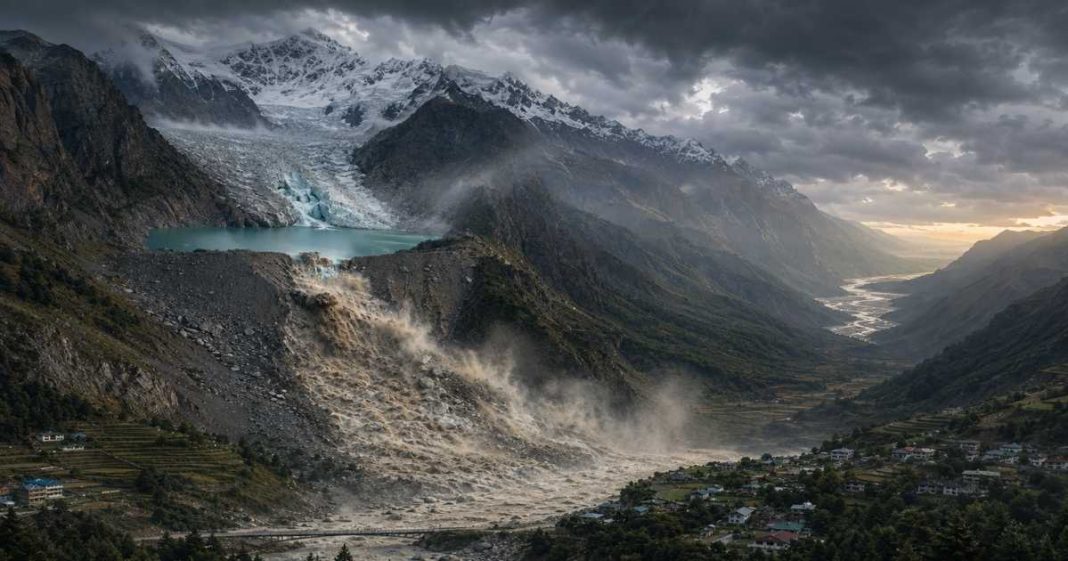
A stark example of this growing threat occurred recently in neighboring Nepal. A sudden flash flood swept through the valleys, leaving a trail of destruction in its wake. A massive collapse of ice and rock near the border with China sent a violent torrent of water, mud, and heavy boulders rushing down the Bhote Koshi River. In a matter of minutes, peaceful communities, roads, and bridges were swallowed by the muddy surge.
This tragic event was not a localized accident, nor was it a rare anomaly. The natural systems of the Himalayas pay no attention to political lines drawn on a map. A river born in the high glaciers flows through multiple nations before reaching the ocean, carrying the consequences of high-altitude changes directly to the people living below. What happens on a remote snowy peak can easily transform into a massive tragedy hundreds of miles away in a bustling valley.
Numerous environmental studies and international reports have confirmed that the Himalayas are warming much faster than the global average. As the atmosphere grows warmer, glaciers pull back, shedding millions of tons of ice every year. The water produced by this rapid melting does not simply flow away safely. Instead, it collects in deep depressions left behind by moving ice, forming what scientists call glacial lakes.
These high-altitude lakes are inherently unstable. Unlike man-made reservoirs built with concrete and engineered steel, a glacial lake is held together by fragile natural dams made of loose dirt, gravel, mud, and random piles of rocks. As the glacier continues to melt, the volume of water behind these weak barriers grows every day, putting immense pressure on the surrounding earth.
It takes very little to break such a fragile wall. A small earth tremor, a period of heavy rainfall, or even a large piece of ice falling into the lake can generate massive waves that breach the natural barrier. When that happens, the entire contents of the lake burst forth in an instant, creating a catastrophic event known as a glacial lake outburst flood.
Events of this nature are becoming terrifyingly frequent across the region. Just a couple of years prior to the recent disaster in Nepal, another glacial lake in the Everest region ruptured, washing away an entire village and destroying vital infrastructure. A similar nightmare unfolded in the Indian state of Sikkim. Years before the tragedy, a team of scientists from prominent research institutions in India, Europe, and the United States carefully studied the South Lhonak Lake in Sikkim. They issued clear warnings that the lake was expanding rapidly and posed an extreme danger to communities living downstream.
Sadly, those scientific warnings did not lead to enough preventive action in time. Two years after the initial research was published, the lake broke its banks. A towering wall of water and debris crashed down the mountain valley, taking more than fifty lives, destroying major hydroelectric dams, breaking bridges, and severing vital communication lines. The event was a grim reminder of how costly it can be to ignore the clear signs offered by nature and science.
The hazard in the high mountains is rarely a single, isolated problem. It is usually a complex chain reaction where one natural event triggers another. Excessive rainfall weakens steep slopes, causing landslides. Falling rocks and mud can block the narrow flow of mountain streams, creating temporary artificial dams that accumulate water until they fail catastrophically. When a landslide or an avalanche crashes into a glacial lake, the displacement of water is instant and violent. The resulting flood gathers momentum as it travels downhill, scooping up trees, soil, and massive boulders, turning a body of clear water into a dense, destructive river of liquid earth that crushes everything in its path.
For communities living in the lower regions, including parts of Northeast India like Assam and Arunachal Pradesh, these mountain disasters carry profound consequences. The powerful Brahmaputra River originates high on the Tibetan Plateau, where it is known as the Yarlung Tsangpo. The health and behavior of the glaciers in Tibet directly dictate the flow of water into the eastern states of India.
When glaciers melt rapidly or high-altitude lakes collapse in the upper reaches, the immediate danger is a sudden, violent flood. The long-term problem is equally serious. These catastrophic floods carry millions of tons of silt and sediment down from the mountains, dumping it onto the riverbeds in the plains. As the riverbeds rise due to accumulated mud and rock, the natural capacity of the rivers to hold water decreases dramatically. As a direct result, seasonal rains that were once manageable now cause widespread, prolonged flooding and severe riverbank erosion, swallowing farmland, homes, and entire villages year after year.
Facing this monumental challenge requires a complete transformation in how we monitor, prepare for, and adapt to changes in the mountains. First and foremost, we need continuous, highly detailed monitoring of the Himalayan glaciers and high-altitude lakes. Relying solely on occasional satellite images is no longer enough. Scientists and researchers need to install real-time ground sensors, automatic weather stations, and specialized monitoring equipment near vulnerable lakes to track water levels, structural integrity, and temperature shifts as they happen.
This task is far too large and complex for any single country to handle alone. The Himalayan range spans across multiple international borders, connecting India, Nepal, China, Bhutan, and Pakistan. The rivers that rise here are shared resources, and the disasters that originate in these peaks are shared threats. If scientists in one nation observe a dangerous buildup of water in a glacial lake near a border, that critical information must be shared immediately with neighboring countries downstream.
Political disagreements and regional rivalries must be set aside when dealing with ecological survival and human safety. Establishing a shared, cross-border data network for river flows, weather patterns, and glacier health is an absolute necessity. Without open communication and real-time data exchange between nations, downstream communities will remain completely blind to incoming dangers until it is far too late to act.
Alongside high-level scientific cooperation, there must be a massive investment in local early warning systems. If a remote glacial lake bursts high in the mountains, people living in the valleys below need to be alerted immediately. Even a notice of thirty minutes or an hour can mean the difference between life and death.
Building effective warning systems involves installing automated sirens along river valleys, creating direct mobile notification networks, and training local populations on how to respond when an alarm sounds. Disaster management cannot remain a reactive process that only focuses on delivering relief packages, food, and tents after a town has been destroyed. The primary focus must shift toward proactive protection, preserving human lives and reducing damage before the water arrives.
At the same time, we must re-examine the way human development is planned and executed in fragile mountain environments. For decades, rapid and careless construction has severely weakened the natural stability of the Himalayas. Cutting down entire mountainsides to build wide highways, blasting tunnels through delicate rock layers for massive hydroelectric projects, and encouraging unchecked tourism development in sensitive zones have stripped the land of its natural strength.
When we destroy the forest cover and disrupt the natural flow of mountain streams, we strip the slopes of their ability to absorb heavy rain and withstand earth movements.
A mountain weakened by human activity is far more likely to crumble when faced with extreme weather. Development in these regions must be guided by deep ecological respect, putting long-term environmental stability ahead of short-term economic gains.
The rising crisis in the Himalayas is a direct reflection of our broader relationship with the natural world. It reminds us that human progress and industrial ambition cannot operate in defiance of natural laws. If we continue to view these majestic mountains merely as resources to be exploited, ignoring the clear warnings written in melting ice and crumbling slopes, the consequences for South Asia will be severe and irreversible.
Stopping global warming completely is a long, difficult task that requires global action, but protecting our mountain communities from immediate threats is something we can do right now through smart science, honest cross-border cooperation, strict environmental regulations, and robust local preparedness.
The water running down from the melting glaciers of the Himalayas does not ask for a passport, nor does it care about political boundaries. It follows the unyielding laws of gravity and nature, forcing us to realize that our safety and our future are inextricably linked across borders, mountains, and plains.