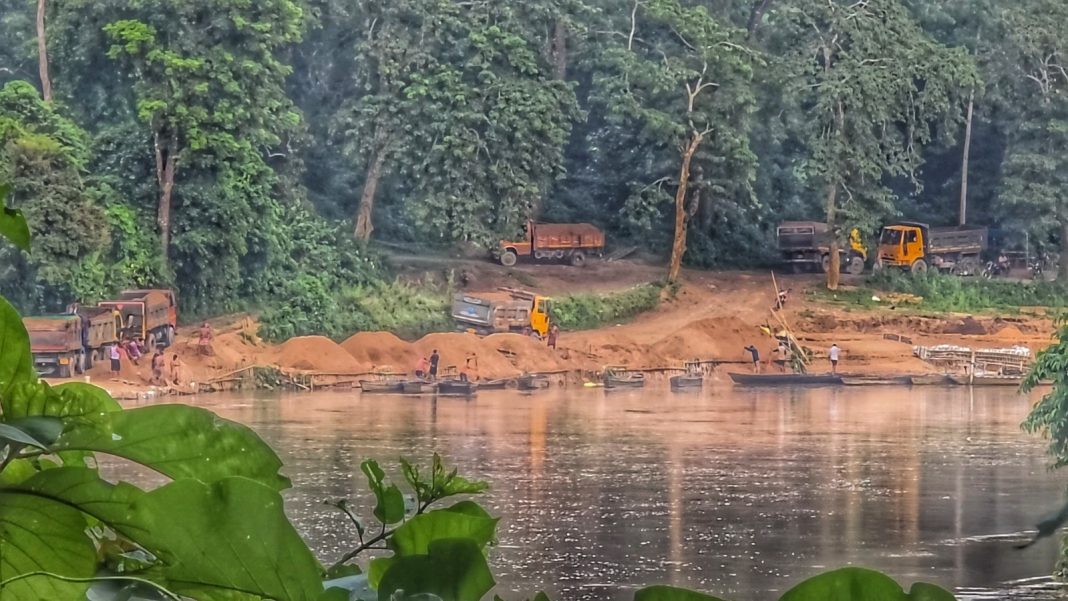

Boko, Sept 1: Residents allege sand extracted in Assam is being transported under passes showing Meghalaya as the source; Forest official cites difficulty in verifying extraction points.
Allegations of large-scale illegal sand extraction from the Kulsi River in Assam’s Kamrup district have prompted demands for an investigation into the possible misuse of Brown Electronic Minor Mineral Transit Passes, or e-TPs.
Residents alleged that sand is being extracted day and night from stretches of the river under the West Kamrup Forest Division, including areas close to the Kulsi Range Forest Office. They claimed that hundreds of sand-laden trucks leave the area at night for Guwahati and other urban centres.
The scale of the alleged operation and its proximity to a Forest Department office have raised questions over monitoring and enforcement. The claims, however, have not yet been established through an official investigation.
Source shown on transit passes questioned
The principal allegation concerns Brown e-TPs reportedly carried by some of the trucks. Residents claimed that certain passes identify Ukiam along the Assam-Meghalaya border as the source of the sand and indicate that the mineral originated in Meghalaya.
Several Garo residents contacted in the Ukiam border area, however, said no sand extraction was currently taking place at the locations cited.
The geography requires careful scrutiny. The Kulsi originates in Meghalaya and enters Assam near the Ukiam border area before flowing through Kamrup district. Residents alleged that sand extracted downstream from the river in Assam could be presented in transit documents as material originating in Meghalaya.
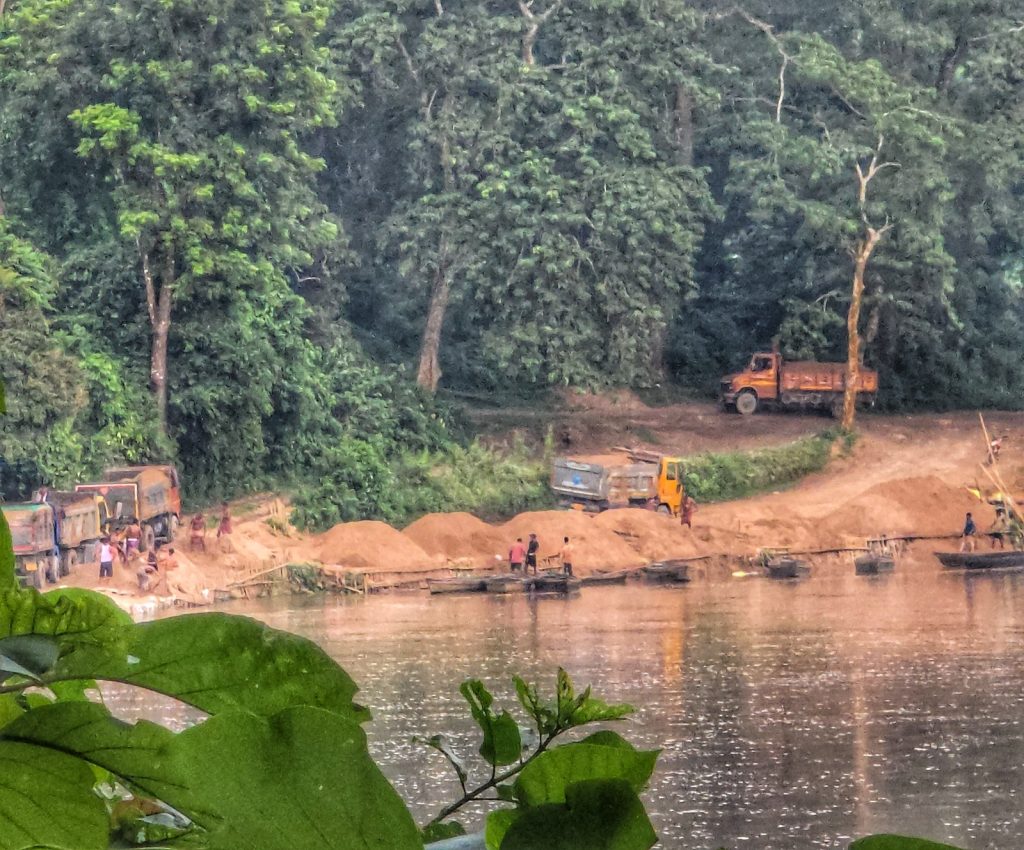
West Kamrup Forest Division official Subodh Talukdar said Forest personnel could inspect the Brown e-TP carried by a sand-laden vehicle but could not determine the actual extraction point solely through such a check.
His statement has reinforced demands for the transit records to be cross-verified against mining permits, declared source coordinates, royalty payments, weighbridge records and vehicle routes.
Residents also sought clarification on whether interstate transportation fees or other levies were paid on consignments shown as originating in Meghalaya. They questioned why Meghalaya would be listed as the source if the sand had actually been extracted in Assam.
Dolphin habitat under pressure
The Kulsi is a southern tributary of the Brahmaputra and an important habitat of the endangered Ganges river dolphin.
The first nationwide river-dolphin estimation, released in 2025, covered a 61-km stretch of the Kulsi from Kukurmara to Nagarbera in April 2022. It estimated a population of about 20 dolphins, with a range of 19 to 21 and a minimum direct count of 17. The wider survey recorded 635 river dolphins in Assam.
Residents fear that unregulated extraction could alter the riverbed, disturb water flow and damage feeding and breeding habitats. They also alleged that machinery, fuel leakage and lubricants associated with mining operations pose risks to aquatic life.
While previous research and conservation reports have identified intensive sand extraction and other human activities as pressures on the Kulsi ecosystem, no official finding linking recent dolphin deaths directly to mining machinery was available.
Residents of Kulsi and Ukiam have urged the Assam and Meghalaya governments to conduct a joint investigation into the questioned e-TPs and trace each consignment to its authorised source. They demanded action against any permit holder, transporter or official found involved in illegal extraction, false source declarations or royalty evasion.
They also appealed to Assam Forest Minister Jayanta Malla Baruah to order stronger surveillance along the river and protect its remaining dolphin population. The residents proposed developing the Kulsi and its adjoining areas as a regulated eco-tourism destination, arguing that conservation could generate more sustainable livelihoods than indiscriminate extraction.