
Roy also drew attention to traditional stingless bee management among the Garo communities of Meghalaya…
Shillong, Nov 9: Known for his voice for indigenous communities across world, Phrang Roy has advocated for indigenous peoples’ voting rights and an equal role in shaping the proposed Global Pollinators Forum.
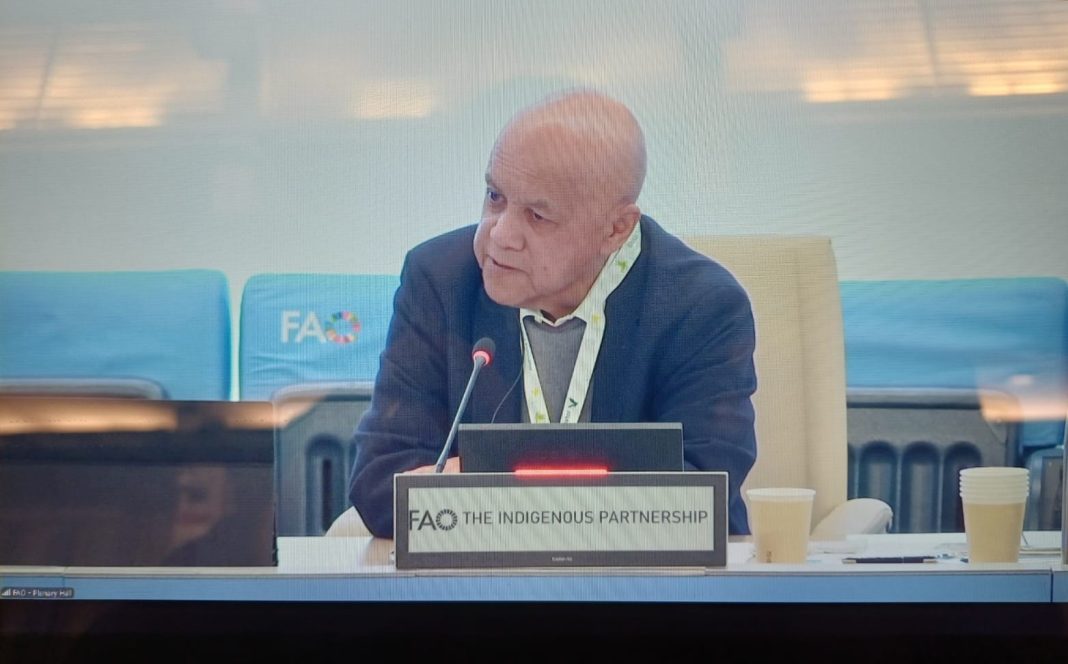
Global pollinator conservation efforts would be fundamentally flawed if Indigenous communities were excluded from decision-making, Roy said at a conference held Food and Agriculture Organisation (FAO) headquarters in Rome.
A coordinator of the Indigenous Partnership for Agrobiodiversity and Food Sovereignty (TIP), Roy’s work has focused on Indigenous peoples’ rights, agrobiodiversity, food sovereignty and community-led development.
He also called for legally enforced zones free of commercially produced European honey bees to protect native pollinator populations from disease transmission and competition for resources.
Speaking at the Global Pollinator Conference on November 5 and 6, Roy argued that Indigenous peoples should be recognised not merely as beneficiaries or occasional consultants, but as active, voting members of the proposed forum.
“We strongly support the attempt of the Commission on Plant Genetic Resources for Food and Agriculture to promote the establishment of the Global Pollinators Forum. However, any attempt to establish a Global Pollinators Forum without the formal, proactive and equal participation of Indigenous Peoples will be a structural absurdity,” he said.
The conference brought together FAO member states, scientists, international organisations, Indigenous peoples, local communities and other stakeholders to discuss the next steps towards establishing a global mechanism for pollinator conservation and sustainable management.
Roy argued that native bee conservation cannot be separated from the way Indigenous communities manage their lands, food systems and natural resources.
He described Indigenous communities as “primary frontline investors in biodiversity”, pointing to their traditional understanding of the interconnectedness of humans, plants, animals and ecosystems.
Roy warned against what he described as the “fortress conservation” model, in which protected areas are managed through restrictions that exclude local communities and criminalise traditional practices such as rotational agriculture, fallow management and ancestral harvesting.
Such approaches, he argued, can contribute to landscape fragmentation, the loss of secondary forests and declining native bee populations.
“Indigenous co-management is not an alternative, experimental conservation strategy—it is the foundational infrastructure upon which local and global pollinator survival and human food security depends,” he said.
Indigenous bee-keeping in Meghalaya
Roy cited examples from the Nilgiri Biosphere Reserve in South India, Meghalaya and Northern Thailand to demonstrate how Indigenous practices can support pollinator conservation while sustaining local food systems and livelihoods.
In Meghalaya, he highlighted the Khasi communities’ traditional protection of soil habitats used by burrowing stingless bees, whose honey is valued for its medicinal properties.
He referred to research conducted by scientists at the College of Agriculture in Kyrdemkulai, who worked with local communities after learning about the soil-nesting bees and their honey.
The collaboration led to the discovery of a species new to science, Tetragonula kyrdemkulaiensis.
According to Roy, laboratory analysis found the honey to have distinctive antimicrobial properties and a low pH, supporting traditional knowledge about its medicinal value.
He said protecting the bees’ soil habitats also helped preserve an important agricultural pollinator, contributing to seed viability and fruit production in crops such as king chilli.
Roy also drew attention to traditional stingless bee management among the Garo communities of Meghalaya, where wild colonies of Mengari bees are carefully relocated closer to homes using tree branches, bamboo hollows and rock crevices.
The honey, he said, is treated with deep reverence and distributed through local traditional healers.
The examples, Roy argued, demonstrate how conservation practices rooted in community knowledge can support biodiversity, nutrition and local livelihoods simultaneously.