
Exclusive | The Meghalayan Express | By Prarthana Hazarika
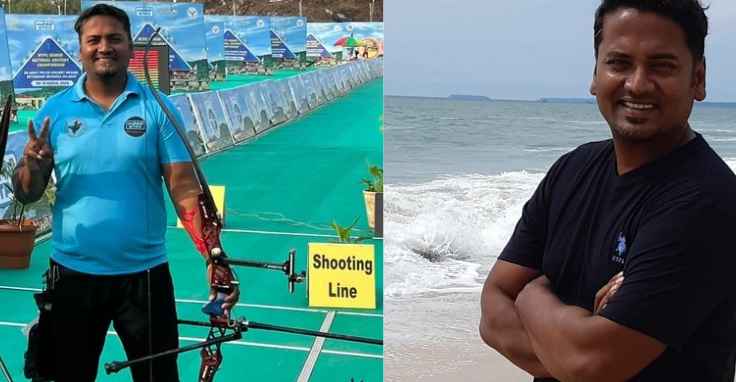
Shillong, Nov 20: The Northeast has the talent and sporting culture to emerge as one of India’s strongest archery hubs, but translating that potential into international success will require sustained investment in infrastructure, quality coaching, sports science and institutional support, believes Olympian archer and coach Jayanta Talukdar.
Speaking to The Meghalayan Express following the conclusion of the 2026 NTPC Senior National Archery Championships in Shillong, Talukdar said hosting national-level competitions in the Northeast could play a significant role in bridging the opportunity gap for young athletes from the region.
The championships, held at the Parade Ground in Umsawli, brought together archers from 18 states and boards across recurve, compound and Indian Round disciplines.
Talukdar, who has represented India at the international level, said such competitions provide young archers with an opportunity to measure themselves against the country’s best without having to travel to distant parts of India.
“When national-level competitions are organised in this region, young archers get an opportunity to compete against some of the best athletes in the country. They also get exposure to the competitive environment, technical standards and professionalism required at the national level,” he said.
Drawing from his own international experience, Talukdar stressed that talent was never the primary concern in the Northeast; rather, the unequal distribution of opportunities remained a major challenge.
“Talent is everywhere, but opportunities are not always equally distributed. Hosting championships like this helps bridge that gap,” he said.
He also underlined the importance of Meghalaya hosting a national championship, saying it demonstrated the region’s ability to organise major sporting events and contribute to India’s sporting ambitions.
However, Talukdar hopes the Shillong championship will not remain an isolated event.
“I hope this championship is not just a one-time event but the beginning of a stronger sporting movement in the region. My vision is to see more archers from the Northeast representing India at the Olympics and winning medals at the international level,” he said.
While acknowledging the region’s sporting potential, Talukdar pointed to the need for a comprehensive ecosystem that can take athletes from grassroots participation to the international podium.
Infrastructure, he said, must be the starting point. The region needs more scientific and fully equipped archery centres with proper shooting ranges, indoor training facilities, modern equipment and strength and conditioning support.
Training, he added, should not be disrupted by adverse weather conditions, making all-weather facilities essential for consistent preparation.
Quality coaching is another critical requirement. Talukdar called for more qualified and experienced coaches familiar with modern international standards, alongside regular technical assessments, performance monitoring and opportunities for coaches to upgrade their skills.
He also emphasised that modern archery has moved beyond talent and repetitive practice, with sports science and technology becoming integral to high-performance preparation.
“Biomechanics, sports psychology, nutrition, physiotherapy, strength and conditioning, video analysis and performance data play a very important role,” he pointed out, adding that these facilities must become part of an athlete’s regular training environment if Indian archers are to compete with the world’s best.
Equally important, according to Talukdar, is stronger institutional and financial support through coordination between state governments, sports departments, the Sports Authority of India, archery associations and corporate partners.
Young athletes require long-term assistance in the form of quality equipment, competition exposure, scholarships and financial security. He cautioned that promising talent should not be lost simply because athletes cannot afford equipment or participation in competitions.
Talukdar also advocated a structured grassroots-to-elite pathway, with talented children identified early and gradually prepared for national and international competition.
“Talent may help you enter the competition, but infrastructure, coaching, discipline, scientific training and institutional support help you stay there and win,” he said.
For a region that has consistently produced sporting talent, Talukdar believes the next step is to move beyond hosting tournaments and build a sustainable high-performance system.
“The Northeast has the potential to become one of India’s strongest archery hubs. What we need now is not just more tournaments, but a long-term vision, investment and a professional sporting ecosystem,” he said.