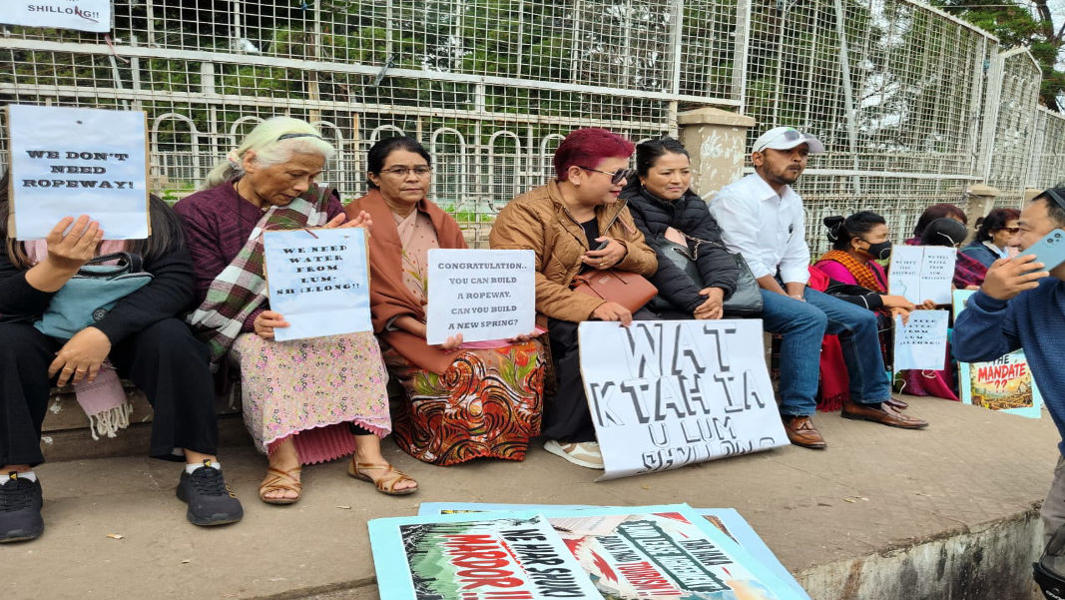

JAC, on protest for 19 days, cites Lum Shyllong as ‘living part of Khasi identity’
Shillong, Nov 24: The Joint Action Committee (JAC), which has been staging protest against the Shillong Ropeway project for 19 days, has sought Governor CH Vijayashankar’s intervention to reconsider the project, which they say threatens the sacredness of Shillong Peak and water security of Shillong.
The JAC, in its memorandum to the Governor, appreciated the government’s efforts to boost tourism and improve infrastructure, but stressed that the administration must prioritise the cultural, spiritual and ecological sanctity of Lum Shyllong, known in olden days as Ka Bri U Shulong.
Pointing out that the peak, Lum Shyllong, is a living part of Khasi identity, it said, “It is not merely a tourist viewpoint or a commercial asset, but a deeply revered sacred site tied to ancestral heritage, spiritual beliefs and identity.”
The idea of commercialising its immediate vicinity through heavy infrastructure, steel towers and increased footfall, the JAC said, will lead to risks of eroding the spiritual serenity and traditional reverence associated with this sacred space.
The memorandum dwells at length on the place of U Shulong in Khasi life. U Shulong, or U Lum Shyllong, the JAC said, is revered as the guardian deity of the Shillong plateau who bestowed democratic governance and justice upon the people, with the Saw Basan serving as the earthly custodians upholding that traditional order across Bri U Shulong as envisaged by the Constitution under Article 29.
That reverence, the JAC argued, is not protected by merely keeping construction a short distance away from the summit.
Although the upper terminal is planned approximately 80 metres below the main viewpoint, it said, large-scale construction and commercial transit near Lum Shyllong undermine the dignity of a site held sacred by the Khasi people for generations.
The JAC linked the cultural concern directly to the environment. The forested slopes around Shillong Peak, it said, serve as vital Green Blocks and Watershed Catchment Areas for local water sources, and tree felling and nearby construction disturbances pose long-term threats to the fragile ecosystem and water security of nearby localities provided under PHE.
The JAC also raised a constitutional and institutional point, insisting that development on indigenous land must uphold the principles of Free, Prior and Informed Consent and fully respect the jurisdiction and permissions of traditional bodies, including the Hima Mylliem and the Khasi Hills Autonomous District Council (KHADC) as specified under the Sixth Schedule of the Indian Constitution.
It further noted that suo motu action complaints can be taken up by the Centralised Public Grievance Redress and Monitoring System, the official online portal that connects directly to all ministries and state governments and requires officials to resolve grievances within a 21-day time frame.
The JAC said the public needs to look beyond the image of a ropeway as a simple cable link. Recent disclosures from project details, it said, indicate that the infrastructure is not merely a minimalist transit cable, but entails heavy commercial structures, parking lots, multi-storey complexes including cable car stations, cable and new road making, a pattern it described as infrastructure versus ecology.
For the JAC, the way forward is not to abandon development altogether, but to rethink its form. True progress in Meghalaya, it said, should harmonize economic growth with the preservation of living heritage and natural environment.
Rather than altering the landscape of Lum Shyllong with heavy ropeway infrastructure, the JAC has appealed to the government to halt the project in its current form and explore sustainable, eco-friendly and community-led tourism alternatives that leave sacred sites undisturbed.
The JAC said it trusts that the Governor’s office will give due consideration to the sentiments of the Khasi people and take steps to safeguard Lum Shyllong for future generations.