
By Mayurath Sinh
I went to Amritapuri believing I would stay for two hours.
Two hours—to wait in a long, patient line, to receive darshan, to bow, to move on. The rational mind had set the itinerary. The artist mind had framed the experience: observe, absorb, return.
But spiritual encounters do not obey itineraries.
I stayed on—through bhajans that rose and fell like ocean tides, through silences that were heavier than speech, through a second summoning to the stage where a life mantra was whispered into my ear, soft as breath and firm as destiny. And when I finally left, I realised I was not leaving the same person who had arrived.
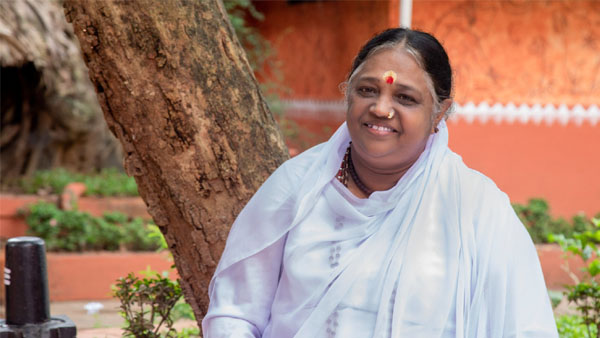
This is the paradox of Mata Amritanandamayi ‘Amma’, she does not demand belief, allegiance, or intellectual surrender. She simply meets you—heart to heart—and lets the rest unfold.
The Mother Who Refuses Distance
Amma is often described as “The Hugging Saint,” a phrase that sounds almost insufficient for what she embodies. Her embrace is not symbolic. It is not metaphorical. It is physical, immediate, and radical in its intimacy.
For a few seconds, you are not your résumé, your anxieties, your failures, your political views, or your carefully curated self. You are simply held.
And something ancient recognises something eternal.
In Indian civilisation, the idea of the Mother is not ornamental. It is foundational. From Annapurna to Durga, from the Earth itself to the rivers that sustain us, motherhood is not weakness but generative power. Amma stands firmly in that lineage—not as a goddess demanding worship, but as a mother offering refuge.
Her compassion is not theatrical. It is relentless.
Amritapuri: A Living, Breathing Experiment
Amritapuri is not an ashram in the conventional sense. It is a civilisation in miniature.
Thousands live here—Indians and foreigners, monks and householders, scientists and seekers, sceptics and believers. Languages blur. Cultures dissolve. Nationalities become incidental. What remains is discipline, seva, and a rhythm of life tuned to something larger than the self.
Foreign devotees—often dismissed in caricature elsewhere—are not ornamental presences here. They cook, clean, teach, serve, chant, and surrender their egos with the same rigour demanded of anyone else. Amma’s ashram does not trade in exoticism. It trades in transformation.
That transformation is not enforced. It is absorbed—slowly, silently, through repetition, humility, and love.
This is perhaps Amma’s greatest achievement: she has built not just an institution, but a culture of compassion that scales without losing its soul.
Bhajans That Rewire the Inner World
I stayed for the bhajans thinking I would listen.
Instead, I was listened to.
The chants were not performances. They were conversations—between breath and being, between longing and surrender. There is a peculiar power in collective chanting that modern psychology is only beginning to understand: it synchronises nervous systems, calms fractured minds, dissolves loneliness.
In Amma’s presence, the bhajans do something more. They feel guided.
Each syllable lands where it must. Each repetition peels away a layer of armour. You begin to realise that devotion is not about escape from the world—it is about re-entering it cleansed.
When Amma sings, her voice is not trained in the classical sense. It trembles, cracks, rises, softens. It sounds human. That is precisely why it heals.
The Whispered Mantra
There are moments that resist language.
When Amma called me again—unexpectedly—to the stage and leaned close, whispering a “life mantra” into my ear, time slowed. The noise of the hall receded. The world narrowed to breath and sound.
A mantra is not merely a string of syllables. It is a seed. Planted correctly, it grows in silence. It rearranges priorities. It becomes a compass.
What Amma gives in that moment is not instruction—it is permission. Permission to let go. Permission to trust. Permission to be less clever and more sincere.
Many leave Amritapuri saying, “My life changed after meeting her.” Skeptics may scoff at the phrase. But change does not always arrive as upheaval. Sometimes it arrives as alignment.
Simplicity as Spiritual Defiance
Amma’s life is a rebuke to excess.
Despite commanding global influence, advising world leaders, and overseeing vast humanitarian networks, she lives with a stark simplicity that feels almost subversive in our age of curated spirituality.
No luxury. No distance. No performative austerity.
Her days are punishingly long—darshan lasting 16 to 20 hours, year after year, decade after decade. Few bodies could endure it. Fewer egos would agree to it.
This is not charisma. It is tapasya.
In a world where spirituality is increasingly commodified—sold as retreats, aesthetics, and Instagram wisdom—Amma’s sheer physical giving feels almost confrontational. She gives until the body protests. Then she gives some more.
Humanitarianism Without Headlines
Amma’s compassion does not end at the ashram gates.
Hospitals, universities, disaster relief, housing for the poor, education for the marginalised—her humanitarian work spans continents. Yet it is rarely advertised with the aggressive branding common to global philanthropy.
There is a reason for this.
Amma does not see service as strategy. She sees it as duty.
Whether it is tsunami relief in Tamil Nadu, housing projects for the homeless, or medical care for those who cannot pay, the work proceeds with quiet efficiency. The left hand does not announce what the right hand has done.
In this, Amma restores an ancient Indian ethic: seva without spectacle.
Why the World Needs Amma Now
We live in an age of furious certainties.
Everyone has an opinion. Everyone has an enemy. Everyone is armed with data but starved of wisdom. Empathy has become conditional—extended only to those who agree with us.
Amma offers something dangerously radical: unconditional compassion.
Not endorsement. Not appeasement. Compassion.
She does not ask you to abandon your intellect. She asks you to soften your heart. And in doing so, she reveals a truth that politics, technology, and ideology cannot solve alone: a world without compassion cannot be engineered into harmony.
It must be embraced into it.
The Mother to the World
Calling Amma “the Mother to the World” is not hyperbole. It is description.
A mother does not demand perfection. She absorbs chaos. She holds grief. She forgives failure. She continues to love when logic advises withdrawal.
In Amma’s embrace, people weep not because they are weak, but because they are finally safe.
That safety—so rare in adult life—is transformative.
Leaving Amritapuri
When I finally left, there was no dramatic revelation. No thunderbolt of enlightenment.
There was something quieter.
A gentler way of breathing. A slower impatience. A sense that life did not need to be wrestled into meaning—it could be trusted into it.
Amma does not convert you. She recalibrates you.
And perhaps that is her greatest gift: in a world addicted to noise, she restores the power of silence; in a civilisation bruised by argument, she reintroduces the language of love.
Some encounters stay with you.
Some encounters stay in you.
Meeting Amma was the latter.
And the mantra still whispers—long after the ashram fades from view—reminding me that the world does not change through force alone, but through the quiet, persistent courage to love.
Mayurath Sinh is a young graduate from the Los Angeles Film School and writes on socially transformative subjects.