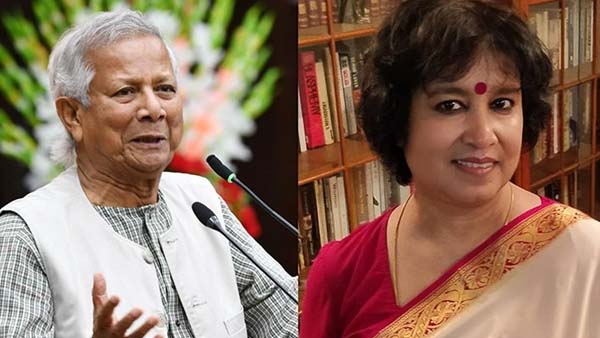

Thiruvananthapuram, Jan 9 : Bangladeshi-Swedish writer Taslima Nasrin on Friday hit out at the Bangladesh government, alleging that its chief advisor, Muhammad Yunus, has aligned himself with “religious extremists and empowered forces of division” in that country.
Speaking on the topic of ‘Book for Peace’ at the 4th Kerala Legislative Assembly International Book Festival (KLIBF), Nasrin also alleged that Yunus, a Nobel Peace Prize winner, was “promoting agendas that threaten secularism and the safety of ordinary citizens.”
She said that the Nobel Peace Prize does not define peace, power does.
“And power rarely cares about the truth,” Nasrin said.
She noted that Henry Kissinger, the 56th US Secretary of State, received the Peace Prize, but “his policies left countries burning and his strategies erased villages.”
Similarly, Aung San Suu Kyi, a Nobel Peace Prize winner and former Myanmar Foreign Minister, had not stood with the Rohingyas when they were driven out of the country, Nasrin claimed.
“She chose power over humanity,” she said.
Regarding the situation in her home country, she said that when “certain religious fanatics and extremists” threatened her life and issued fatwas against her in connection with her books, the then-Bangladesh government took no action against them and instead issued an arrest warrant against her.
“Had the government acted against the fanatics and jihadists then, this country (Bangladesh) would not be in such a bad state now. The government used religion for its political interests and to stay in power as long as possible,” she said.
She also accused the Bangladesh government of building religious schools to gain the support of fanatics “to stay in power longer,” instead of establishing secular educational institutions and science academies.
Blaming the interim government for the current crisis, she said, “The fundamentalists are in power, and Dr Yunus is supporting them. I do not know how we will restore this secular country for which it fought against Pakistan in 1971.”
“Now the nation is divided, and Muslim extremists are killing and persecuting religious minority communities. This must be stopped,” she added.
Later, on the sidelines of the event, Nasrin told reporters that past heads of state in Bangladesh—Hossain Mohammad Ershad, Khaleda Zia, and Sheikh Hasina—encouraged the growth of religious extremism in the country.
“It is their fault. They unnecessarily built mosques and madrasas. These are factories of jihadists. If they grow, they attack women and minorities. And it is happening now,” she alleged.
She claimed the situation was “very bad for Hindus in Bangladesh and accused Yunus of taking no action against the killers, the fundamentalists and jihadis.”
Nasrin expressed hope that the next election in the country would be “true” and that things would change only if a pro-secular party came to power.
However, she expressed concern that the largest political party in Bangladesh, the Awami League, was banned while Jamaat-e-Islami was gaining strength.
“If Jamaat-e-Islami comes to power, they will likely establish Sharia law, and women and religious minorities will suffer greatly,” she said.
Asked whether the alleged persecution of Muslims in India was affecting Bangladesh, Nasrin denied it.
“No, I don’t think India has anything to do with the Bangladeshi killings. Hindus have been persecuted since 1947. It is not a reaction to events in India. There has always been an anti-Hindu mentality among certain fundamentalists and jihadis, and they are growing with the support of different governments,” she said.
Asked if secularism in India was under threat, Nasrin again denied it.
“India is still a secular state, but Bangladesh, which was once secular, became a state with Islam as the official religion in the 1980s. When you make a state religion, all non-Muslims become second-class citizens. We want secularism back in the Constitution. If political parties use religion for political gain, the country will be destroyed,” she said.
Nasrin added that, just as people fought against the Islamic regime in Iran, Bangladesh must also resist religious extremism.
The writer also highlighted the plight of Hindu women in Bangladesh, citing a lack of laws to prevent polygamy, allow divorce, or permit inheritance from their fathers, and called for a Uniform Civil Code. (PTI)