
By Satyabrat Borah
The recent Enforcement Directorate (ED) raids in West Bengal have once again thrust the state into the national spotlight, igniting fierce debates about the role of central agencies in India’s fractious political landscape. On January 8, 2026, ED teams descended on multiple locations linked to the Indian Political Action Committee (I-PAC), a prominent political consultancy firm closely associated with the ruling Trinamool Congress (TMC). These searches, tied to an alleged money laundering probe stemming from a coal pilferage scam, quickly escalated into high drama when West Bengal Chief Minister Mamata Banerjee arrived at the premises, including the residence of I-PAC co-founder Pratik Jain. She accused the agency of attempting to seize sensitive TMC election strategy documents, data, and digital materials ahead of the crucial 2026 Assembly polls. What followed was a day of protests, courtroom chaos, and mutual accusations that underscored a deeper, more troubling pattern: the perceived weaponisation of central investigative bodies like the ED by the ruling Bharatiya Janata Party (BJP) at the Centre against its political opponents.
This is far from an isolated incident. For years, opposition parties across India, including the TMC, Congress, Aam Aadmi Party, and others, have raised alarms about what they describe as selective enforcement. Data from various analyses, including reports around 2022-2024, suggest that a staggering majority,often cited as 95 percent,of cases initiated by the ED and the Central Bureau of Investigation (CBI) under the Modi government have targeted opposition figures. In West Bengal specifically, the TMC has faced repeated scrutiny. The long-running school teachers’ recruitment scam, which erupted in 2022, has seen high-profile arrests of TMC leaders such as former Education Minister Partha Chatterjee, whose residence yielded massive cash recoveries, and more recently, Trinamool MLA Jiban Krishna Saha. In August 2025, Saha was arrested after attempting to flee during ED raids, reportedly jumping a wall and discarding his phone—incidents that TMC supporters dismiss as overblown while the BJP hails them as proof of systemic corruption under Mamata Banerjee’s watch.
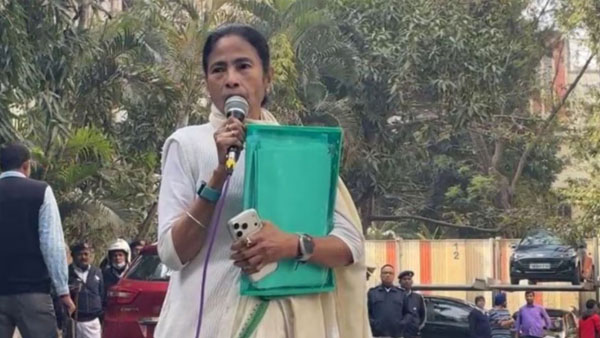
Yet the January 2026 raids on I-PAC mark a new escalation. Unlike previous actions focused on direct allegations against politicians or officials, this probe targeted a private consultancy firm that has been instrumental in TMC’s electoral machinery. I-PAC, known for its data-driven campaign strategies, played a pivotal role in the TMC’s 2021 victory against the BJP. Raiding its offices and the home of its director feels, to many observers, akin to raiding a party headquarters itself. Mamata Banerjee did not mince words. She stormed the sites, carried away files she claimed were her party’s private property, and later led a massive protest march through Kolkata on January 9. Flanked by party leaders, ministers, and thousands of supporters, she declared that she had “done nothing wrong” and was merely protecting her organisation from theft. She pointed fingers at Union Home Minister Amit Shah, calling the raids an “attack on democracy” orchestrated to sabotage TMC’s preparations for the upcoming elections. In fiery speeches, she even alleged that senior BJP leaders in Delhi were beneficiaries of the very coal scam proceeds the ED was supposedly investigating, offering to produce proof if needed.
The ED, for its part, pushed back hard. Agency officials claimed obstruction during the searches, alleging that documents and electronic devices were forcibly removed from their custody. They approached the Calcutta High Court seeking a CBI probe into Mamata Banerjee and state police officials for interference. The hearing descended into chaos on January 9, with lawyers shouting over each other until the judge walked out, adjourning proceedings to January 14. Meanwhile, West Bengal Police filed FIRs against the ED and Central Armed Police Forces based on the Chief Minister’s complaints. I-PAC itself issued a measured statement, describing the raids as an “unfortunate day” that set an “unsettling precedent,” while affirming full cooperation with the probe.
This tit-for-tat has only amplified the broader narrative of institutional misuse. Critics of the central government argue that agencies like the ED, once seen as independent watchdogs against financial crimes under laws such as the Prevention of Money Laundering Act (PMLA), have increasingly become instruments of political coercion. Opposition voices, from TMC’s Abhishek Banerjee to Congress leaders like Rahul Gandhi, have repeatedly pointed out the timing of such actions—often intensifying just before state elections. In West Bengal, with polls looming in 2026, the raids on I-PAC appear particularly convenient for the BJP, which has struggled to make inroads in the state despite aggressive campaigning. The pattern extends beyond Bengal: similar complaints have arisen in Delhi with AAP leaders, in Maharashtra with former allies turned rivals, and elsewhere. Even neutral observers note that while corruption must be investigated regardless of political affiliation, the disproportionate focus on opposition figures raises legitimate questions about impartiality.
Defenders of the government counter that these probes are based on concrete evidence, not vendetta. The coal scam allegations involve hawala transactions and pilferage worth crores, and the ED insists its actions are routine, unrelated to politics. They point to past arrests in Bengal, like those in the school jobs scam, where irregularities in teacher recruitments deprived deserving candidates and enriched a network allegedly linked to TMC leaders. The BJP accuses Mamata Banerjee of shielding corrupt elements and behaving like a “mafia” by intervening in federal investigations. Assam Chief Minister Himanta Biswa Sarma, a vocal BJP ally, remarked that her actions would “erode public respect” for constitutional authorities.
This confrontation reflects the deepening fault lines in Indian federalism. When a state government led by an opposition party clashes with central agencies, the result is often polarisation rather than resolution. Mamata Banerjee’s dramatic interventions—while criticised as overreach—resonate with her base as a bold stand against perceived bullying from Delhi. Her supporters see her as the only leader with the courage to confront what they call “BJP thuggery.” For the BJP, these operations demonstrate a commitment to anti-corruption, even if it means taking on powerful regional satraps.
As the dust settles and legal battles unfold in the Calcutta High Court, the real casualty may be public trust in institutions. When agencies are viewed through partisan lenses, their credibility suffers. Whether the ED’s actions in West Bengal are genuine accountability drives or politically timed pressure tactics, the repeated pattern has convinced many that central power is being wielded selectively. In a democracy as diverse and competitive as India’s, preserving the independence of investigative bodies is essential to ensure that justice, not politics, prevails. Until that balance is restored, episodes like the recent ED raids will continue to fuel accusations, protests, and the sense that the game is rigged—depending on which side one sits.