
By Satyabrat Borah
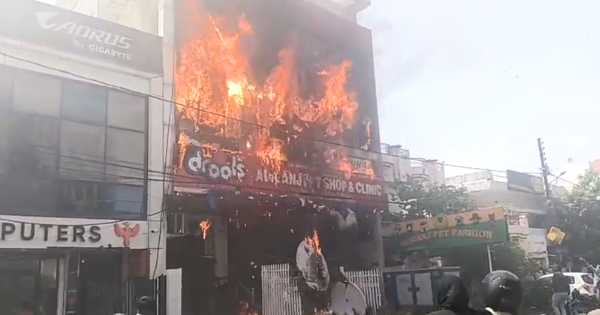
The tragic fire in Lucknow that claimed fifteen precious lives, mostly young students full of dreams, and left several others severely injured, is not just another unfortunate accident written off in the daily news. It is a stark and painful reflection of the deep dualities defining modern India. On one hand, we see an ambitious nation driven by an exploding education economy and a rapidly growing services sector, where millions of young minds are desperate to climb the socio-economic ladder. On the other hand, we are forced to confront the dark reality of unplanned urban growth, crumbling safety standards, and a systemic failure of regulatory bodies that repeatedly turns a blind eye to imminent dangers. This heartbreak highlights a dangerous gap between our national aspirations and the basic infrastructure required to keep our people safe.
India currently possesses one of the youngest populations in the world, a demographic dividend that is often celebrated on global stages. This youth force is hungry for success, eager to acquire new skills, and determined to secure stable economic prospects in a highly competitive job market. This intense demand has fueled a massive, multi-billion-dollar ecosystem of coaching centers, private training institutes, and parallel educational hubs. From tiny towns to major state capitals like Lucknow, these centers have sprouted in every nook and corner. The business model is incredibly lucrative because it requires minimal capital investment. Anyone with a rented floor, a few whiteboards, and a handful of plastic chairs can start a coaching institute. Because many of these operations function entirely outside formal regulatory frameworks, they generate immensely high profits while evading the scrutiny that traditional schools and universities are subjected to daily.
The pressure on this parallel education system is set to intensify even further in the coming years. With rapid advancements in artificial intelligence and automation threatening to disrupt traditional employment patterns, the global job market is shifting beneath our feet. Formal educational institutions, bound by rigid curricula and slow bureaucratic processes, are struggling to update their courses to keep pace with these fast-evolving skill requirements. As a result, desperate students will increasingly turn to these flexible, short-term private coaching centers to stay relevant. If the current state of affairs is any indication, this impending proliferation of unregulated institutes will only expand the net of vulnerability, packing more young souls into hazardous structures that are ill-equipped to handle emergencies.
The three-story building in Lucknow where the disaster unfolded is a classic example of this widespread systemic negligence. Investigative reports revealed that the structure was never authorized for commercial use in the first place. It was built and registered under a residential category, meaning its design, exits, and load capacities were meant for a single family, not for hundreds of students crowding into small rooms for hours. What makes this even more infuriating is that the local civic authorities had reportedly issued repeated notices and demolition warnings to the owners over the years. Yet, the building stood tall, escaping any real punitive action, and continued to operate as a commercial death trap. The First Information Report filed by the authorities after the tragedy confirmed that neither the property owners nor the business operators running the institutes had made even the most basic provisions for fire safety. There were no accessible emergency exits, no functional fire extinguishers, and no ventilation systems to let out toxic smoke.
This kind of blatant violation is not an isolated anomaly in Lucknow. It is a pervasive, nationwide norm. Across India, commercial complexes, coaching hubs, and even schools routinely flout building codes with complete impunity. Profit margins are prioritized over human lives, and safety measures are viewed as unnecessary administrative hurdles or wasteful expenses rather than non-negotiable necessities. The tragic reality is that it often takes a catastrophic loss of life for society and the administration to briefly acknowledge these violations, only to fall back into a state of comfortable apathy once the media attention fades.
The Lucknow incident belongs to a deeply disturbing and recurring pattern that has plagued the nation, particularly during the intense summer months. This past season alone witnessed a horrific succession of major fire accidents across various states, from crowded gaming zones and newborn care hospitals to bustling commercial markets. Every time such a disaster occurs, public outrage naturally focuses on immediate administrative negligence, pointing fingers at local inspectors and corrupt officials. While this anger is entirely justified, the official explanations that follow almost always wrap up the entire conversation with a lazy and convenient phrase, attributing the disaster to an electrical fire or a short circuit.
This specific description conceals far more than it reveals. By simply blaming an electrical short circuit, the authorities wash their hands of deeper structural accountability, treating the fire as an act of god or an unpredictable technical glitch. In truth, electrical fires do not happen in a vacuum. They are the direct result of identifiable, preventable human errors and systemic failures. As our reliance on heavy electronic appliances like air conditioners, large computer servers, and heavy-duty projectors grows, the total electrical load on buildings increases exponentially. Most of these older or poorly converted residential buildings are running on primitive wiring systems that were never designed to handle such massive currents. This leads to severe overloading of circuits.
Sophisticated modern electronic equipment creates complex electrical distortions known as harmonic currents. These harmonics can travel through the electrical system and generate localized hotspots deep within the walls, heating up the wiring silently until the insulation melts away and ignites surrounding flammable materials. When you combine this with the widespread use of cheap, substandard wires that lack proper fire-retardant coatings, you create a ticking time bomb. Most commercial buildings in India also completely lack advanced safety mechanisms like arc-fault protection devices, which are designed to detect dangerous electrical sparking and shut down the power before a fire can even start.
Preventing future tragedies requires us to develop a rigorous culture of scientific investigation. Right now, when a fire occurs, the site is rarely preserved for detailed forensic study. Local fire departments, which are often understaffed and poorly equipped, focus primarily on dousing the flames rather than analyzing the root cause. India suffers from a critical shortage of trained fire-forensics experts who possess the scientific capability to conduct comprehensive investigations, trace the exact point of ignition, and analyze how the smoke and fire traveled through the structure. Without this precise expertise, the lessons we learn from each disaster remain superficial, preventing us from designing and implementing effective, data-driven systemic remedies.
The scale of this challenge demands a comprehensive, unified national response that goes beyond local knee-jerk reactions. India has made its global ambitions crystal clear, striving to transform itself into a fully developed nation and an economic superpower in the near future. This grand vision of a developed India cannot be separated from the fundamental responsibility of ensuring the safety and security of its citizens in public spaces. Economic growth becomes meaningless if our children are sent to study in places where their lives are constantly at risk.
When we look at developed countries, mandatory fire detection, automated sprinkler systems, and strictly enforced occupancy limits are standard, non-negotiable features of any building layout. In contrast, many prominent commercial and educational structures in Indian cities lack even a basic smoke alarm. To change this trajectory, the government needs to initiate a massive, nationwide assessment of building safety. Even a scientifically designed sample survey covering major educational and commercial hubs would yield invaluable data, exposing the most critical vulnerabilities and providing a clear roadmap for urgent regulatory reform.
Undertaking such a massive overhaul across a country as vast as India is undoubtedly a monumental and complex task that will require immense political will, financial investment, and bureaucratic coordination. The human and economic costs of maintaining the status quo are far greater than any investment we could make. Every young student we lose to such preventable disasters is an irreplaceable loss to their family and a tragic waste of national potential. We cannot allow our cities to expand into hazardous concrete jungles where safety is sacrificed at the altar of quick profits. True progress lies in building a nation where development and safety walk hand in hand, ensuring that the spaces built to nurture the future of India do not turn into their final resting places.