
Raipur, Sep 2 : Vice President C P Radhakrishnan on Wednesday said parts of Chhattisgarh had faced the grave challenge of Left Wing Extremism (LWE) for decades, but the state has now overcome the menace and is witnessing a new dawn of development, progress and prosperity.
Addressing the third convocation of the All India Institute of Medical Sciences (AIIMS), Raipur, Radhakrishnan said areas once marred by violence are increasingly being identified with roads, schools, hospitals, connectivity, investment and development opportunities.
He also highlighted women’s achievements, saying that more women than men were receiving degrees at AIIMS Raipur.
For decades, parts of Chhattisgarh faced difficulties, inadequate connectivity and a grave challenge of LWE. In many of its remote and tribal areas, fear and violence became obstacles to development, he said.
“Where roads should have been built, there were barriers, where schools should have flourished, there was disruption, and where hospitals and healthcare should have reached our tribal and remote communities, there was often only deprivation,” the Vice President said.
“But today’s Chhattisgarh has come out of the shadows of its past. It is a great achievement and great news for all of us. It is witnessing a new dawn of development, progress and prosperity,” he said.
Under the decisive leadership of Prime Minister Narendra Modi, strategic resolve of Union Home Minister Amit Shah and committed leadership of Chief Minister Vishnu Deo Sai, the state has “turned a historic corner” and the Naxal menace of decades has been brought to an end, Radhakrishnan said.
“This transformation is a powerful example of the difference that strong political will, firm security policy and development-oriented governance can make,” he said.
On March 31 this year, the state government declared Chhattisgarh free from armed Maoists.
The Vice President further said AIIMS Raipur stands as one of the finest symbols of the new Chhattisgarh, which is moving from an era of fear and deprivation to one of peace, progress and possibility.
AIIMS Raipur was established in 2012 to address regional disparities in healthcare, medical education and research, particularly in central India, he said.
“In a remarkably short period, it has evolved into a major tertiary care institution serving Chhattisgarh and neighbouring states, including rural and tribal communities. The growth of AIIMS Raipur is also a reflection of the remarkable transformation taking place in Chhattisgarh and across the country,” Radhakrishnan said.
He also lauded AIIMS Raipur’s achievements in advanced healthcare and transplantation, highlighting Chhattisgarh’s first swap kidney transplant, more than 95 per cent success rate in kidney transplantation, renal and corneal transplants and ear implants as significant milestones demonstrating the rapid expansion of advanced medical care in the region.
The approval for a heart-transplant programme would be another important milestone, he said.
Emphasising the importance of balanced development in achieving the vision of Viksit Bharat (Developed India), Radhakrishnan said it could be realised only when every state, district and village develops.
Access to higher education is at the core of the Viksit Bharat vision, he said, highlighting the expansion of higher education over the last 12 years and the significant increase in women’s participation.
Since 2014, he said, 16 Indian Institutes of Information Technology, eight central universities, eight IIMs, seven IITs, two Indian Institutes of Science Education and Research, one NIT and 12 new AIIMS have been established across the country.
India now has more than 1,425 universities, 54,000 colleges and 16,850 standalone institutions, Radhakrishnan said.
Women’s enrolment in higher education increased from 1.57 crore in 2014-15 to 2.24 crore in 2023-24, a rise of 42.2 per cent since 2014, he said.
“This is real empowerment of women. You give them education and knowledge, and they know how to stand on their own feet. There is no need to empower them; they will empower themselves,” he said.
“Wherever I go, I find more women getting degrees and medals compared to men. At the AIIMS Raipur convocation too, 376 women and 313 men are receiving degrees. That is another great achievement and a welcome development,” he said.
Addressing the graduates, he called upon them to always say a firm “No to Drugs” and contribute to building a Bharat where technology reaches the last citizen and every young Indian can aspire to a better future.
“A convocation is not merely a moment of celebration but also a moment of responsibility. Today, you receive your degrees and tomorrow, you will be entrusted with something far more valuable – the health, trust and lives of the people of Bharat,” he said.
“May your knowledge heal, your research innovate and your service inspire,” the Vice President said.
He wished AIIMS Raipur continued success in clinical excellence, scientific innovation, public health and compassionate service. He also expressed hope that Chhattisgarh’s transformation would become an important chapter in the larger journey towards Viksit Bharat 2047.
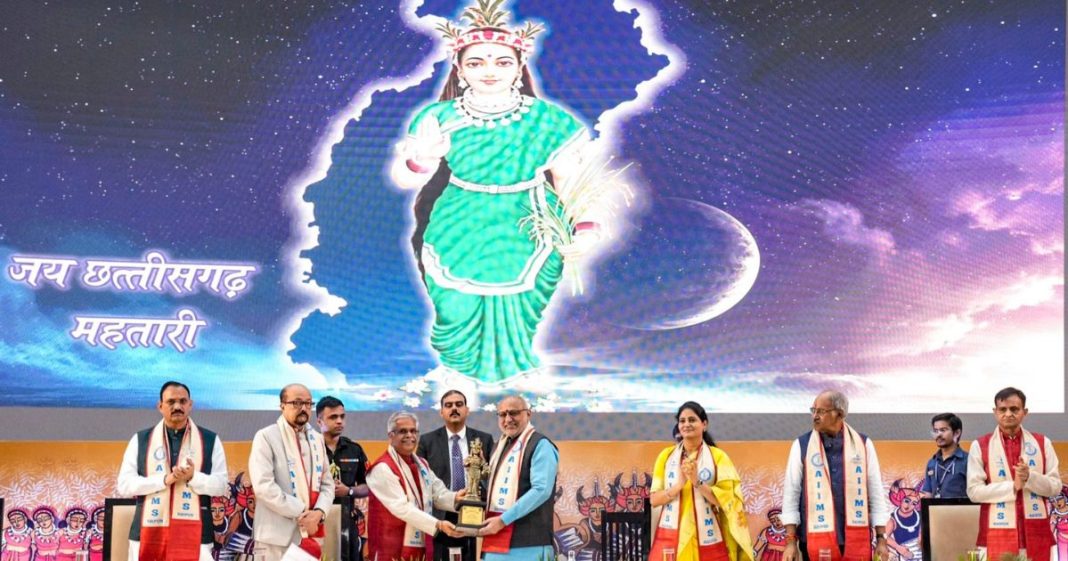
Radhakrishnan also conferred gold medals and certificates on meritorious students.
Chhattisgarh Governor Ramen Deka, Union Minister of State for Health and Family Welfare and Chemicals and Fertilizers Anupriya Patel, AIIMS Raipur President Prof (Dr) Sanjeev Handa, Executive Director Retired Lieutenant General Ashok Jindal and others were present on the occasion. (PTI)