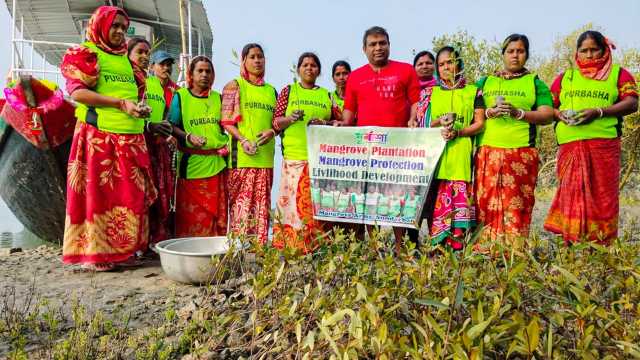

Gosaba (Sundarbans), Feb 21: Even in knee-deep murky waters, Rina Sarkar is nimble on her feet as she navigates the slippery mudbanks of Chargheri village on Satjalia island in the Sunderbans. She is one of the 150 local women who have come to the embankment, walking through a dense forest, to plant 2,000 mangrove saplings as part of a green initiative.
Rina, like several of her companions, is a “tiger widow” — a local woman whose husband has been taken by the Bengal tiger.
“In 2022, my husband Sudipto Sarkar went to catch fish and crabs, and never returned. He was killed by a tiger,” Rina says as her voice trails off.
According to locals, there are thousands of tiger widows in the expansive Sunderbans region — their lives riddled with social ostracisation, financial instability, and psychological distress.
The situation has been exacerbated in recent years, amid rising instances of human-tiger conflict, primarily due to the adverse effects of climate change.
While there are legal provisions to provide compensation for wildlife-related fatalities, and several non-government organisations (NGOs) and community-based initiatives to help tiger widows, these women continue to face challenges.
Debaroti Das, who works with Purbasha Eco Helpline Society (PEHS), a Sunderbans-based NGO, says, “Human beings have three basic needs for survival: food, clothes, and shelter. In the Sunderbans, however, there are not many sources of income; here, attaining a quality life is near impossible. Even if people somehow manage to build a house, frequent cyclones that hit the region destroy them.”
A bad omen
The husband of Anima Mondal, a resident of the Chargheri village, was killed by a tiger around 20 years ago when he went to catch crabs — one of the few sources of income in the region, selling for up to Rs 800 per kg.
The attack did not just leave Anima without a husband, the family’s main breadwinner, but also turned her into an outcast. She was believed to be a bad omen and labelled as “swami-khejo”, an insult innate to the region, signifying “husband-eater”.
Das says, “The ostracisation of tiger widows leads to isolation, without financial or social support. I recently found that sons of these women are not even allowed to see the face of their mothers before they leave home for work in the morning, as it is believed that it would bring bad luck.”
To make matters worse, many tiger widows are denied financial compensation for wildlife-related fatalities under the Wild Life (Protection) Act, 1972.
Umashankar Mandal, founder of PEHS, says, “Since many men enter the forests without official permits, their deaths are often considered illegal, disqualifying their families from receiving government compensation.”
This leaves numerous tiger widows vulnerable to exploitation and abuse. Several studies have revealed cases of physical abuse, sexual exploitation, and trafficking into sex work.
Climate change adds to plight
In recent years, the Sundarbans — the world’s largest mangrove forest, where around 4.5 million people live — has been a hotbed of climate change, facing an existential threat from rising sea levels, frequent and intense cyclones, and increasing salinity in water. These have also led to an increase in the frequency of human-tiger conflicts, according to experts.
For instance, in 2015-2016, the region — stretching across 10,000 sq km across the Indo-Bangladesh border — had shrunk by 210 sq km since the 1960s due to rise in sea level. Also, a gradual reduction in sediment flow from rivers to the Sundarbans region has resulted in loss of land mass.
Das says, “Habitat for both humans and tigers is getting submerged due to rising sea level. When the islands where tigers live submerge, the animal moves to human-inhabited areas, resulting in more number of attacks.”
Climate has led to an increase in water salinity, threatening the health of mangrove forests and the quality of soil and crop. This has also caused disruptions to fish populations in the region, affecting livelihood of residents who depend on them for income.
“In search of fish and crabs, village residents are forced to enter forests illegally, and fall prey to tiger attacks,” Das says.
Every year, around 40 people are targeted by tigers in the region, according to an article published in the Asian Journal of Arts, Humanities and Social Studies in March 2025.
This number is expected rise, as no suitable tiger habitat will be left in the Sundarbans by 2070 because of climate change and rise in sea level, according to a 2019 study published in the Science of The Total Environment journal.
Conservation efforts
To curb the adverse impacts of climate change, Mandal and his organisation, PEHS, have been planting mangrove saplings in the Sundarbans since 2009.
Mandal says, “Cyclone Aila in 2009 caused large-scale destruction in my village, Chargheri. It was then that I realised the significance of mangroves, and decided to start planting and nurturing them.”
Mangrove forests act as a natural shield against cyclones, tidal surges, and coastal erosion. They can also be a rich carbon sink, a storehouse of carbon — the primary driver of climate change.
According to Mandal, his organisation has so far planted more than 1,120,000 mangrove saplings in six islands of the Sunderbans, with the help of 500 residents, who also maintain these trees.
PEHS also works to support tiger widows and other community members by running a primary school and promoting sustainable income sources, such as beekeeping.
However, residents of the Sunderbans would need much more support to improve their quality of life.
Sarkar says, “PEHS helps us with rations and planting mangroves. But since my husband has died, I have not had enough money to support my children.” (PTI)