
By Dipak Kurmi
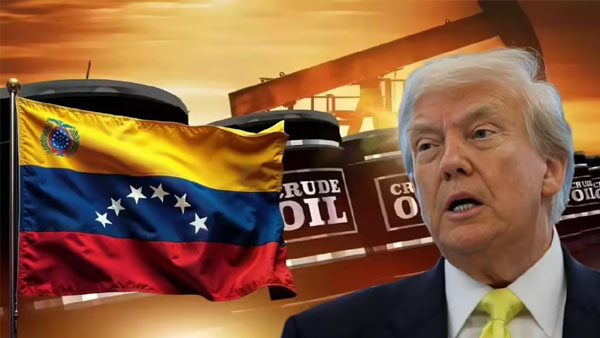
US President Donald Trump’s confident declaration that Washington would effectively “run” Venezuela and allow American oil giants to rebuild the country’s battered oil sector has sent shockwaves across the global energy and geopolitical landscape. While the statement signals a dramatic assertion of American power in Latin America, it also opens up an unexpected strategic window for India. At a time when New Delhi is navigating mounting pressure from Washington over its continued purchases of Russian crude, the prospect of Venezuela emerging as an alternative supplier could recalibrate India’s energy diplomacy. Trump has repeatedly expressed his displeasure at India’s large-scale imports from Russia, warning that tariffs on Indian goods could be raised if New Delhi did not fall in line with US preferences. His post-raid remarks on Venezuela included fresh hints of economic retaliation, even as Russian oil imports to India continued in December 2025. In this context, Venezuelan oil, paradoxically under American control, could offer India a way to diversify supplies without directly buying from the United States, while still satisfying Trump’s core political and corporate interests.
Trump’s anger with India is rooted in trade asymmetries and strategic expectations. From his perspective, India buys vast quantities of discounted Russian oil but imports relatively little American energy, despite enjoying a sizeable trade surplus with the US. The American president has made it clear that he wants this equation reversed. Yet India has resisted direct pressure to replace Russian oil with American crude, citing commercial logic, price competitiveness, and long-standing diplomatic ties with Moscow. Venezuela presents a convenient workaround. Once American firms take over Venezuelan oilfields, India could import oil produced by US companies operating abroad, rather than from US soil itself. This would allow Trump to claim a geopolitical and economic victory, as American oil giants would profit, while India could avoid the higher costs and logistical complexities associated with large-scale US crude imports. In essence, Venezuela could become a Trump-approved substitute for Russia in India’s oil basket.
At present, however, India’s imports from Venezuela remain marginal. Due to sweeping American sanctions, India currently imports only about 30,000 barrels per day from Venezuela, a fraction of its overall crude intake. China, by contrast, has openly defied US pressure and has emerged as Venezuela’s largest buyer, importing around 400,000 barrels per day in 2025. Trump sought to deter such trade through an executive order issued in March 2025, which instructed his administration to identify countries importing Venezuelan oil and consider imposing additional tariffs on them. The order explicitly stated that from April 2, 2025, a tariff of 25 per cent could be levied on all goods imported into the US from any country buying Venezuelan oil, directly or indirectly. India largely complied with this directive, curbing Venezuelan purchases, though it refused to abandon Russian oil altogether due to a mix of economic necessity and diplomatic prudence. The current crisis, however, may dismantle this sanctions regime, allowing countries once again to tap into Venezuela’s vast reserves.
The irony is that despite possessing the world’s largest proven oil reserves, Venezuela currently accounts for less than one per cent of global oil supplies. This paradox is the result of chronic underinvestment, technological stagnation, and the crippling impact of US sanctions, which deterred international companies from operating in the country. Infrastructure decayed, production collapsed, and reserves that were commercially viable became effectively stranded. The anticipated entry of American oil majors is expected to change this equation dramatically. With access to capital, advanced drilling technology, and global supply chains, these firms could spend billions of dollars to rejuvenate Venezuela’s oil sector. Over time, this could significantly increase global supplies, easing market pressures and creating new options for major importers like India. For New Delhi, this would mean access to another supplier with Washington’s explicit approval, a rare convergence of commercial benefit and geopolitical convenience.
Yet India’s ability to capitalise on this opportunity will depend on several complex variables. The first is time. Even with aggressive investment, it may take months, if not years, to ramp up Venezuelan production to levels that meaningfully impact global markets. India, which sources most of its oil through long-term contracts rather than spot purchases, cannot abruptly shift suppliers without careful planning. Negotiating long-term deals with American oil firms operating in Venezuela will require sustained diplomatic and commercial engagement. This transition would have to be gradual, reducing dependence on Russia incrementally rather than through a sudden break. Given the scale of India’s energy needs and the entrenched nature of its existing contracts, this recalibration will be neither swift nor simple.
Another major challenge lies in the nature of Venezuelan crude itself. Venezuelan oil is typically heavy and extra-heavy, making it more difficult and expensive to refine compared to lighter grades. While India’s refineries are among the most sophisticated in the world and are capable of processing a wide variety of crude types, refiners will closely scrutinise costs, margins, and risks. In the past, Venezuelan oil was attractive largely because it was available at significant discounts, much like Russian crude in recent years. If American firms sell Venezuelan oil at prevailing market prices, Indian refiners will need to assess whether the economics still make sense. They will also evaluate whether additional investments or technological adjustments are required to optimise refining efficiency, especially at a time when global energy markets remain volatile.
India’s historical engagement with Venezuela provides both experience and incentive. According to media reports, India was once a major processor of Venezuelan heavy crude, importing more than 400,000 barrels per day at peak levels until US sanctions and rising compliance risks forced a shutdown of purchases in 2020. The state-owned Oil and Natural Gas Corporation holds a 40 per cent stake in one of Venezuela’s oilfields, though operations there were severely hampered by a lack of equipment and technology. If American companies revitalise the sector, ONGC’s operations could be revived, leading to a substantial increase in output. Estimates suggest that production from ONGC’s oilfield alone could rise by 10 to 15 times under favourable conditions. Moreover, Venezuela reportedly owes around one billion dollars to ONGC as unpaid dividends accumulated over the past 11 years, payments that were frozen due to audit disputes and sanctions. A revival of production and a loosening of restrictions could unlock these funds, boosting India’s foreign exchange earnings.
Hovering over all these calculations, however, is the unpredictable Trump factor. Analysts caution that it is difficult to anticipate what ultimately pleases or provokes the US president. While Venezuelan oil could reduce India’s reliance on Russia, Trump may still insist that India buy more American goods directly, including US crude, to address the bilateral trade imbalance. India’s large trade surplus with the US remains a sore point, and Trump has consistently sought to reshape these dynamics through tariffs and threats. Venezuelan oil could also be used as leverage against China, which dominates imports from the South American nation, and as a signal to Saudi Arabia, long the kingmaker of global oil markets. In this broader strategic contest, India’s interests may not always align neatly with Washington’s objectives.
Still, many analysts see potential upside for India if sanctions are eased and production surges. Drawing parallels with past geopolitical episodes, such as Panama in 1990, when trade restrictions were lifted soon after regime change, experts argue that oil flows can resume rapidly under new political conditions. Nikhil Dubey, a senior research analyst at Kpler, has noted that Venezuelan barrels could once again find their way to Indian refineries, adding flexibility and resilience to India’s oil basket. Before 2019, Venezuela produced more than 700 million barrels a year, with India and China together absorbing over a third of that output. A return to even a fraction of those levels would materially alter India’s energy options.
In the final analysis, America’s intervention in Venezuela is reshaping more than just Latin American politics; it is redrawing the contours of global energy trade. For India, the prospect of Venezuelan oil under American management presents both opportunity and uncertainty. It could ease pressure from Washington, reduce overreliance on Russia, revive stranded investments, and strengthen India’s negotiating hand in global markets. At the same time, it demands careful calibration, technological assessment, and diplomatic agility. As Caracas becomes the latest theatre where energy, power, and politics collide, New Delhi must navigate this shifting terrain with caution, pragmatism, and a clear-eyed understanding that in the world of oil, today’s solution can quickly become tomorrow’s dilemma.
(the writer can be reached at dipakkurmiglpltd@gmail.com)