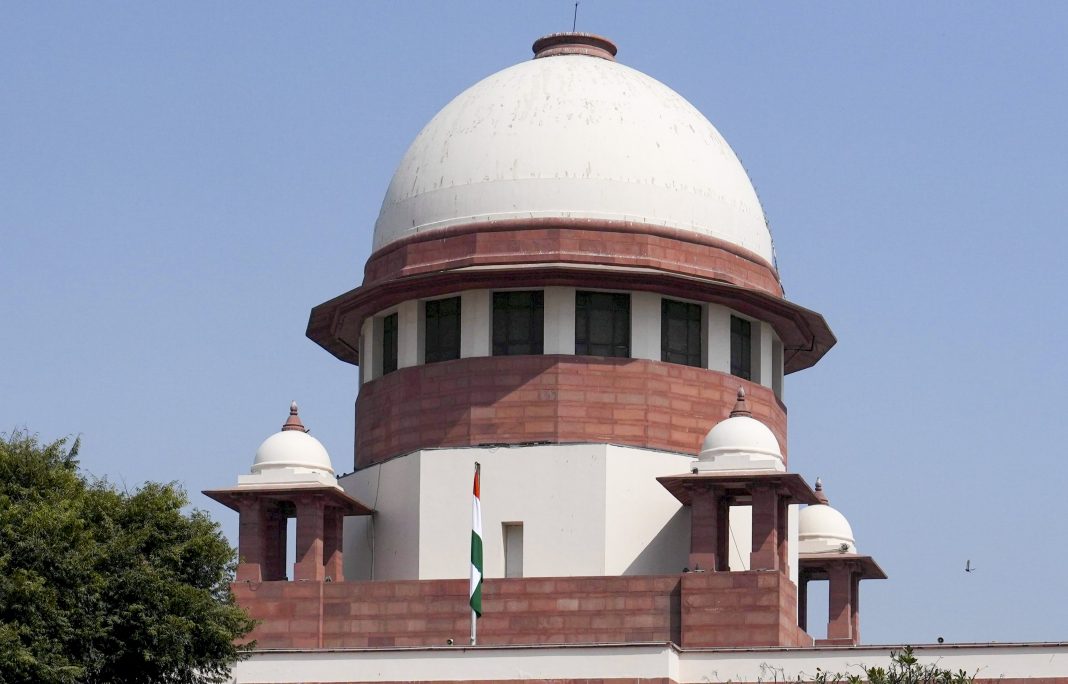

New Delhi, April 22: The Supreme Court on Wednesday said it is very difficult, if not impossible, for judicial forum to define parameters to declare a particular practice of a religious denomination as essential and non-essential.
A nine-judge Constitution bench headed by Chief Justice Surya Kant said that if a particular religious Hindu denomination follows a set of practices, all of them cannot be said to be essential religious practices if they impinge upon morality, public order and health.
Under the Constitution, religious practice of a particular sect of any religion is protected unless they are in contravention of morality, public order and health.
The bench, also comprising Justices B V Nagarathna, M M Sundresh, Ahsanuddin Amanullah, Aravind Kumar, Augustine George Masih, Prasanna B Varale, R Mahadevan and Joymalya Bagchi, said the expression “essential” does not find mention in the Constitution.
Senior advocate Rakesh Dwivedi, appearing for an intervener, submitted that a religion cannot be described by the tenets of a denomination and the right of freedom of religion will certainly include what the believers decide for themselves.
“How they worship and when they worship are all for the believers to decide. So please don’t bring in any new ideas or replace the old with the new one.
“Don’t keep it as a tool which will create problems in the future. Please leave it to the denomination to decide how they want to worship,” Dwivedi said while faulting the majority judgment of 2018 in the Sabarimala case, which allowed women of all ages to enter the iconic hilltop temple.
The senior lawyer submitted that the important aspect for consideration of the court is the emotion of believers as religion attracts emotion.
“People are attached to a particular denomination, particular temple and when they get attached to the emotion, they react very strongly if the emotion is hurt,” he said, adding that the courts will have to be very slow and deal with a soft touch in the exercise of the power of judicial review of a practice.
“The Courts will have to be harsher when testing a law on a religious practice. Unless there is some mal-intention, play of fraud in the name of religion, which is not established by any evidence at all, the court should refrain from going into the question of religious practice especially if it is not hurting anybody,” Dwivedi said.
During the seventh day of hearing petitions related to discrimination against women at religious places, including the Sabarimala temple, and on the ambit and scope of the religious freedom practised by multiple faiths, Justice Nagarathna said the Hindu society has to unify itself.
“You cannot say we are one denomination and they are from another denomination. They cannot come to one temple and we cannot go to their temple.
“That cannot be the idea of Hindu society. The Hindu denominations will suffer if they don’t open doors for others,” she told Dwivedi.
The senior counsel replied that he agreed with the view and submitted that if a particular denomination prevents the other from worshipping, the law enacted by the state will be sustained under social reforms.
Justice Nagarathna said Article 25 (2)(b), which empowered a state to enact a law for social welfare and reform or to throw open Hindu religious institutions of a public character to all classes and sections of Hindus, was inserted in the 1950s because the social evil of exclusion was prevalent at that time.
The day saw several senior lawyers making submissions on the issue of faith and fundamental rights.
While hearing arguments of senior advocate Gopal Subramanian, the bench observed that it would be difficult to lay down any universal or broad guidelines when the State can intervene in religious practices in the name of social reform and emphasised that such questions would necessarily depend on the facts of each case. (PTI)