
By Bhaskar Saikia
On 21 March, the world observes the International Day of Forests, a date chosen by the United Nations General Assembly not by accident, but for its symbolism. It coincides with the spring equinox in the Northern Hemisphere, marking the first day of spring — a moment of balance between light and darkness, and a reminder of renewal, regeneration and fresh beginnings in nature.
Yet, as we celebrate forests on this day, we are confronted with a stark reality: the threat of deforestation today is not distant or abstract; it is real, immediate and accelerating. And the first to bear its consequences are not distant populations, but the tribal and indigenous communities who have lived in coexistence with forests for generations.
However, the idea about conservation does not come from observance of this day or myriad climate agreement. Interestingly, it comes from an unlikely source: a medieval political document signed over 800 years ago.
The 800-year-old forgotten Charter
The Magna Carta (the Great Charter), signed in 1215, limited the power of the English King John by the English barons and is widely regarded as the foundation of civil liberties. It limited the powers of the monarchy and introduced principles of justice, accountability and rights; ideas that would later influence document such as the United States Declaration of Independence and the Universal Declaration of Human Rights. Yet, hidden in its shadow lies a lesser-known but profoundly relevant companion charter signed two years later: the Charter of the Forest in 1217.
While the Magna Carta addressed political rights, the Charter of the Forest addressed something far more fundamental: how humans interact with nature.
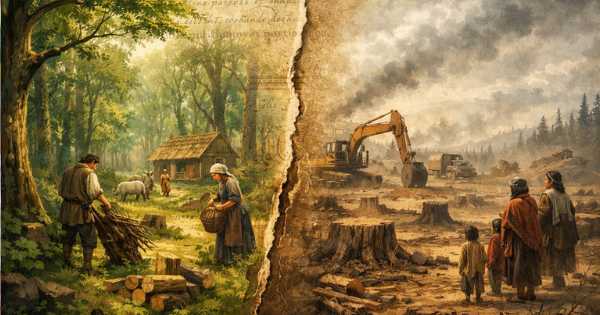
At a time when vast forest lands were controlled exclusively by the monarchy, the Charter of the Forest restored rights to ordinary people. It allowed them access to forests for grazing livestock, collecting firewood and gathering other essentials. In doing so, it did two remarkable things: first, it checked the overreach of elite power and second, it ensured that forests were used, but not exhausted.
Long before the term “sustainability” entered modern vocabulary, this charter embodied its essence. It recognised that forests are not merely resources to be exploited, but life-support systems that must endure across generations.
From Rights to Exploitation
However, history did not follow this wisdom for long. With the rise of industrialisation and globalised commerce, forests gradually transformed from shared ecological resources into economic commodities. The logic of profit maximisation overtook the principle of shared sustenance. The consequences are now visible in widespread deforestation, biodiversity loss and climate instability.
But perhaps the most immediate and profound impact has been on those who depend most directly on forests. Indigenous and tribal communities, who have been the custodians of traditional ecological knowledge, are increasingly pushed to the margins. Their displacement is not always visible, but it is persistent, often justified in the name of development.
In his critique of modern economic systems, American writer and political thinker, Noam Chomsky draws a striking parallel. He compares the ongoing loss of forests and displacement of indigenous peoples to the idea of terra nullius—a Latin term meaning “nobody’s land.” Historically, it was used to legitimise the occupation of lands by declaring them empty, disregarding the people who lived there.
Today, a similar logic quietly persists. Forests are treated as if they are empty spaces awaiting economic use, rather than living ecosystems inhabited by communities with deep cultural and ecological ties. In this sense, deforestation is not just an environmental issue; it is also a question of justice and rights.
The troubling paradox of the 21st Century
We now live in an era defined by climate change, biodiversity loss and ecological crises. Forests, once seen as inexhaustible, are shrinking at alarming rates. The demand for minerals, timber and land continues to grow resulting in a troubling paradox: economic systems designed to generate wealth from forests are simultaneously eroding the ecological foundations that sustain life. At the same time, scientists continue to discover new species, reminding us how much of nature still remains unknown.
Climate change, too, is deeply intertwined with this process. Forests act as carbon sinks, biodiversity reservoirs and regulators of climate systems. Their destruction accelerates global warming, while also destabilising local environments. And in this chain of consequences, indigenous communities become the first casualties, losing not just their homes, but their identity, knowledge systems and ways of life.
When past wisdom paves the way for the future
Revisiting the Charter of the Forest today, therefore, is not about romanticising the past or merely an academic exercise. It is an opportunity to reflect on a principle that modern systems have largely ignored: that environmental justice, sustainability and equity must go hand in hand.
The charter recognised that protecting forests also meant protecting people, their livelihoods, cultures and futures. This idea resonates strongly today, especially in countries like India, where millions depend directly on forests.
The Magna Carta is often celebrated as the beginning of democracy and human rights. But its companion, the Charter of the Forest, may well represent the beginning of ecological ethics. As we mark the International Day of Forests, this 800-year-old idea offers a simple but powerful lesson: conservation is not just about protecting trees, it is about ensuring fairness, restraint and responsibility in how we use nature.
In the end, the question is not whether we can afford to conserve forests. It is whether we can afford not to.
(Bhaskar Saikia is a taxonomist currently working at the Zoological Survey of India, Shillong. He can be reached at mail.bhaskarsaikia@gmail.com)