
ROOPAK GOSWAMI
Shillong, Sep 28: A bird that had not been recorded in the Garo Hills for 75 years has been sighted again in Meghalaya’s Balpakram National Park, offering a rare glimpse of one of the region’s most elusive nocturnal birds.
The finding was reported by Daniel Miranda and Tribhuwan Singh of the Wildlife Institute of India, Dehradun, in a note published in Indian BIRDS.
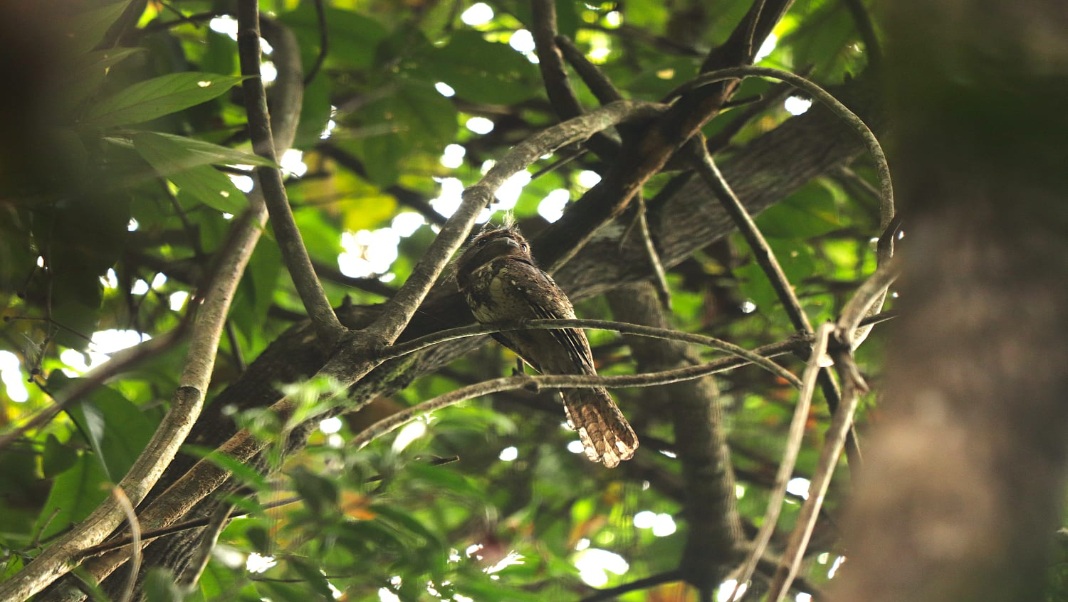
The Hodgson’s Frogmouth (Batrachostomus hodgsoni) was spotted by Miranda and Singh while birdwatching and trekking through Balpakram National Park in South Garo Hills on January 30, 2025. The bird has been infrequently spotted in Khasi Hills.
The encounter began with a commotion in a dense bamboo thicket. Small birds were screeching and mobbing something hidden in the undergrowth when a medium-sized bird suddenly flew out and perched high above the observers.
It turned out to be a male Hodgson’s Frogmouth.
Its mottled grey, lichen-like plumage, large gape and long facial bristles helped confirm its identity. The bird remained almost completely still as Miranda and Singh photographed it. They observed it for about five minutes before leaving it undisturbed.
But the sighting was not a one-off.
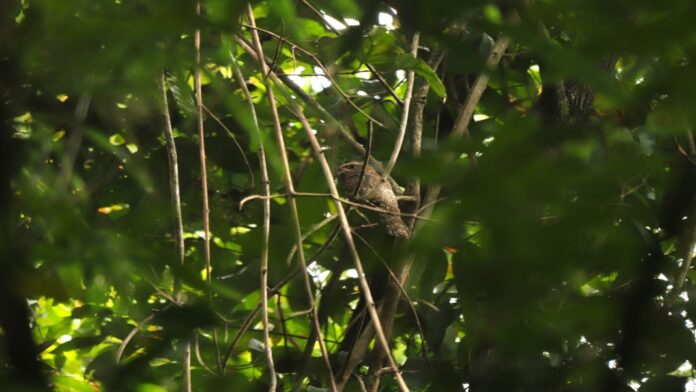
Between February and May 2025, Miranda and Singh heard the frogmouth’s distinctive, haunting whistle on several occasions and recorded the species in the Mahadeo and Baghmara ranges of Balpakram National Park.
The last known record from the Garo Hills was a specimen collected near Tura in West Garo Hills in 1950. The new observations therefore represent the first recorded sighting of the species in the Garo Hills in 75 years.
Hodgson’s Frogmouth is particularly difficult to detect because of its nocturnal and secretive behaviour. The researchers noted that the species remains understudied and is frequently overlooked.
The observations also underline the importance of Balpakram’s forests. The sightings were made within Balpakram National Park, an Important Bird Area and Key Biodiversity Area. Miranda and Singh have called for targeted ecological research and greater use of citizen-science approaches to improve information on the species.
The sighting adds to growing evidence of the rich but still incompletely documented birdlife of the Garo Hills. The Balpakram–Nokrek landscape supports hundreds of bird species, ranging from hornbills and pheasants to forest specialists and migratory birds. Surveys in the region have recorded more than 250 species, while recent work in village reserve and community forests has continued to add to the picture of the area’s avian diversity. The landscape’s extensive forests, bamboo thickets, streams and varied elevations provide habitat for a wide range of birds, including several species that are difficult to detect.
For a bird that can remain almost motionless and blend into its surroundings, its rediscovery in the Garo Hills is a reminder of how much of Meghalaya’s forest biodiversity may still remain poorly documented.