
Meghalaya’s caves, hidden beneath forests and limestone hills, are now emerging as silent witnesses to the region’s climate history — and as guides for understanding what the future may hold.
ROOPAK GOSWAMI
Guwahati, Dec 30: The caves in Meghalaya were quietly recording the story of the Indian monsoon, long before existence of weather stations, satellites or climate models. As scientists have learnt to read those ‘records’, they are revealing fascinating facts that are relevant for the present.
Published in Journal of Geophysical Research: Atmospheres, a study has reconstructed monsoon behaviour over Northeast India between 722 and 1250 CE, using a stalagmite collected from Bylliat Cave in Jaintia Hills region.
The study was led by Professor Anil Gupta from IIT Kharagpur with his students Yachna Verma and Priyantan Gupta, in collaboration with Dr Naveen Gandhi of IITM Pune, Professor Hai Cheng of the Chinese Academy, and Dr Som Dutt of the Wadia Institute, Dehradun — a team of Indian and international scientists.
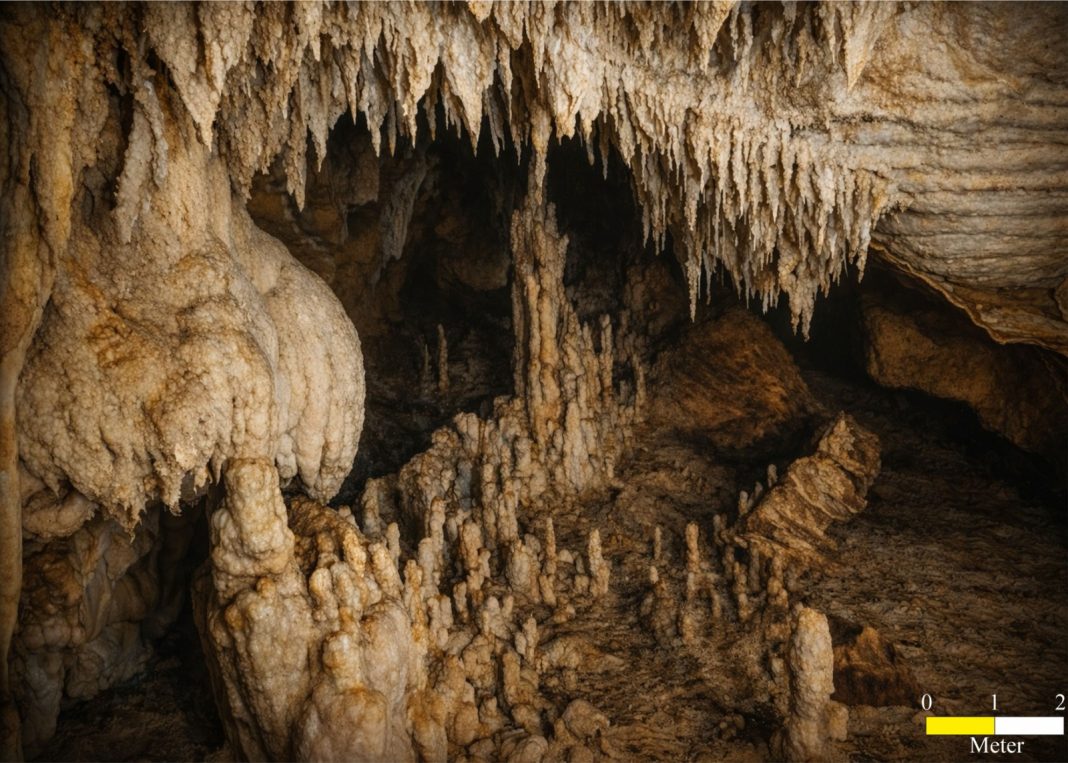
Krem Bylliat cave located near Kseh village in East Jaintia Hills district lies about 732 metres above sea level and stretches for nearly 4 kilometres in total.
The cave was formed in limestone rocks that were deposited millions of years ago, between the Paleocene and late Eocene epochs. These rocks were originally laid down in a shallow sea and contain fossils of marine organisms, showing that the area was once underwater.
Krem Bylliat lies within the Meghalaya Plateau, a region that plays an important role in shaping the Indian monsoon. The plateau acts as the first major barrier for moisture-laden winds coming from the Bay of Bengal. When these winds hit the southern slopes of the plateau, they are forced upward, leading to very heavy rainfall.
Because of this effect, areas around Kseh village receive exceptionally high rainfall. The combination of heavy rain and suitable limestone geology makes Krem Bylliat an ideal site for studying past climate changes. Rocks deposited inside the cave (speleothems) preserve detailed records of ancient monsoon patterns, allowing scientists to reconstruct climate history with high accuracy.
A 26.5-cm-long stalagmite sample was collected from a poorly ventilated chamber located 1 km deep inside the Bylliat cave (BYL) entrance having more than 95% relative humidity.
Stalagmites grow slowly as mineral-rich water drips from cave ceilings, layer by layer. Each layer carries a chemical signature linked to rainfall at the time it formed. By analysing these layers, researchers can reconstruct past monsoon strength with surprising precision — almost year by year.
“Meghalaya is the wettest place on Earth, receiving over 80% of its rainfall from the Indian Summer Monsoon. The limestone caves of Meghalaya are important for monsoon studies because their stalagmites preserve high-resolution records of past rainfall, allowing reconstruction of summer monsoon variability on sub-decadal to centennial timescales,” says Dr Anil Gupta from IIT Kharagpur, who is the corresponding author of the study.
The study shows that Meghalaya and the broader Northeast experienced significant swings in monsoon rainfall during the medieval period. The early phase, from around 722 to 850 CE, was marked by relatively strong monsoon conditions. This was followed by a prolonged dry phase between 850 and 890 CE, which the researchers describe as one of the more severe drought periods of that era.
From around 1140 CE onwards, the monsoon appears to have stabilised, entering a phase of relatively steady rainfall that lasted more than a century.
According to the authors, this later period resembles what is considered a “normal” monsoon regime today.
Scientists believe these long-term shifts were influenced by a combination of factors, including changes in solar activity and large-scale ocean-atmosphere systems such as El Niño and La Niña. When these global drivers aligned in certain ways, the monsoon weakened or strengthened across the subcontinent — including in rain-rich regions like Meghalaya.
Why does this matter today?
Researchers say understanding how the monsoon behaved in the past helps place modern climate change in context.
While today’s warming climate is driven largely by human activity, natural climate variability has always played a role in shaping rainfall patterns — sometimes with serious consequences for societies dependent on agriculture.
For Meghalaya, one of the wettest regions on Earth, the study is a reminder that even places known for abundant rain are not immune to long dry spells.
“The cave record shows that the monsoon has never been constant,” the authors note, pointing out that past droughts would have affected farming, water availability and settlement patterns.
As climate change increases the frequency of extreme rainfall events as well as dry spells, such long-term records are becoming increasingly valuable. Meghalaya’s caves, hidden beneath forests and limestone hills, are now emerging as silent witnesses to the region’s climate history — and as guides for understanding what the future may hold.
In a state where rain shapes daily life, culture and livelihoods, these ancient rock formations are telling a story that feels more relevant than ever.