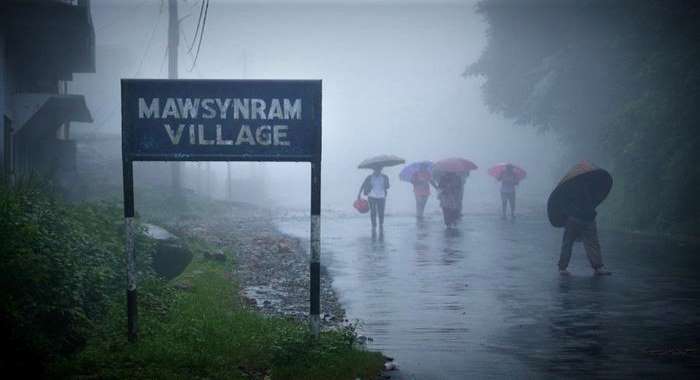

Annual rainfall in Mawsynram fell from 10,235 mm in 2014 to 8,838 mm in 2023, a sharp 14% decline in just ten years.
Roopak Goswami
Shillong, Feb 11: An atmospheric particle is found to be particularly responsible – among other factors – for the present “world’s wettest place” Mawsynram getting drier.
A new peer-reviewed study on Mawsynram, published in the Journal of the Indian Society of Remote Sensing, warns that rising levels of atmospheric aerosols — tiny pollution particles suspended in the air — are disrupting cloud formation and reducing rainfall in Meghalaya’s rain capital.
The research was done by Mamta Devi and Dr Sumit Kumar Mishra of the CSIR–National Physical Laboratory, in collaboration with scientists from the India Meteorological Department, Indian Institute of Technology Delhi, the Indian Institute of Tropical Meteorology, and Academy of Scientific and Innovative Research.
Using satellite observations and meteorological data spanning 2014 to 2023, the team examined how pollution particles interact with clouds and rainfall over the East Khasi Hills.
The study reports a 14.6% increase in aerosol concentration over Mawsynram during the last decade. More importantly, the particles are increasingly fine-mode aerosols — the kind most effective at disturbing cloud physics.
“These fine aerosols increase the number of cloud droplets but keep them small,” the researchers note. “Smaller droplets struggle to merge into raindrops, delaying or suppressing rainfall.”
The consequences are already measurable on the ground.
According to the study, annual rainfall in Mawsynram fell from 10,235 mm in 2014 to 8,838 mm in 2023, a sharp 14% decline in just ten years.
Monsoon months — especially July, August and September — show the steepest drop, despite persistent cloud cover.
Statistical analysis reveals a strong negative correlation between aerosol levels and rainfall, reinforcing the link between pollution and drying trends.
The researchers also observed increasing atmospheric heating caused by aerosols, particularly in winter and pre-monsoon months. This heating alters cloud dynamics and regional circulation patterns, further weakening Meghalaya’s rainfall system.
Black carbon—linked to biomass burning and fossil fuel use—was found to be rising, adding to atmospheric warming over the region.
For Meghalaya, where rainfall underpins agriculture, drinking water, forest health and tourism, the findings are deeply concerning. Scientists warn that continued aerosol build-up could make even high-rainfall zones like Mawsynram and Sohra more vulnerable to water stress and climate extremes.
The study calls for stronger control on biomass burning and regional pollution, more ground-based climate and air-quality monitoring in Meghalaya and inclusion of aerosol–cloud interactions in Northeast climate planning.
“Mawsynram is no longer just a symbol of extreme rainfall,” the authors caution. “It is becoming a sensitive indicator of how human activity can reshape even the most resilient climate systems.”