
ROOPAK GOSWAMI
Shillong, May 6: A quiet village landscape in Meghalaya will come alive on May 8-9 with one of India’s rare natural spectacles. The Ñiangtaser Festival at Iewsier in Saiden village will mark the return of the elusive “World Cup cicada,” an insect that emerges only once every four years.
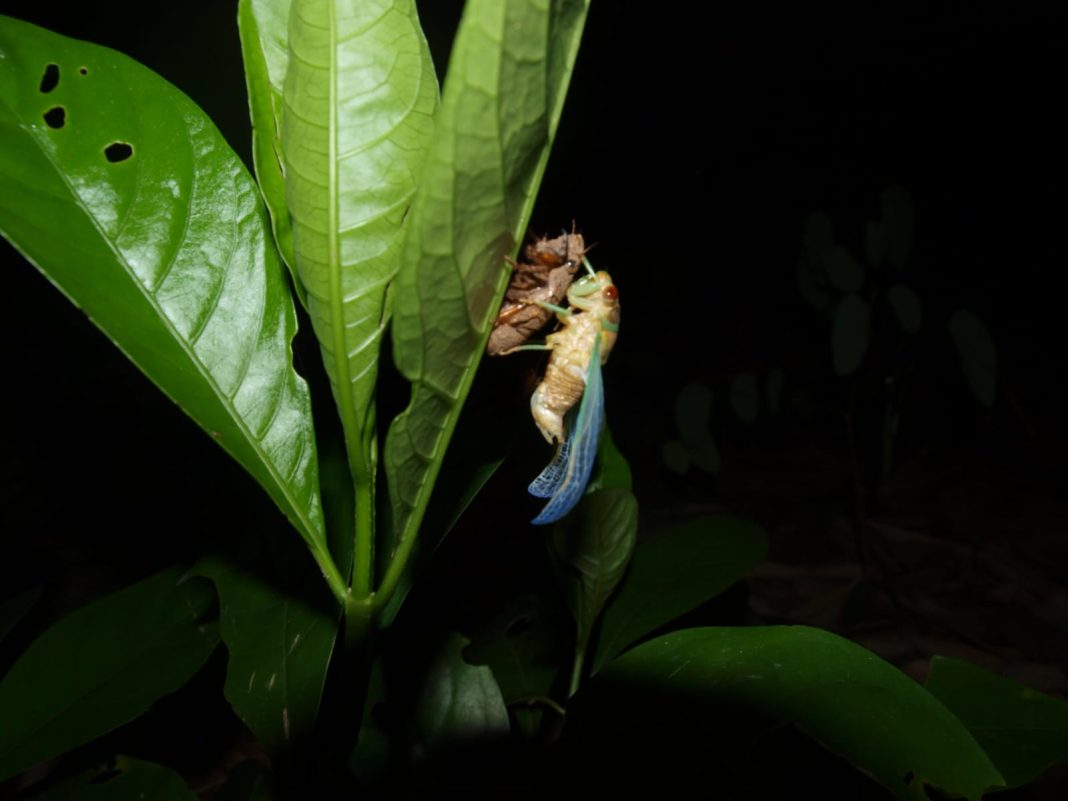
Organised by the Ri Bhoi Tourism and Environmental Developmental Forum, the festival coincides with the mass emergence of Chremistica ribhoi. The species spends nearly four years underground, feeding on bamboo roots, before surfacing in a brief, synchronised burst across parts of Ri Bhoi. The forum had earlier organised the event in 2018.

The phenomenon was first scientifically documented in 2013 by Sudhanya R. Hajong of North Eastern Hill University, who reported the mass emergence from the region. Later that year, Hajong and Yaakop described it as a new species under the genus Chremistica. Among nearly 3,000 cicada species worldwide, only a few show such periodical life cycles, and C. ribhoi remains the only known periodical cicada in the Indian subcontinent.
The emergence begins after sunset. Between 6 pm and 8:30 pm, thousands of nymphs crawl out of the ground and climb tree trunks and bamboo culms. Within the next hour, they shed their skins and emerge as pale, winged adults, leaving behind empty shells clinging to bark. By morning, forests are dotted with these husks—evidence of an overnight transformation. Within days, the males begin their sharp, rising calls that carry across hills and villages.
The insect’s popular nickname, “World Cup cicada,” comes from local observation. Villagers noticed that its four-year cycle often aligns with the FIFA World Cup, usually appearing weeks before the tournament. In Khasi, ñiang means insect, and over time the name Ñiangworldcup became part of local vocabulary.

The Ñiangtaser Festival reflects this link between ecology and community life. The event features traditional dance and music, football tournaments, fishing competitions, fashion shows, and other cultural programmes. Organisers say visitors will also be able to witness the emergence up close. “There are camping tents at the venue. People can come, and guides will take them to spots where the cicadas emerge,” an organiser said.
For the Bhoi Khasi community, the cicada is also a seasonal food. Newly emerged insects are roasted, dried, or pickled and sold in local markets. However, scientists caution that rising attention—from tourism and social media—could put pressure on the species if harvesting is not managed carefully, especially given its four-year life cycle.
Ecologically, the mass emergence plays an important role. It briefly provides abundant food for birds, reptiles, mammals, and other insects, ensuring that enough cicadas survive to reproduce despite heavy predation.

As the festival approaches, Meghalaya is once again preparing for a phenomenon that blends science, culture, and ecology—drawing visitors to a rare event that unfolds quietly in the forests, just after dark.
Sudhanya R. Hajong, who first scientifically documented the phenomenon in Meghalaya, perhaps captures the spirit of the cicada best in a poem inspired by the insect’s extraordinary life cycle.
I am the ‘Niangtaser’
I come after every four years
Deep within the earth I dwell
As I wait for four long years
In the darkness of the earthly womb
To see the light of day
The tree roots nurture me with sweet sap
And caress me when I climb the trees
Spreading my wings
I am here today, so was I
For millions of years
I don’t claim the Earth,
Nor do I claim the sky
But let us also live beneath the twinkling stars
And sing among the branches
And bask in the glory and warmth of the sun
I am the ‘Niangtaser’
And I come after every four years.