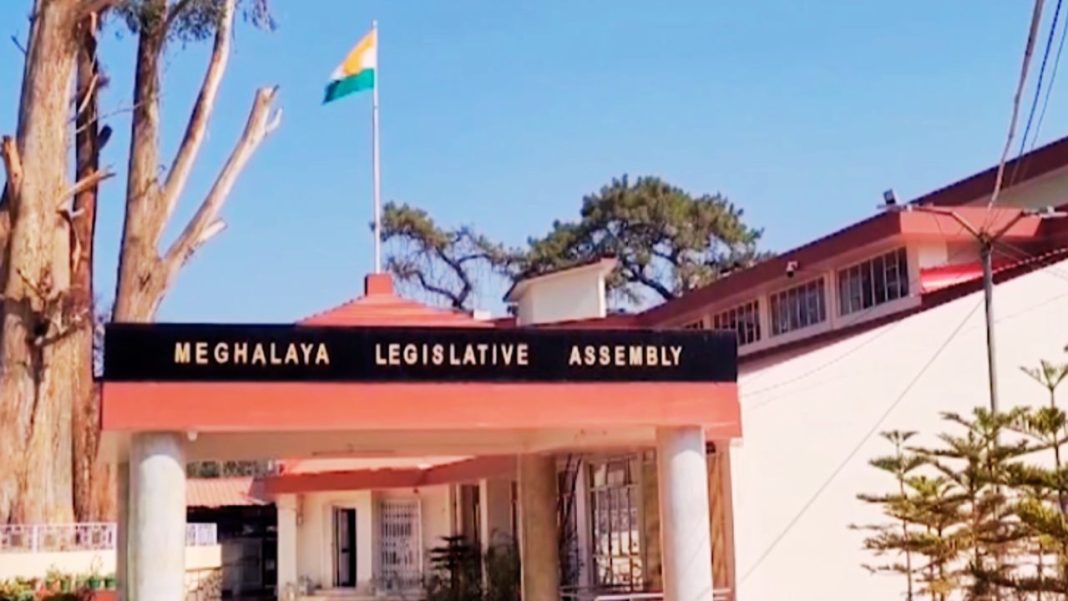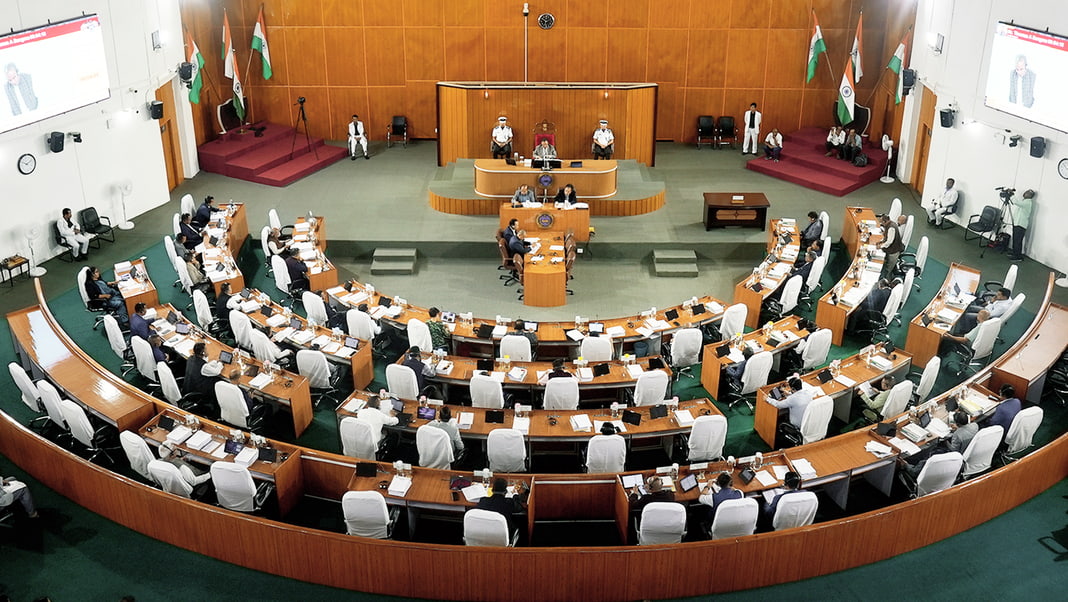

Govt tables expert committee report on State Reservation Policy in assembly
Shillong, Feb 18: In what can be a milestone towards ending a long-lasting controversy over reservation ratio among communities living in Meghalaya, the Expert Committee on State Reservation Policy has ruled out scope of change in reservation framework just on the basis of population.
In its report, which was submitted in the assembly on Wednesday, the committee recommended retention of the existing 1972 Job Reservation Policy (JRP) framework while proposing several administrative and policy refinements to improve implementation and equity.
Constituted in September 2023, the committee was mandated to review the functioning of the five-decade-old policy, consult stakeholders across Meghalaya, and suggest modifications where necessary.
The recommendations were finalized by the committee after extensive consultations with tribal bodies, civil society organisations, employee associations, academics and student groups.
Reaffirming that reservation should not be based solely on population proportion, the committee recommended for continuing to rest on constitutional criteria such as social and educational backwardness, historical disadvantage and adequacy of representation in public services.
Meanwhile, the committee significantly clarified that religion cannot be used as a criterion for reservation.
“The Constitution provides for affirmative action based on socio-economic backwardness and under-representation, and not on religious affiliation,” it stated.
On the demand for extension of reservation to educational institutions, the committee said the matter is outside its formal mandate and observed that the State Government may independently examine the issue.
Making a particular reference to Garo Hills districts, the Committee has recommended for targeted interventions to enhance educational standards in the region to promote long-term socio-economic development and improve competitiveness in public employment.
The committee, meanwhile, did not recommend extending EWS benefits to SC, ST, and OBC categories, observing that EWS constitutes a separate constitutional category distinct from the existing reserved groups.
Supporting the “carry forward” provision, the Committee recommended for its continuation under the 1972 Resolution. It has further recommended extending the carry forward period from one year to three years, noting that such extension has received judicial recognition and may help address backlog vacancies more effectively.
On sub-classification within reserved category, the committee has observed that it is legally permissible subject to collection of detailed, quantifiable data. It has recommended that the State Government take a considered decision on this matter after undertaking a comprehensive data-driven exercise.
Making its observation on “Creamy Layer”, the Committee has recommended that the State Government examine introduction of the “creamy layer” principle, where constitutionally applicable, to ensure that the benefits of reservation reach the most disadvantaged sections within reserved categories.
The committee termed the reservation for persons with disabilities as adequate under existing laws and did not propose additional measures in this regard.
With respect to providing preference to residents of local districts in district-level Class C and D posts, the Committee has opined that such a measure is not administratively feasible in view of rural-urban migration patterns and demographic mobility.
The Committee has strongly emphasized the need for strict and transparent implementation of the reservation roster system to ensure fairness, compliance, and accountability in recruitment processes.
After examining all representations and stakeholder views, the Committee has recorded that a majority of stakeholders supported continuation of the existing framework and that no compelling grounds presently exist for fundamental alteration.