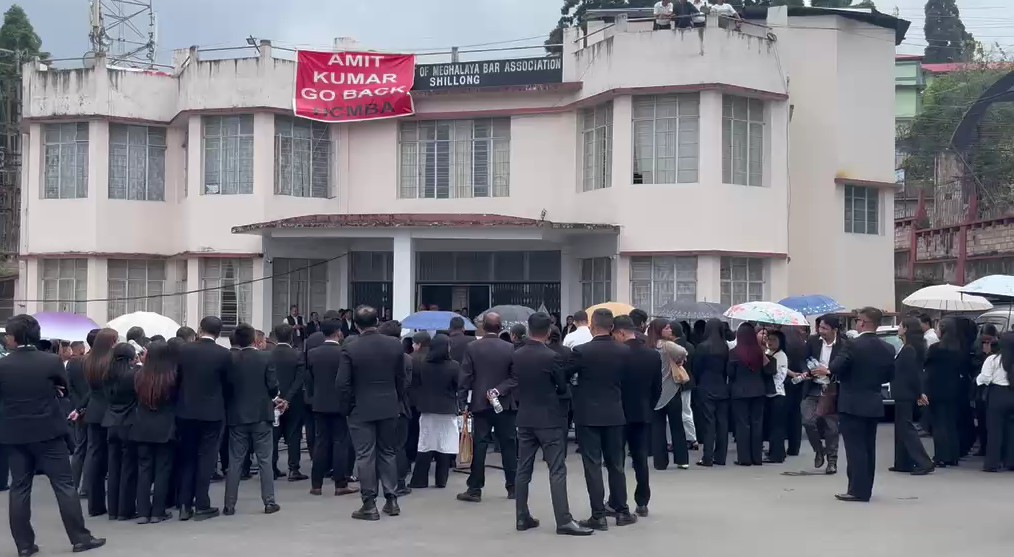

Shillong, Oct 10: Twenty-six lawyers have been directed by the Meghalaya High Court to appear before the court on October 13 for boycotting the court as part of their agitation demanding removal of Advocate General Amit Kumar.
The lawyers also include the chairman of the Bar Council of Meghalaya facing a criminal contempt case over their judicial boycott.
A Division Bench of Chief Justice Revati Mohite Dere and Justice H.S. Thangkhiew initiated a suo motu PIL against the High Court of Meghalaya Bar Association and the Shillong Bar Association, terming the boycott “completely unacceptable and illegal”.
The dispute stems from an August-3 hearing concerning the alleged molestation of a female law intern, during which Kumar criticised the bar associations for allegedly failing to protect women lawyers.
On August 5, the two associations removed Kumar from their membership rolls and demanded his removal as Advocate General.
Lawyers across most district courts began abstaining from judicial proceedings on October 1 to press for his replacement.
Rejecting the boycott, the High Court said lawyers could not use courts as leverage to achieve their demands.
“The reason given for abstention is ‘abstain from judicial work till the state government removes the Advocate General’ — a reason completely unacceptable,” the Bench observed, adding that strikes or abstention from court work were illegal.
Citing the Supreme Court’s ruling in Ex-Capt. Harish Uppal v. Union of India, the court reiterated that advocates have no fundamental or legal right to strike or boycott judicial proceedings. Such actions, it said, undermine litigants’ rights to speedy justice under Articles 14 and 21 of the Constitution.
The court issued criminal contempt notices under Section 15 of the Contempt of Courts Act, 1971, read with Article 215 of the Constitution.
The Bench also warned that contempt proceedings would be initiated against bar leaders in other districts if lawyers failed to resume judicial work immediately.
It praised the Baghmara Bar Association for refusing to participate in the boycott and upholding the rule of law.