PM Modi highlights success stories of women farmers from WJ Hills, WG Hills
Shillong, Oct 25: Success stories of reviving millet farming with efforts for value addition in Meghalaya has drawn the attention of Prime Minister Narendra Modi, who highlighted initiatives taken in West Jaintia Hills and West Garo Hills in 139th episode of his Mann Ki Baat.
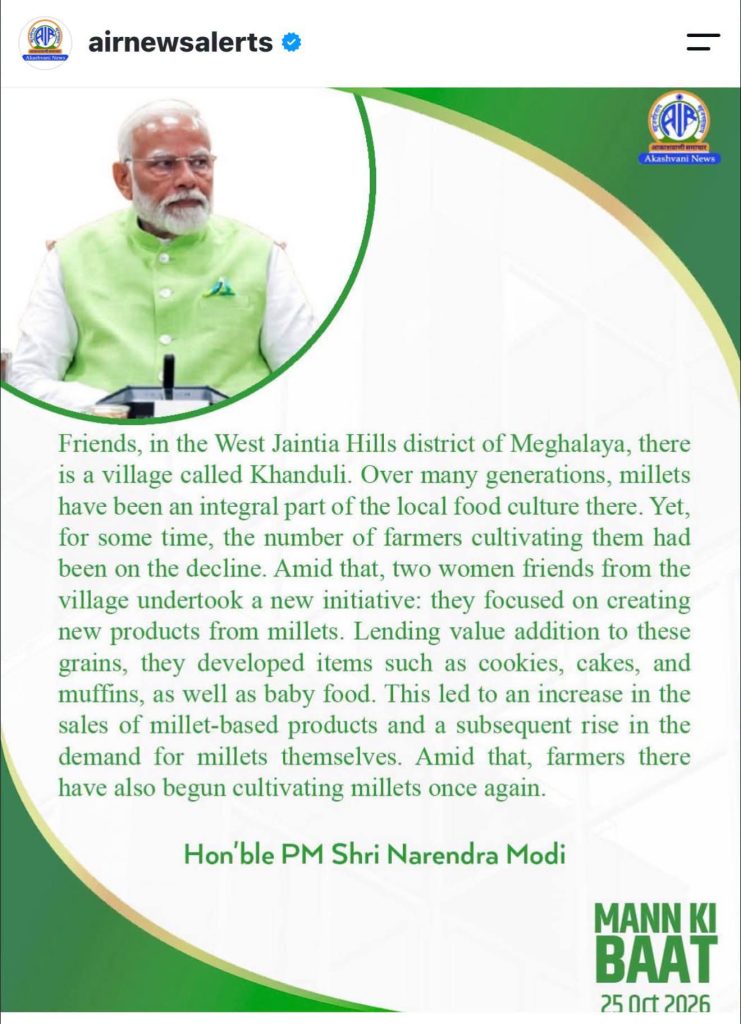
The Prime Minister spoke about how two women friends in Khanduli village in West Jaintia Hills district are helping revive interest in millets by turning the traditional grains into products such as cookies, cakes, muffins and baby food.
Millets have been part of the village’s food culture for generations, but the number of farmers growing the crop had declined over time.
The two women, Darapbiang Mulieh and Daieidlangki Suchiang, are working to reverse the trend by developing new products and creating a market for locally grown finger millet.

Their enterprise, which markets products under the brand name “Darap & Daieid”, buys raw millet from local farmers and processes it into millet powder, roasted millet powder, cookies, muffins, cakes, pakora and rice-and-millet baby food.
According to the Meghalaya government’s account of the initiative, the enterprise purchases raw finger millet at around Rs 80 per kg. Its products have reached markets in Khanduli, Jowai and Shillong, providing an additional outlet for local farmers.
“Lending value addition to these grains, they developed items such as cookies, cakes, and muffins, as well as baby food,” Modi said, describing how the initiative helped revive millet cultivation in the village.
The enterprise demonstrates how processing and marketing can create fresh demand for a traditional crop, potentially encouraging more farmers to resume cultivation.
Garo Hills farmer records higher yield
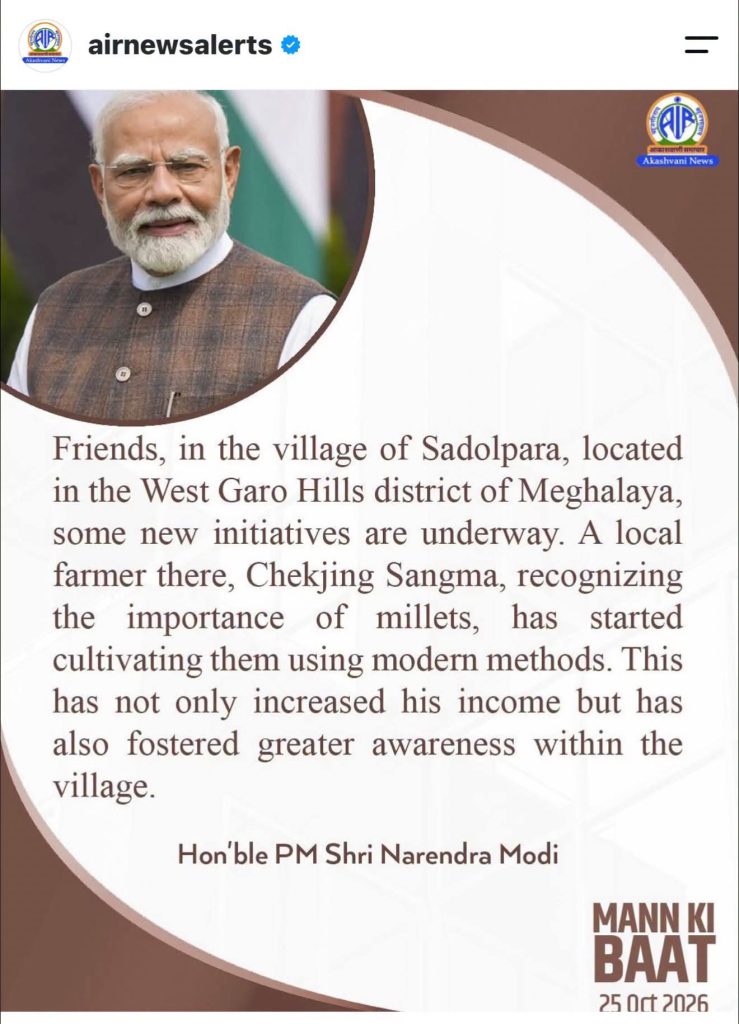
The Prime Minister also highlighted the efforts of Chekjing Sangma, a farmer from Sadolpara village in West Garo Hills, who has taken up millet cultivation using improved farming practices.
According to the state Agriculture and Farmers’ Welfare Department, Sangma recorded a yield of 750 kg per hectare on a demonstration plot supported under the National Food Security and Nutrition Mission’s Nutri-Cereals programme.
This compared with 500 kg per hectare under normal cultivation, an increase of 250 kg per hectare.
The department’s account attributes the improvement to quality seeds, timely sowing and better crop management, including the use of biopesticides.
Sangma grows millet alongside paddy, maize, vegetables and other crops on his largely rainfed farm. The department reported a net income of Rs 50,000–Rs 55,000 from the millet cultivation.
The example highlights another aspect of Meghalaya’s millet revival: improving farm productivity alongside efforts to expand consumption and develop markets for the crop.
Linking traditional crops with livelihoods
The two initiatives reflect complementary approaches to bringing millets back into Meghalaya’s agricultural landscape. While improved cultivation practices can help farmers raise production, local enterprises can create the demand needed to make the crop commercially attractive.
The state Agriculture Department is promoting millet cultivation through the Millet Development Scheme and the National Food Security and Nutrition Mission’s Nutri-Cereals programme. Support includes quality seeds, technical guidance, training and assistance with cultivation and post-harvest management.
However, challenges remain, including limited processing facilities, inadequate drying and storage infrastructure, and difficulties in accessing wider markets.
In Khanduli, the enterprise run by Mulieh and Suchiang has helped connect local farmers with buyers and consumers, while in Sadolpara, improved cultivation practices have demonstrated the potential for higher yields.
Modi also cited the revival of millet cultivation in Kezoma village in Nagaland’s Kohima district, where farming of the crop had stopped for more than a decade. The community resumed cultivation in 2024 and organised its first millet festival in 2025.
The examples from Meghalaya and Nagaland underline how community initiatives, improved agricultural practices and demand for millet-based foods can help revive traditional crops while creating new livelihood opportunities in the Northeast.