
By Dipak Kurmi
Few issues in Nagaland evoke as much collective emotion and enduring uncertainty as the unresolved Naga political question. Often described as one of the world’s longest-running insurgencies, the issue has never been merely about armed confrontation or political negotiation; it is fundamentally a story of identity, memory, and the difficult pursuit of a shared Naga consciousness across tribes and territories. For more than seventy years, the movement has shaped everyday life in the Naga-inhabited regions, influencing governance, economics, and social relations in ways both visible and subtle. What many once believed would culminate in a historic political settlement has instead stretched into an exhausting stalemate, producing factional fragmentation and deepening public disillusionment. It is within this climate of prolonged uncertainty that the emergence of a new collective of “like-minded” Naga youths under the banner Fed Up Nagas has captured public attention, symbolizing both frustration and a renewed impatience with the status quo.
The very name Fed Up Nagas encapsulates a generational mood marked by fatigue, disappointment, and a growing urgency for closure. The youths behind the initiative have been careful to clarify that they do not represent a political party, a tribal council, or even a conventional civil society organization. Rather, they describe themselves as individuals united across tribal, organizational, and regional divides, including Nagas living beyond the territorial boundaries of Nagaland. Their stated objective is singular and direct: the urgent implementation of the Framework Agreement and the Agreed Position. Both accords were widely celebrated at the time of their signing as major milestones in the peace process between Naga political groups and the Government of India, yet years later their practical realization remains elusive, creating a vacuum that many now view as dangerous and corrosive.
Into this prolonged vacuum, the youths argue, have crept entrenched systems of monopolies, syndicates, and corruption that are steadily eroding the social and economic foundations of Naga society. Their critique is not abstract. They point specifically to Dimapur, once envisioned as the commercial nerve centre of the region, which they claim has effectively been reduced to a “collection hub.” According to their assessment, more than thirty political groups alongside over a hundred unions and syndicates now operate in an environment where extortion and forcible collection have become normalized features of economic life. For ordinary citizens and small entrepreneurs, the meaning of unity has shifted dramatically; it no longer evokes only the historic aspiration for political self-determination but increasingly reflects a collective yearning for freedom from harassment and the restoration of basic law and order.
The youths’ criticism extends beyond economics into the deeper normalization of abnormality. They contend that temporary arrangements born out of conflict have hardened into permanent dysfunction, creating a society where instability is treated as routine. Two broad generational cohorts, those born between 1965 and 1980 and those between 1981 and 1996, have borne the brunt of this prolonged uncertainty. These generations came of age in an atmosphere where ceasefires coexisted with underground taxation, where political negotiations stretched endlessly, and where opportunities were frequently mediated by informal power structures rather than merit. The warning issued by Fed Up Nagas—that future generations must not inherit the same burden—carries a moral weight that resonates strongly in a region where many young people already feel trapped between historical memory and uncertain prospects.
The economic consequences of the prolonged impasse are particularly severe. Decades of delay, the youths argue, have not only scarred social life but have also undermined the very culture of merit and enterprise. In many sectors, prices are allegedly fixed not by competitive quality but by coercive arrangements, while syndicates dictate the rules of commerce in ways that discourage innovation and punish independent initiative. Such distortions, they insist, betray the original ideals of the Naga movement, which historically emphasized dignity, self-respect, and collective advancement. Instead of fostering a vibrant regional economy, the prolonged political limbo has produced what critics describe as a climate of risk aversion, capital flight, and shrinking opportunity for the educated youth.
Equally striking in the Fed Up Nagas discourse is their sharp denunciation of the prevailing gun culture. Weapons that were once seen by many supporters of the movement as symbols of resistance against perceived political marginalization have, in their view, increasingly become instruments of fear within society itself. Moral authority, they argue, has too often been replaced by coercion, and ceasefire arrangements have not prevented what they describe as continuing collateral damage to civilian life. This observation reflects a significant generational shift in attitude. Where earlier decades often romanticized armed struggle, a growing segment of Naga youth now appears to prioritize peace, institutional stability, and economic normalcy over prolonged militarization. The movement’s trajectory, as the youths suggest, has undergone what they call a 360-degree turn—from defense to offense—leaving ordinary people caught in the crossfire of competing claims and authorities.
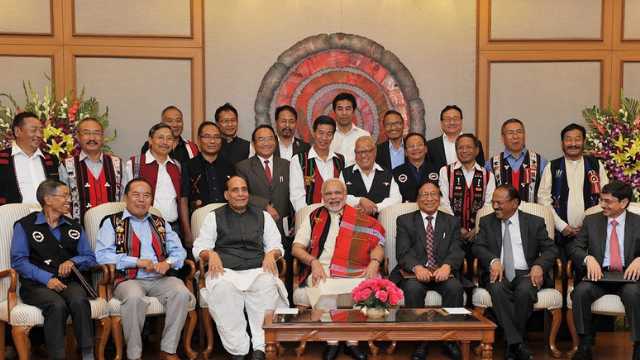
The broader historical context helps explain the depth of present frustration. The Naga political movement dates back to the mid-twentieth century, with roots in early assertions of self-determination that predated India’s independence. Over the decades, multiple armed groups emerged, ceasefires were signed, and negotiations periodically raised hopes of a comprehensive settlement. The 2015 Framework Agreement between the Government of India and the National Socialist Council of Nagaland (Isak-Muivah) was widely projected as a breakthrough, while the 2017 Agreed Position involving the Naga National Political Groups was intended to broaden inclusivity. Yet the final contours of a political solution—particularly sensitive issues such as the demand for a separate Naga flag and constitution—have remained unresolved, contributing to the sense that the peace process is perpetually near completion but never quite arrives.
The call for inclusivity, therefore, is not new, but the urgency with which it is now being articulated by younger voices is noteworthy. For decades, unity has been invoked rhetorically even as factions multiplied, each claiming fidelity to the core principles of the Naga struggle. The resulting fragmentation has often diluted negotiating leverage and complicated consensus-building. Fed Up Nagas positions itself not as another faction but as a pressure group representing the silent majority that has grown weary of prolonged transition. Whether this positioning will succeed in bridging entrenched divides remains uncertain, yet its emergence signals that younger Nagas are no longer willing to remain passive observers of elite-driven negotiations.
Another important dimension of the youths’ intervention is their framing of dignity as a central political demand. For them, the issue is no longer confined to questions of sovereignty or administrative arrangements; it is equally about restoring everyday normalcy in public life. The demand for the implementation of the existing agreements is presented not as a maximalist political gamble but as a pragmatic step toward stabilizing society. In their narrative, the prolonged delay has already imposed heavy psychological and economic costs on ordinary people, and further postponement risks deepening public cynicism toward both underground groups and formal political institutions.
Skepticism, however, remains a powerful undercurrent. Observers note that many earlier civil society initiatives have struggled to sustain momentum in the face of entrenched interests and complex negotiations. The structural challenges are formidable: multiple armed factions, competing tribal sensitivities, and the strategic calculations of the Indian state all intersect in ways that resist simple solutions. Moreover, the peace process has historically moved in cycles of optimism and disappointment, making public trust fragile. The real test for Fed Up Nagas will lie not merely in articulating public frustration but in maintaining cross-tribal credibility and constructive engagement over time.
Yet the significance of the moment should not be understated. After more than seven decades of conflict and negotiation, the psychological landscape of Naga society appears to be shifting. A generation that grew up amid ceasefires but without closure is now asserting its voice more forcefully. Their message is neither romantic nor revolutionary; it is, in many ways, deeply pragmatic. End the delay, honor the signed agreements, restore law and order, and allow society to breathe. Whether this appeal will catalyze meaningful movement in the stalled peace process remains uncertain, but it undeniably reflects a widening impatience among the youth.
If the Fed Up Nagas movement can translate sentiment into sustained civic pressure while avoiding the pitfalls of factional politics, it may yet shape the discourse around the Naga political future. The realities remain complex, and no single group can resolve a conflict layered with history, identity, and geopolitics. Still, the emergence of this youth-driven voice serves as a telling reminder that the costs of delay are no longer abstract statistics but lived experiences carried by successive generations. Should they remain consistent in purpose and disciplined in approach, their insistence on dignity, stability, and implementation may well leave an imprint on the long and unfinished story of the Naga peace process.
(the writer can be reached at dipakkurmiglpltd@gmail.com)