
Dipak Kurmi
Uruka Night, observed on the eve of Magh Bihu, stands as one of the most enduring cultural expressions of Assam, rooted deeply in the agrarian rhythms that have shaped the region for centuries. Celebrated at the close of the harvest season, Uruka is far more than a festive prelude to Bihu; it is a collective pause in time when communities come together to acknowledge abundance, labour, and the quiet generosity of nature. Traditionally marked by communal feasting and shared rituals, Uruka reflects a worldview in which gratitude is not an abstract sentiment but a lived, social act. In an age increasingly dominated by individual pursuits and urban anonymity, the persistence of Uruka Night underscores the continuing relevance of collective celebration as a foundation of social life.
At its core, Uruka Night draws its meaning from Assam’s agrarian heritage, where agriculture has long dictated not only economic activity but also social and cultural rhythms. The festival marks the culmination of months of physical labour invested in the land, making it a moment of both relief and reflection for farming communities. Historically, Uruka functioned as a collective thanksgiving to nature, recognising the harvest as the outcome of human effort working in harmony with environmental forces. This relationship with the land carries a moral dimension, reminding communities that prosperity is inseparable from care for soil, water, and ecological balance. Uruka thus symbolises the closing of one agricultural cycle and the hopeful beginning of another, reinforcing an ethic of stewardship that looks beyond immediate gain to the inheritance of future generations.
The communal feast that defines Uruka Night is perhaps its most visible and emotionally resonant feature. Families, neighbours, and friends gather without distinction of social status, creating a shared space where differences are temporarily set aside in favour of collective belonging. Traditional Assamese dishes such as maasor tenga, various forms of pitha, and other locally sourced delicacies dominate the menu, each carrying with it layers of cultural memory and regional identity. The act of eating together transforms food into a social language, one that communicates hospitality, equality, and warmth. In a contemporary world where meals are often solitary or hurried, the Uruka feast reasserts the importance of slowing down and reaffirming bonds through shared experiences.
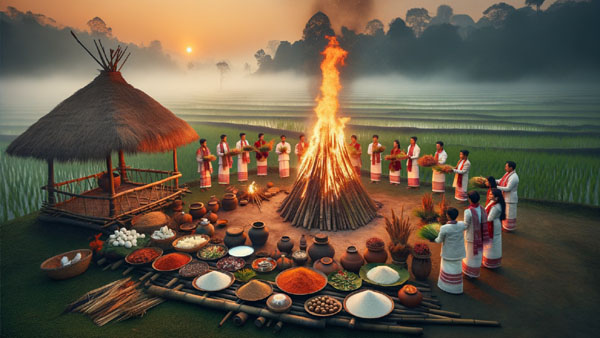
Equally significant to Uruka Night is the construction of the bhelaghar, a modest hut made from bamboo, hay, and other natural materials. Built collectively by members of the community, the bhelaghar serves as both a physical and symbolic centre of the celebration. Its construction is itself an exercise in cooperation, requiring shared effort and mutual participation. Throughout the night, the bhelaghar becomes a space for singing, dancing, storytelling, and laughter, embodying the joy that follows the completion of hard labour. At the end of the festivities, the hut is ceremonially burned, a ritual act that signifies the release of negative energies associated with the past year and the purification of the community as it steps into a new cycle. This symbolic destruction underscores a profound understanding of renewal, where endings are necessary conditions for growth.
Uruka Night also functions as a vital mechanism for cultural continuity, ensuring that traditions, values, and collective memory are passed from one generation to the next. The night is animated by folk songs, traditional dances, and oral narratives that carry historical knowledge and social wisdom. Elders play a central role in this process, sharing memories and interpretations that connect the past with the present. In doing so, Uruka creates an intergenerational dialogue that resists cultural erosion in a rapidly changing world. As globalization and technological acceleration threaten to dilute local traditions, Uruka remains a living archive, preserving Assamese identity through practice rather than abstraction.
In the context of modern life, Uruka Night offers a powerful counterpoint to the isolating tendencies of individualism and urbanization. As people increasingly migrate to cities and engage with digital spaces that often replace physical community, festivals like Uruka reclaim the value of face-to-face interaction and shared physical presence. The celebration encourages participants to step away from screens and reconnect with their surroundings, neighbours, and environment. It reinforces the idea that communities thrive not through competition or isolation but through cooperation, mutual support, and shared responsibility. In this sense, Uruka is not merely a cultural relic but a contemporary social lesson.
Beyond its social and cultural dimensions, Uruka Night carries an ecological message of remarkable relevance. The use of biodegradable materials such as bamboo and hay in constructing the bhelaghar reflects an inherent understanding of sustainability embedded in traditional practices. Unlike modern celebrations that often generate significant waste, Uruka’s rituals leave minimal ecological footprints, demonstrating how cultural continuity and environmental responsibility can coexist. At a time when climate change and environmental degradation pose existential threats, the ecological wisdom of Uruka offers a model for living in harmony with nature. It reminds communities that human survival is inseparable from environmental health and that respect for natural cycles is fundamental to long-term prosperity.
The values emphasised during Uruka Night extend far beyond the single evening of celebration. Unity, gratitude, environmental respect, and cultural continuity are principles that resonate universally, transcending regional boundaries. In a world frequently marked by division and fragmentation, Uruka presents an alternative vision grounded in collective identity and shared purpose. It invites reflection on what it means to belong, to share resources, and to care for both people and the planet. Amidst rapid globalization and technological change, Uruka stands as a quiet but powerful affirmation of the enduring strength of tradition.
As the night draws to a close and communities gather around the meji, the sacred bonfire associated with Magh Bihu, Uruka reaches its symbolic culmination. The flames illuminate faces marked by both fatigue and contentment, capturing a moment of renewal and hope. This final act encapsulates the essence of Uruka Night: a celebration that honours the harvest, strengthens communal bonds, preserves cultural memory, and reaffirms humanity’s relationship with nature. In doing so, Uruka Night continues to speak directly to the heart of what it means to live together with dignity, gratitude, and respect in an ever-changing world.
(the writer can be reached at dipakkurmiglpltd@gmail.com)