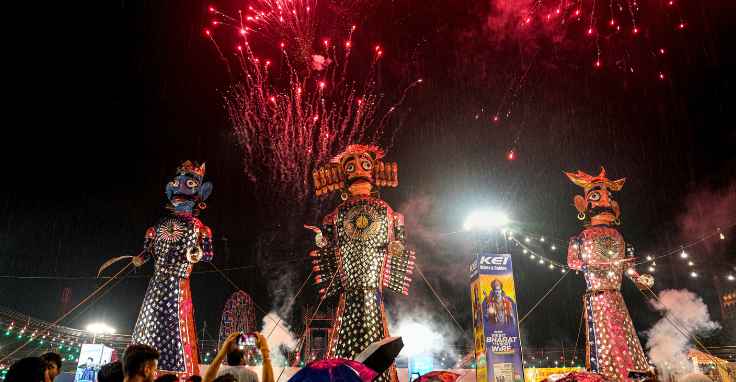

New Delhi, Oct 5: Once upon a time red sherbet flowed, as if blood, from a Ravana effigy. In a different era when the British ruled, their Indian soldiers in costumes re-enacted the battle between the armies of Rama and Ravana, their horses painted with henna, decked in jewellery. This was an older Delhi when Dussehra and Ramlila were very different spectacles from those seen today.
From the Mughal emperor’s ‘jharokha’ overlooking the Yamuna to the cantonments of the East India Company and today’s sprawling Ramlila grounds with giant screens and AI effects, the city over the centuries has found myriad ways of bringing the Ramayana to life.
“When Emperor Shah Jahan shifted the Mughal capital from Agra to Delhi and established Shahjahanabad, Dussehra became one of the Hindu festivals to receive royal patronage. It was celebrated by the emperor’s Hindu soldiers,” historian Rana Safvi told PTI.
According to books describing 19th-century Delhi, the celebrations were visible across the markets and chowks of Shahjahanabad. Huge effigies of Ravana, made of cardboard and paper, were erected for the crowds, with an earthen vessel filled with sherbet placed inside Ravana’s stomach, Safvi said.
Children dressed as Lord Rama would fire arrows at the effigy and, when it was struck, the sherbet would be distributed among the people in earthen cups or kulhads
“The drink was red in colour and represented Ravana’s blood, while drinking it symbolised victory over him. Alongside the spectacle, a large fair was held on the banks of the river, drawing people from far and wide,” Safvi said.
The Ramlila was held on the sandy floodplains between the Yamuna and the Red Fort, allowing the royal family to watch from the ‘jharokhas’, or overhanging enclosed balconies, historians said.
The emperor would reward courtiers and citizens during the Dussehra darbar. By evening, the royal stables became part of the spectacle. The ‘darogha’, or the official in charge of the royal stables, would have horses decorated with henna on their hooves, designs on their foreheads and jewellery.
The horses were then taken to the Red Fort and paraded, where the emperor inspected them and rewarded the grooms responsible for the best-decorated animals, the historian said in her book ‘Shahjahanabad: The Living City of Old Delhi’.
Decorated horses and elephants were also taken to the havelis of nobles, where they too were suitably rewarded.
The Neelkanth bird, or Indian roller, was released in front of the emperor. It was considered a symbol of victory and success according to local traditions. A falcon was also brought to perch on the emperor’s hand, reflecting the Mughal tradition in which the bird symbolised victory and success.
Preparations for Dussehra began nine days earlier, during Navratri. Barley was sown in small boats and, on Dussehra, the sprouts were worn on caps, turbans and ears as an auspicious symbol.
Persian, or Farsi, was the language of the Mughal court and was widely understood, so quatrains from Tulsidas’s Ramayana were recited in that language, Safvi said. People dressed as Rama, Sita, Lakshman and Ravana were also taken around on chariots, with new tableaux presented each day.
One of the scenes played out near Shahji’s pond, close to the Ramlila grounds. When the exile of Rama was enacted, a boatman would ferry Rama, Sita and Lakshman across the pond, which symbolically represented the Ganga.
The pond remained part of the landscape for years before it was filled up after 1947 to make way for Kamla Market.
But Delhi’s Ramlila did not have a single form. Historian Swapna Liddle told PTI that before the 1857 revolt, also recognised as the first campaign for independence from the East India Company, Ramlila was also staged in a very different setting — the East India Company’s cantonment near Wazirabad.
The Company’s soldiers, comprising both Hindus and Muslims, staged a highly realistic recreation of the battle. This was closer to an actual military enactment, with soldiers recreating the battle as part of what could be described as a “soldiers’ Ram Lila”.
Historians added that the traditions associated with Ramlila may have been practised in Delhi long before the 19th century.
Arjun Kumar, president of the Luv Kush Ram Lila Committee, said Ramlila had been a major part of Delhi’s cultural life for centuries. He traced its popularisation to Goswami Tulsidas, whose narration of the Ramayana gradually evolved into tableaux and small theatrical performances.
Delhi now has more than 600 Ramlilas, Kumar said, reflecting how deeply the tradition has become part of the city’s cultural life.
But the way these performances are staged has changed considerably over the years. There was a time when even the casting was different. Female characters were traditionally played by men. The Luv Kush Ram Lila Committee was the first to break with that tradition and introduce women in female roles, Kumar said.
He added that while the way Ramlilas are conducted has changed, the essence has remained the same, as has the story behind them.
And perhaps that is what has allowed Delhi’s Ramlila to survive so many versions of the city itself. (PTI)