
By Dipak Kurmi
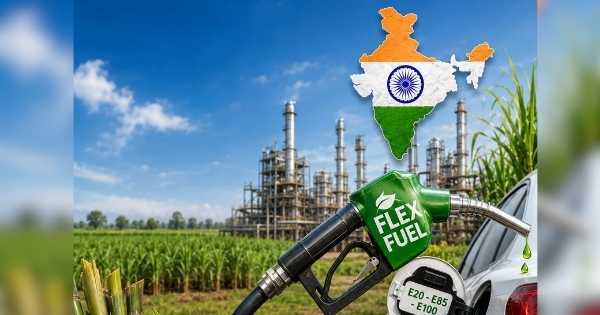
India has conclusively demonstrated its capacity to move with remarkable velocity when implementing its ethanol blending program, but the defining challenge of the current era is whether the nation can execute the next phase of this transition with strategic intelligence. The immediate pitfall lies in the temptation to linger over incremental, halfway stops such as E22, E25, or E27 blending mandates. Instead, the logical, definitive leap forward for the domestic automotive ecosystem is the wholesale adoption of flexible-fuel vehicles. If the objective is to structurally lower reliance on imported crude oil, foster a resilient domestic energy architecture, and build a transportation network capable of scaling seamlessly across a massive geography, flex-fuel represents the cleaner, more durable pathway. The underlying operational logic is fundamentally simple yet powerful. Flex-fuel platforms empower consumers to utilize whatever fuel blend happens to be available locally, whether that is standard E20, high-blend E85, or pure E100. This inherent adaptability is critical in an ecosystem as expansive and logistically uneven as India, where regional supply chains, feedstock availability, and localized infrastructure vary dramatically between states. Furthermore, embracing a unified flexible architecture spares original equipment manufacturers from the repetitive, financially draining burdens of designing, testing, and calibrating separate engine variants for every minor incremental change in ethanol percentages. One robust vehicle platform capable of digesting multiple fuel options yields the true manufacturing and engineering efficiency gain that India requires.
This strategic debate takes on heightened urgency against the backdrop of an increasingly volatile and unpredictable global energy market. Ongoing geopolitical instabilities, particularly recurring crises across West Asia, serve as a stark reminder that India’s transport sector remains dangerously exposed to imported crude oil and the sudden supply shocks or pricing spikes that inevitably follow. In this context, leadership calls to conserve fuel and aggressively curtail import dependence transcend mere political rhetoric; they constitute urgent strategic warnings regarding national sovereignty. Evaluated through this lens of national resilience, ethanol-blended flex-fuel vehicles present an unassailable proposition. They are the practical embodiment of self-reliance, or Atmanirbhar Bharat, because the entire value chain remains firmly anchored within national borders. The fuel is distilled locally, the agricultural feedstock is grown by domestic farmers, and the economic value generated by the energy sector is retained within the domestic economy rather than being exported to oil-producing cartels. During an era where energy security is being actively tested from multiple geopolitical directions, the capacity to insulate a nation’s mobility framework from external vulnerabilities is an extraordinary strategic advantage.
The argument for prioritizing flex-fuel becomes even more compelling when evaluated alongside the prevailing, often oversimplified narrative surrounding the transition to battery electric vehicles. While electric mobility will undoubtedly constitute an important component of India’s long-term transport portfolio, the immediate, mid-term reality of a rapid electric vehicle rollout is fraught with supply-chain complexities. A significant portion of the contemporary electric vehicle manufacturing ecosystem remains deeply reliant on foreign suppliers for critical components, including lithium-ion cells, battery packs, specialized electric motors, and high-strength permanent magnets. To illustrate this systemic vulnerability, an analysis of the market reveals that out of forty-nine electric passenger vehicle models currently available to Indian consumers, a mere six models successfully meet the forty percent local value-addition threshold mandated by the government’s Performance Linked Incentive schemes. Consequently, an aggressive, single-minded push toward total electrification in the near term risks failing to eliminate import dependency altogether. Instead, it threatens to merely shift India’s strategic vulnerability from oil fields in the Middle East to processing hubs in China. This risk was underscored by the recent enforcement of Chinese restrictions on rare-earth magnet exports, an intervention that disrupted the global electric vehicle supply chain just as severely as maritime disruptions in the Strait of Hormuz traditionally threaten internal combustion engines.
To mitigate these interconnected risks, India must champion a diverse and broad-based fuel strategy rather than confining its ambitions to a narrow technological lane. Ethanol and flexible-fuel systems deserve elevated policy priority precisely because they are deeply rooted in Indian agriculture, domestic biomass abundance, and existing industrial manufacturing capabilities. These systems effectively convert agricultural externalities—such as surplus food grains, sugarcane molasses, damaged maize, and non-food agricultural residues—into high-value transport energy. By transforming rural byproducts into fuel, the nation keeps financial resources circulating within its borders, alleviates the structural pressure on its foreign exchange reserves caused by crude imports, and charts a developmental trajectory that is both highly practical and genuinely sovereign. However, transforming flexible-fuel technology from a niche offering into a ubiquitous mass-market reality requires the government to address the valid demands of the automotive industry for concrete fiscal and policy support. For manufacturers to commit the capital necessary to scale production, and for consumers to enthusiastically embrace the technology, the underlying economics must be aligned. This necessitates targeted fiscal interventions, such as a reduced Goods and Services Tax rate for flexible-fuel vehicles, paired with consumer-facing fuel pricing that makes economic sense. Specifically, high-ethanol blends like E85 or E100 must be retail-priced at a level that is meaningfully cheaper than standard petrol—ideally by a margin of at least thirty percent—to offset the slightly lower energy density of ethanol and provide a tangible, financial incentive for the switch. Consumers do not alter their long-term buying behaviors solely out of patriotism; they transition when economics, daily convenience, and widespread fuel availability converge seamlessly.
Recognizing these dynamics, the evolving direction of state policy, as evidenced by recent frameworks from NITI Aayog, marks a highly significant evolution in institutional thinking. For the first time, the policy establishment has formally included biofuel-based vehicles within the comprehensive definition of Zero Emission Vehicles, signaling an understanding that India’s mobility transition will not follow a simplistic, linear path from fossil fuels directly to batteries. The phased sequencing outlined in these strategic roadmaps offers a pragmatic, highly realistic blueprint rather than relying on aspirational slogans. The initial phase appropriately focuses on mitigating immediate urban pollution by systematically phasing out the most polluting legacy diesel commercial vehicles while accelerating the adoption of low-emission alternatives like compressed natural gas, conventional hybrids, and early-stage electric options. The subsequent phase expands the role of biofuels by aggressively scaling flexible-fuel vehicles, introducing high-blend bio-CNG options, and promoting hybrid flex-fuel models in tandem with ongoing electric vehicle adoption. The ultimate phase envisions the mature deployment of a comprehensive Zero Emission Vehicle ecosystem where electric batteries, hydrogen fuel cells, flexible-fuel engines, and compressed biogas systems coexist under segment-specific compliance timelines. This portfolio-based realism is exactly what India requires, as no single technology possesses the silver-bullet capability to power the nation’s massive transit needs. Electric vehicles, advanced hybrids, compressed natural gas, and biogas all hold merit, but flex-fuel demands a central position in the strategic mix because it leverages India’s immediate biomass advantage today, avoiding reliance on distant infrastructure timelines. By converting agricultural surpluses into domestic energy, the policy supports rural livelihoods, fortifies the agrarian economy, and insulates national security. The government must cease viewing flex-fuel as an experimental, secondary branch of the broader ethanol narrative and instead establish it as the primary corridor for internal combustion engines. This requires immediate fiscal parity for flexible-fuel platforms, a transparent and predictable retail pricing mechanism for E85 and E100, and a coordinated market-building strategy that inspires long-term confidence across both industrial manufacturers and the car-buying public. India cannot afford to anchor its geopolitical resilience to halfway solutions; it requires a decisive energy policy capable of sustaining its macroeconomic ambitions, and flex-fuel stands ready to carry that strategic weight.
(the writer can be reached at dipakkurmiglpltd@gmail.com)