
By Dipak Kurmi
The release of the biennial Environmental Performance Index for the year 2026 has once again thrust Indias environmental trajectory into the international spotlight, igniting a fierce debate between global researchers and domestic policymakers. In this latest iteration of the index, compiled by scientists at Yale and Columbia universities, India has landed near the absolute bottom of the global table, ranking 176th out of the 177 countries evaluated. Ahead only of Laos, which occupies the final spot, Indias overall score of 22.46 out of a possible 100 stands in stark, unflattering contrast to table-topper Estonia, which achieved a leading score of 74.79. This dramatic disparity has immediately revived a critical question: is this ranking an objective reflection of a massive domestic environmental crisis, or is it merely the highly distorted output of a structurally biased international measurement system? While New Delhi has historically rejected these poor rankings as unscientific surmises, a detailed examination of both the index’s mechanics and Indias domestic environmental metrics suggests that the truth is highly nuanced, requiring a balanced perspective rather than outright denial.
To evaluate the fairness of the ranking, one must first critically analyze the methodologies employed by the Environmental Performance Index, which have drawn legitimate scientific and diplomatic objections from various emerging economies. The index operates by grading nations on 47 distinct environmental indicators distributed across 12 crucial issue categories, which are subsequently weighed under three primary policy objectives: environmental health, which accounts for 25 percent of the total; ecosystem vitality, which contributes 45 percent; and climate change mitigation, which represents the remaining 30 percent. A major limitation of this system is its tendency to alter indicators and weightings across successive editions, rendering year-on-year comparisons mathematically inconsistent and highly volatile. Furthermore, the index primarily measures current-state environmental performance rather than integrating historical responsibility, a methodological blind spot that penalizes rapidly developing nations that are currently building their industrial infrastructure, while effectively giving a free pass to wealthy Western countries whose historical carbon footprints laid the foundation for modern global warming.
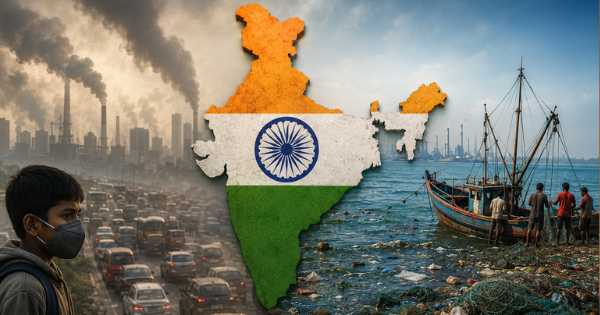
However, while these methodological criticisms are valid, totally dismissing the index as a flawed Western academic construct does not survive closer contact with Indias own domestic environmental data. The lived experience of millions of Indian citizens living in heavily polluted urban centers reveals a grim picture of rising public health crises and ecosystem degradation that cannot be explained away by statistics. Within the policy objective of environmental health, where India ranks 174th out of 177, the country continues to struggle with elevated levels of ambient fine particulate matter, which are directly linked to respiratory diseases, cardiovascular complications, and thousands of premature deaths annually. Over the past decade, monitoring stations have recorded worsening trends in human exposure to toxic air pollutants such as carbon monoxide, nitrogen oxides, and sulfur dioxide. These numbers are not mere academic abstractions formulated in distant ivy league universities; they are tangible, dangerous realities experienced by ordinary citizens during the hazardous smog episodes that regularly blanket major urban zones like New Delhi every winter.
The crisis is equally visible along Indias extensive coastline, where the index evaluates maritime biodiversity and ecological sustainability under the broader objective of ecosystem vitality, in which India ranks 171st globally. The data points to a serious collapse in the practical effectiveness of the countrys marine protected areas, which frequently exist as designated zones on official maps but lack the necessary enforcement to prevent illegal exploitation. Overfishing and uncontrolled commercial trawling have severely depleted native fish stocks, pushing local coastal communities toward targeting species much lower on the marine food chain. This ecological shift, known as fishing down the food web, threatens long-term marine biodiversity and compromises the economic security of millions of traditional fishers who depend on stable marine ecosystems. The degradation of these precious coastal habitats demonstrates that the challenges India faces are not confined to industrial air pollution but extend deep into its vital ecosystems and natural resource reserves.
At the heart of Indias low score lies a deep-seated structural tension between the urgent demands of rapid economic development and the necessity of environmental conservation. As an emerging economic powerhouse, India faces the immense responsibility of lifting hundreds of millions of its citizens out of poverty, a process that requires providing reliable, universal access to modern energy services. Because domestic power generation remains overwhelmingly dependent on cheap, abundant coal, this massive expansion of the national energy grid has inevitably led to a spike in greenhouse gas emissions and severe localized pollution. In terms of climate change policies, where India achieves a comparatively better ranking of 130th, the report acknowledges that the countrys per capita emissions remain remarkably low by international standards. This development-versus-pollution dilemma is a complex policy challenge rather than a simple narrative of environmental neglect, as any sudden, forced reduction in fossil fuel reliance would directly threaten the livelihoods of the countrys most vulnerable populations.
This years edition of the index also highlights the critical importance of less-recognized ecosystems by incorporating grassland conversion as a new indicator for the first time. Grasslands are highly valuable carbon sinks and play an indispensable role in maintaining regional biodiversity, yet they have historically been treated as agricultural wasteland or policy afterthoughts in domestic conservation frameworks. In India, vast tracts of semi-arid grasslands are systematically converted for agricultural expansion, industrial development, or infrastructure projects, severely disrupting local wildlife and releasing stored soil carbon back into the atmosphere. The inclusion of this new metric by the index authors serves as a powerful reminder that comprehensive ecosystem protection cannot stop at the borders of designated national forests. Protecting these open natural ecosystems requires a major shift in land-use policies, demanding that India recognize grasslands as ecologically vital assets that require the same legal protection and restoration efforts as its dense forest reserves.
Despite the overall low placement of the country in the global list, a deeper analysis of the long-term trends reveals some encouraging signs of environmental progress. Over the past ten years, Indias overall index score has registered a positive change of 7.47, indicating that the country is steadily making progress even if the overall scale of its challenges continues to outpace its current efforts. This positive trajectory is notably stronger than that of several other developing and middle-income nations, such as Romania, which recorded a decline of 0.91, and the Dominican Republic, where the environmental performance score fell by 3.04 over the same ten-year period. While total carbon dioxide emissions and other greenhouse gases remain high, the rate of increase has actually begun to slow down, demonstrating that domestic policies aimed at energy efficiency and fuel transition are starting to yield measurable benefits. This slow but steady deceleration of emissions growth suggests that India has the capacity to bend its environmental curve in the coming decades.
To translate this positive momentum into meaningful environmental recovery, India must rapidly implement four critical policy interventions. First, air quality enforcement must be given genuine regulatory teeth by expanding real-time monitoring networks, establishing strict industrial accountability, and accelerating the transition from coal-fired power plants to renewable energy sources, where national pledges must be backed by fast, consistent implementation. Second, marine and coastal governance requires a complete administrative overhaul to ensure that marine protected areas are actively managed and policed rather than existing purely as paper parks. Third, the government must formulate a dedicated national policy for grassland conservation, halting their unchecked conversion and restoring degraded grazing lands to protect key carbon sinks. Fourth, India must invest heavily in building its own transparent, scientifically rigorous domestic environmental data infrastructure. By establishing a credible national database, the country can hold its own institutions accountable while simultaneously contesting international rankings from a position of objective evidence rather than defensive rhetoric.
Ultimately, rejecting an imperfect international index outright only serves to isolate the country and forfeits a valuable opportunity to utilize global benchmarks constructively. Engaging directly with the authors of the index, who have publicly stated that they welcome collaborative scientific dialogue, would allow India to highlight its unique regional challenges and advocate for methodological refinements that better reflect developmental realities. By combining constructive international engagement with a relentless focus on domestic reforms, India can shift the conversation away from defensive arguments about rankings and toward the actual health of its citizens. Whether the government chooses to treat the 2026 index as an alarm worth heeding or merely as a statistical bias to be argued away will ultimately shape the quality of the air, water, and soil inherited by its future generations.
(the writer can be reached at dipakkurmiglpltd@gmail.com)