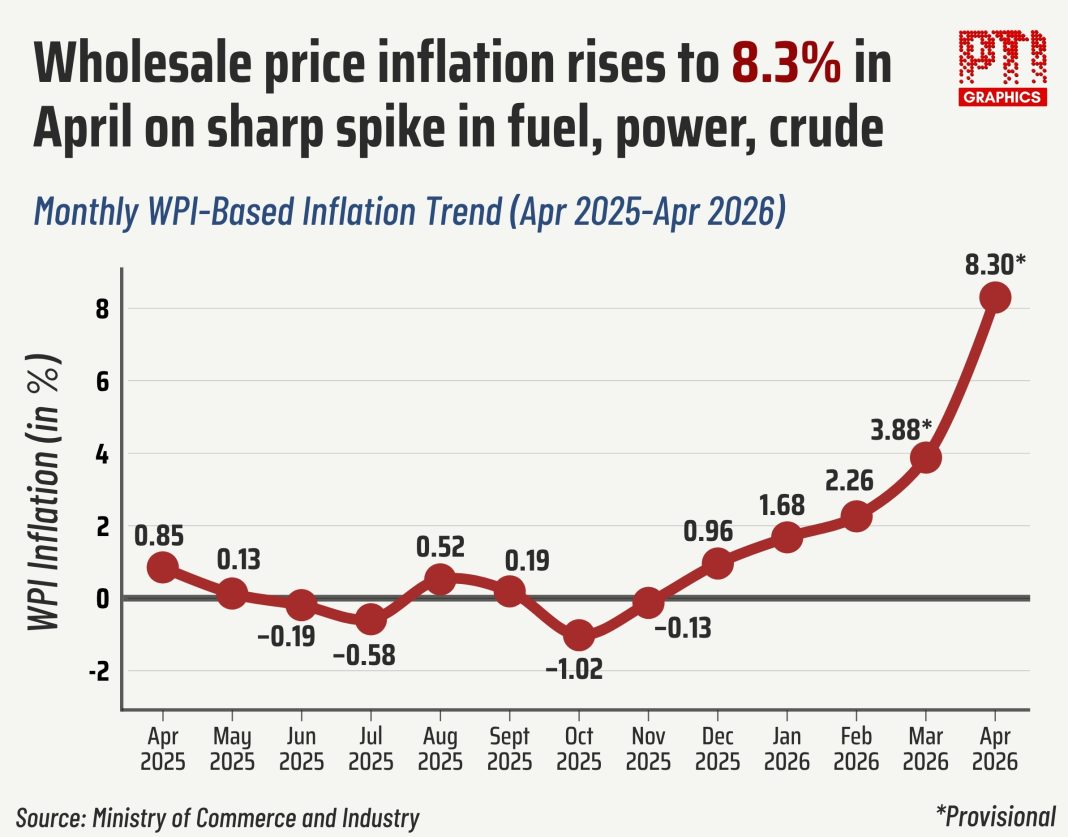

New Delhi, May 14: Wholesale price inflation shot up to a 42-month high of 8.3 per cent on the back of a spike in energy prices that followed the disruptions caused by the West Asia conflict.
Wholesale price index (WPI) inflation was 3.88 per cent in March, while it was 0.85 per cent in April last year.
According to global brokerage Barclays, the sequential increase in WPI inflation was the highest on record in the series.
A sharp increase in global oil prices drove the surge in the headline rate. Core WPI inflation rose to 5 per cent year-on-year, led by higher manufactured prices of metals, chemicals and textiles.
WPI inflation in fuel and power jumped to a 42-month high of 24.71 per cent in April, from 1.05 per cent in March. In crude petroleum, inflation was 88.06 per cent in April, the highest since October 2021.
The West Asia war and the blockade of the Strait of Hormuz has disrupted crude petroleum imports into India. Also, the sharp rise in crude prices globally has made fuel imports costlier.
“Positive rate of inflation in April 2026 is primarily due to an increase in prices of mineral oils, crude petroleum & natural gas, basic metals, other manufacturing and non-food articles, etc,” the ministry said in a statement.
Inflation in food articles was 1.98 per cent in April, compared to 1.90 per cent in March. In non-food articles, inflation rose to 12.18 per cent during April, 11.5 per cent in the previous month, data released by the commerce and industry ministry showed.
In manufactured products, inflation was 4.62 per cent in April, as against 3.39 per cent in the previous month.
In the fuel and power basket, inflation in LPG was 10.92 per cent in April, as against (-) 1.54 per cent in March, while in petrol it was 32.40 per cent, as against 2.50 per cent in the previous month. In high-speed diesel, inflation was 25.19 per cent in April as against 3.26 per cent in March.
Despite a 50 per cent spike in global crude oil prices, the government has so far held fuel pump and household LPG rates stable to shield households from the impact of the retail price rise of petrol, diesel and LPG.
However, prices of commercial LPG cylinders have been raised.
This was evident from the April retail inflation data, which came in at 3.48 per cent.
India Ratings & Research Director Megha Arora said the headline inflation is likely to further rise to 9 per cent in May 2026, due to transmission of high energy prices and via its users, ie. the manufacturing sector.
“WPI is expected to be higher than the CPI on account of higher weight of fuels in the index, as well as delayed transmission of high crude price to consumers, as the government and the oil marketing companies absorbed most of it until now,” Arora said.
The West Asia conflict leading to higher price of crude and its derivatives, as well as the potential El Nino effect continues to pose the upside risk to inflation, Arora added.
Bajaj Broking Fundamental Analyst Shashwat Singh said higher logistics, freight, and commodity prices are now increasingly getting reflected in wholesale inflation, which could eventually pass through to consumer inflation as well.
“The spike also suggests margin pressure for manufacturing and industrial companies if cost increases cannot be fully passed on to consumers,” Singh said.
Barclays further said it expects a Rs 5/litre hike for both petrol and diesel is imminent in May, as crude oil prices remain elevated ” We expect the MPC to look through the supply-shock-driven increase in inflation and persist with a pause for the remainder of 2026,” it added. (PTI)