
By Dipak Kurmi
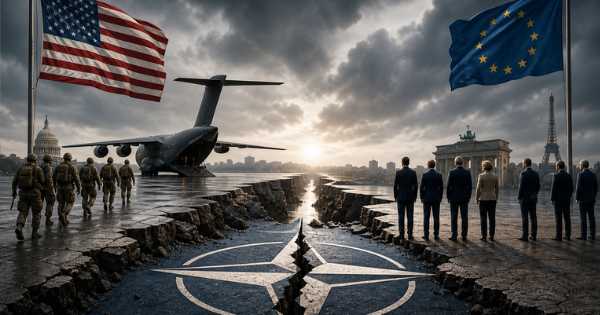
The tectonic plates of global geopolitics are shifting with a violent precision that threatens to dismantle the structures which have defined international stability for over seven decades. Alliances once deemed sacrosanct and unshakable are now exhibiting deep, structural schisms, replaced by a pervasive sense of unease that permeates the halls of power from Washington to Berlin. This erosion of trust has been catalyzed by two defining conflicts: the protracted war in Ukraine and the recent, volatile escalations in West Asia. In the latter, the United States has increasingly opted for unilateral intervention, a move that has sent shockwaves through the North Atlantic Treaty Organisation. NATO, an entity birthed in the freezing climate of the Cold War on April 4, 1949, was originally designed as a bulwark against Soviet expansionism. It established a revolutionary principle of collective defense where an attack on one member was viewed as an attack on all, positioning the United States as the indispensable big brother charged with the strategic safeguarding of its allies. However, the world of 1949 has long since vanished, and the geopolitical realities of 2026 suggest that the bedrock of Western security is undergoing a painful, perhaps irreversible, metamorphosis.
The recent and highly controversial decision by the United States to withdraw 5,000 troops from German soil serves as a visceral manifestation of these deepening fissures. This is far from a routine administrative adjustment of military personnel; it is a symbolic and strategic retreat that signals a departure from the historical US-Europe security compact. Germany has functioned for decades as the logistical and operational nerve center of American military presence on the continent, hosting tens of thousands of troops that acted as a physical deterrent against Eastern aggression. By ordering a drawdown to levels reminiscent of the pre-Ukraine war era, the US is not merely reallocating assets but is effectively signaling a partial disengagement from the immediate security concerns of the European theater. This move has been framed by Washington as a direct response to Europe’s perceived failure to provide adequate support, particularly regarding the security of the Strait of Hormuz, highlighting a growing resentment within American leadership toward allies they view as strategically hesitant or economically self-interested.
The friction is fueled by a fundamental divergence in strategic priorities and political rhetoric. Washington increasingly demands a world view where its allies endorse American military posture without hesitation, yet Europe is no longer content to remain a silent partner in its own defense. The German Chancellor, Friedrich Merz, has emerged as a vocal critic of this unilateralism, condemning the lack of coordination in critical military decisions, such as the recent strikes on Iran. This disconnect illustrates a broader European aspiration for strategic autonomy—a desire to decouple its security from the whims of American domestic politics and to pursue a path of economic pragmatism and diplomatic caution. For Europe, the risk of being dragged into a broader West Asian conflict without a seat at the decision-making table is becoming an unacceptable price for the American security umbrella. This tension suggests that the alliance is no longer a monolith but a collection of states with competing national interests that are becoming increasingly difficult to reconcile.
The implications of this American drawdown are particularly acute for Eastern European nations, which have historically viewed the presence of US boots on the ground as the ultimate guarantee of Article 5. For Poland, the Baltic states, and others sharing borders with an assertive Russia, the specter of a fragmented alliance rekindles deep-seated anxieties about the reliability of collective defense. If the logistical hub of Germany is being hollowed out, the perceived speed and efficacy of a NATO response to potential Russian incursions are called into question. This atmosphere of doubt does not exist in a vacuum; it emboldens rival powers who view Western fragmentation as an opportunity to accelerate the transition toward a multipolar world order. In this emerging landscape, the historical dominance of Western unity can no longer be taken for granted as the primary stabilizing force in global affairs. Instead, we are witnessing the rise of a system where regional powers assert more influence, often at the expense of the cohesive Western front that dominated the post-Cold War era.
Furthermore, the internal political dynamics of the United States have introduced a level of volatility that NATO was never designed to withstand. The vociferous nature of the current administration’s world view demands absolute alignment, often disregarding the nuanced diplomatic ties Europe maintains with Middle Eastern and Asian powers. When Europe seeks to balance its security commitments with a desire to avoid direct military entanglement in West Asia, Washington interprets it as a betrayal of the transatlantic bond. This mutual distrust is creating a vacuum that was previously filled by shared values and common enemies. Without the unifying threat of the USSR, and with the rise of China as a global peer competitor, the original mission of NATO has become blurred. The alliance is struggling to redefine itself in an age where the greatest threats are often economic or cyber-related rather than purely territorial, leading to a mismatch between the military tools of the past and the strategic challenges of the present.
As these trends persist, the very nature of NATO is likely to evolve from a tightly knit security bloc into a loose, interest-based coalition. This redefinition suggests a future where European nations accelerate their efforts to build independent defense capabilities, moving away from a reliance on the American military-industrial complex. Such a shift would require a massive increase in European defense spending and a total overhaul of its internal military integration, tasks that are as much political as they are financial. However, the alternative—remaining tied to a unilateralist United States that may withdraw support at any moment—is becoming increasingly unpalatable for European leaders. The world order is indeed changing, moving toward a state of fluidity where old alliances are being stress-tested to their breaking points. Whether NATO can survive this era of transition depends on its ability to navigate these diverging priorities, but for now, the once-unshakable foundation of the West appears to be resting on shifting sands.
(the writer can be reached at dipakkurmiglpltd@gmail.com)