
By Dipak Kurmi
The anniversary of Operation Sindoor marks a pivotal juncture in India’s long-standing battle against cross-border subversion and internal instability. Launched on May 7, 2025, in direct retaliation to the harrowing Pahalgam terror attack of April 22, the operation was conceived as a paradigm-shifting response to the persistent threat of terror infrastructure nestled within Pakistan-controlled territories. By integrating high-precision kinetic strikes with real-time intelligence and sophisticated surveillance technology, India signaled a departure from strategic restraint toward a more proactive, anticipatory posture. However, a year of retrospection reveals that while Operation Sindoor was a masterclass in tactical execution and a robust display of national resolve, the strategic deterrent it sought to establish remains contested. The adversary has not retreated into passivity; instead, it has adapted, shifting from overt confrontation to a more insidious, covert, and technologically driven campaign designed to circumvent traditional defensive perimeters.
The current geopolitical climate has paradoxically emboldened Pakistan’s security establishment, particularly the Inter-Services Intelligence (ISI). Despite the pressure of previous years, recent infusions of external financial support, including critical assistance from the International Monetary Fund, have provided the Pakistani state with much-needed economic breathing room. This financial stabilization, coupled with a surprising elevation in international diplomatic circles—such as Pakistan’s role as vice-chair of the United Nations Security Council counter-terrorism committee and its mediation efforts between the United States and Iran—has boosted its strategic confidence. This “upbeat mode” in Islamabad has revitalized the aging but persistent doctrine of “bleeding India through a thousand cuts,” ensuring that the proxy war continues unabated. Consequently, Indian intelligence agencies now face a landscape where the threat is not diminishing but is instead mutating into more sophisticated forms that leverage global connectivity and regional instability.
One of the most alarming shifts in this shadow war is the renewed and rigorous focus on urban terrorism, aimed at the psychological heart of the Indian republic. Major metropolitan centers and symbolic landmarks remain the primary targets because of their potential for high media visibility and the resulting societal trauma. The investigation into the 2025 Red Fort blast serves as a sobering case study of this trend, uncovering a sprawling conspiracy that spanned multiple states and involved a complex hierarchy of operatives. These are no longer isolated incidents of localized violence but are rather the results of a well-integrated system of recruitment, funding, and logistical execution. The arrest of over ten individuals in the Red Fort case, including key planners linked to groups like Ansar Ghazwat-ul-Hind, underscores the depth of these networks, proving that the infrastructure of terror has embedded itself far more deeply into the domestic fabric than previously estimated.
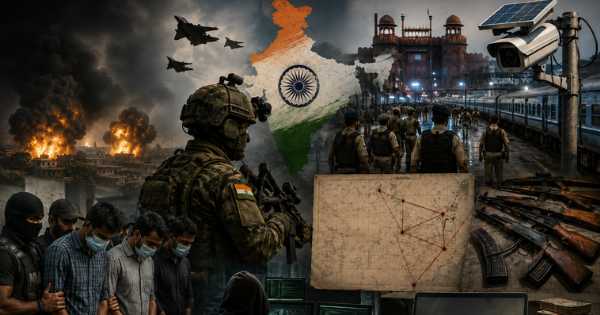
Perhaps the most challenging aspect of this “New Face of Terrorism” is the changing sociological profile of the recruits. We are witnessing the rise of white-collar terrorism, where the foot soldiers are no longer just marginalized individuals but educated professionals, including doctors, engineers, and IT specialists. These actors are exceptionally difficult to detect because they operate within legitimate socioeconomic systems, maintaining low profiles while utilizing their technical expertise to manage encrypted communications, facilitate hawala transactions, or design improvised explosive devices. This shift toward technical proficiency was vividly demonstrated in March 2026, when an espionage plot involving solar-powered CCTV cameras at the Delhi Cantt railway station was dismantled. These discreet devices were intended to provide real-time streaming of military movements to foreign handlers, illustrating how even small, seemingly innocuous technological tools can be weaponized to map national vulnerabilities.
Concurrent with the rise of educated operatives is the growing visibility of ISIS-linked modules across the Indian heartland. Investigations in Maharashtra and Pune have recently unmasked sleeper cells that were meticulously engaged in surveillance, recruitment, and explosives training. These modules represent a decentralization of terror, where global extremist ideologies are localized through digital radicalization. The internet has become a primary theater for this conflict, with encrypted platforms and targeted propaganda used to influence vulnerable youth. Furthermore, the role of women in these networks is expanding, as they are increasingly utilized in logistical and communication roles to exploit societal biases that often overlook women as potential security threats. This multifaceted approach makes the modern terror cell a hydra-like entity, where the removal of one head does not necessarily neutralize the entire organism.
The logistical backbone of these operations is further strengthened by a burgeoning nexus of illegal arms trafficking and the exploitation of legitimate business platforms. The seizure of AK-47 rifles in Muzaffarpur highlighted an organized supply chain with direct cross-border links, bridging the gap between external sponsors and domestic executors. Even more concerning is the emergence of “corporate jihad,” where businesses are used as fronts for extremist activities. A recent case involving a BPO in Nashik revealed how legitimate corporate entities could be used to channel illicit funds and provide operational cover for operatives. By embedding themselves within the service sector, terror networks gain access to financial systems and communication infrastructures that are traditionally outside the primary focus of counter-terrorism agencies, necessitating a much broader and more holistic approach to national security.
Beyond the immediate threat of blasts and bullets, there is a concerted effort to revive dormant internal fault lines, specifically the Khalistani issue. Recent incidents, such as the explosion at a BJP office in Chandigarh and the blast outside the BSF headquarters in Jalandhar, indicate an attempt to create multiple pressure points within India’s borders. These activities are bolstered by sophisticated digital propaganda campaigns designed to deepen communal divisions and shape public perception against the state. By fueling internal discord, the ISI and its proxies hope to stretch India’s internal security resources thin, creating a state of perpetual agitation. This strategy recognizes that the most effective way to weaken a rising power is to ensure its attention is constantly diverted toward managing domestic crises rather than projecting influence externally.
To counter this evolving threat, India must transition from a reactive security model to an adaptive and integrated internal security framework. The lessons of Operation Sindoor must be institutionalized through better inter-agency coordination and the implementation of real-time intelligence-sharing protocols. Quick-response systems, exemplified by the PRAHAAR-type frameworks, are essential for neutralizing threats the moment they materialize. However, the kinetic response is only one part of the solution. The state must also invest heavily in counter-narratives to combat digital radicalization. Educating the youth about the dangers of misinformation and introducing basic internal security awareness into the school curriculum can help build a more resilient and alert society. Addressing the root causes of alienation through inclusive development and social harmony is the only way to ensure that extremist ideologies find no fertile ground in which to take root.
The fight against modern terrorism is as much about technology and ideology as it is about boots on the ground. The transition toward hybrid terrorism—where external aggression and internal subversion are inextricably linked—requires constant vigilance and a refusal to succumb to complacency. While Operation Sindoor proved India’s capability to strike back, the emerging modules and sophisticated surveillance plots discovered in 2026 remind us that the adversary is constantly learning. The threat is no longer distant; it is networked, internal, and shifting its methods daily. As India continues its ascent on the global stage, its internal security apparatus must remain one step ahead of those who seek to use the tools of the modern world to dismantle it. Only through a combination of technological superiority, social cohesion, and unwavering resolve can the nation hope to secure its future against the ever-changing face of global and domestic terror.
(the writer can be reached at dipakkurmiglpltd@gmail.com)