
By Dipak Kurmi
The landslide victory of the Bharatiya Janata Party in the 2026 Assam Legislative Assembly elections represents far more than a fleeting political trend or a successful electoral cycle. It stands as the definitive maturation of a sophisticated political philosophy that has effectively re-engineered the state’s socio-political fabric. This triumph was not accidental but the result of a meticulously planned strategy that bridged the gap between governance and grassroots engagement. While opposition entities often remained dormant until the cusp of the election, the ruling party maintained a relentless, year-round organizational presence that fortified its foundations at the booth level. By the time the first ballot was cast, the collective efforts of the opposition to forge alliances or launch negative narratives were rendered ineffective against a wall of systematic achievement. This victory serves as a case study in how a political organization can transcend traditional power-seeking to become a permanent fixture in the public consciousness through the synchronization of leadership, policy implementation, and cultural resonance.
At the epicenter of this political juggernaut is the extraordinary leadership and unique working style of Chief Minister Dr. Himanta Biswa Sarma. He has redefined the parameters of modern Assamese politics by shifting the focus from mere power acquisition to a continuous, deeply personal commitment to the citizenry. Known for maintaining a grueling schedule of eighteen to twenty hours of public service daily, Dr. Sarma has cultivated an intuitive understanding of the public pulse that few of his contemporaries can match. His governance model is characterized by an obsessive attention to detail, where he monitors the minutiae of every department with surgical precision. This tireless energy has acted as a catalyst, transforming a once-sluggish administrative machinery into a dynamic and accountable system. Consequently, the common man perceives a level of transparency and efficiency in government services that was previously unimaginable. On the electoral stage, his aggressive yet intellectually grounded oratory bridges generational divides, effectively dismantling opposition critiques with data-driven rebuttals that resonate with both the youth and the elderly.
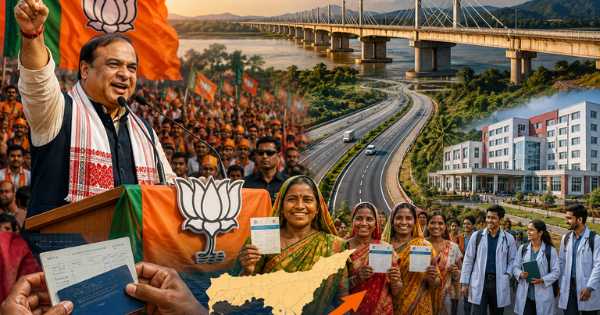
A cornerstone of this political stability is the ingenious implementation of beneficiary-centric politics, which has bypassed traditional middlemen to deliver state benefits directly to the people. This direct-to-consumer model of governance has sparked a silent social revolution across the rural landscapes of Assam. The Orunodoi scheme, in particular, has emerged as a transformative force by providing a consistent financial lifeline to millions of underprivileged women. By ensuring a fixed monthly deposit directly into their bank accounts, the government has not only offered financial relief but has also restored a sense of dignity and autonomy to the female electorate. This vast demographic of beneficiaries has evolved into a reliable and loyal support base that transcends traditional caste and religious boundaries. Furthermore, initiatives like the Lakhpati Baideu scheme have empowered women toward self-reliance, fundamentally altering the rural economic landscape. Despite opposition critiques labeling these measures as mere electoral tactics, for a family struggling with poverty, these regular financial interventions constitute a tangible bond of loyalty toward the state.
The physical transformation of Assam’s infrastructure under this administration has provided a visible and undeniable testament to its developmental agenda. The past decade has witnessed an unprecedented acceleration in the construction of mega-bridges, flyovers, and high-speed national highways, creating a visual narrative of progress that is difficult to ignore. New bridges over the Brahmaputra have done more than facilitate transport; they have bridged emotional and geographical divides between disparate regions of the state. From the urban sprawl of Guwahati to the remotest district headquarters, the presence of modern infrastructure has instilled a sense of pride and security among the voters. The revolutionary expansion of medical education, marked by the establishment of medical colleges in nearly every district, has brought specialized healthcare to the doorsteps of the rural populace. When citizens witness these projects transitioning from blueprints to reality, it fosters a deep-seated belief that the government delivers on its promises. This tangible evidence of work functioned as a protective shield during the election, rendering abstract opposition rhetoric largely irrelevant to a population seeing progress with their own eyes.
The organizational prowess of the BJP, functioning as a highly disciplined and scientific machine, provides the structural backbone for these electoral successes. The seamless coordination between the party and the Rashtriya Swayamsevak Sangh provides an ideological and logistical depth that is unmatched in the region. Their strategy is not top-down but starts at the micro-level with innovative concepts like the Pristha Pramukh, which ensures that every voter has a personal point of contact within the party hierarchy. This ensures that party workers remain active 365 days a year, allowing them to gauge public sentiment and address local grievances long before an election begins. In stark contrast, the opposition remains fragmented and structurally weak, often struggling to maintain internal cohesion. The BJP’s ability to craft bespoke strategies for individual constituencies and reconcile internal dissent demonstrates a level of political sophistication that is now a subject of academic study. In 2026, this scientific approach to booth management ensured that the government’s message reached every household, leaving the opposition’s traditional campaigning methods in the shadows.
Identity politics and the protection of indigenous rights have also been masterfully integrated into the ruling party’s narrative. In a state where demographic shifts are a sensitive issue, the government has positioned itself as the sole guardian of the Jaat-Maati-Bheti (Nationality, Land, and Hearth). The Chief Minister’s firm stance against illegal encroachment and his vocal opposition to communal politics have resonated deeply with the indigenous Hindu and Muslim populations alike. The liberation of Sattra lands from illegal occupiers and the implementation of legal safeguards for indigenous land rights have created a sense of security among the native population. While the opposition, particularly the Congress, often appeared hesitant or ambiguous on these sensitive issues, the BJP embraced them as a central pillar of its identity. The 2026 results confirm that the Assamese electorate prioritizes the protection of their historical identity and cultural heritage alongside economic development. By projecting itself as the ultimate savior of indigenous interests, the party has successfully harnessed the emotive power of regional nationalism.
The catastrophic failure of the opposition to present a viable alternative significantly lowered the threshold for the ruling party’s victory. Historic parties like the Congress are currently mired in a crisis of leadership and a lack of clear ideological direction, which has alienated the common voter. Their campaign remained largely reactionary, focusing on the blind criticism of the government rather than offering a constructive roadmap for the future of Assam. The emergence of new regional parties further diluted the anti-incumbency vote, as they failed to unite under a single umbrella, thereby gifting a mathematical advantage to the treasury benches. Meanwhile, the BJP maintained robust alliances with its partners, demonstrating a maturity in coalition politics that ensured a unified front. This lack of a coherent and credible opposition allowed the BJP to dominate the narrative, making the election feel like a one-sided contest. Until the opposition can produce a leadership that is both grounded in local realities and capable of matching the government’s work culture, the current political hegemony is unlikely to be challenged.
The administration has also placed significant emphasis on the spiritual and cultural revitalization of the state, integrating heritage into the modern political discourse. Efforts to project the ideals of Mahapurush Srimanta Sankardeva on a global stage and the international celebration of the heroism of Bir Lachit Barphukan have struck a deep chord with the Assamese psyche. The substantial financial grants provided for the renovation of ancient temples and Sattras have reinforced the image of the party as a custodian of the state’s spiritual legacy. Every government function now reflects Assamese traditions, ensuring that the indigenous culture is not just preserved but celebrated with state patronage. This cultural politics has created a moral alignment between the party and the people, where the BJP is seen as more than a political entity; it is viewed as a protector of the Assamese way of life. This blend of modern progressivism and traditionalist preservation proved to be a potent combination in the 2026 elections, appealing to both the aspirational youth and the culturally conscious elder generation.
Finally, the success of the ruling party can be attributed to a scientific understanding of collective psychology and the strategic use of communication technology. The government realized early on that in an era of rapid information flow, the mere execution of work is insufficient; that work must be marketed effectively to reach the last person in the queue. Through a sophisticated use of social media and digital platforms, the success stories of various schemes were disseminated into every corner of the state. This created a continuous feedback loop between the government and the governed, making politics a vibrant and interactive process rather than a five-yearly ritual. The 2026 victory is the culmination of this long-term investment in communication, organization, and delivery. It marks a golden chapter in the political history of Assam, where a new equation of development and nationalism has been established. This mandate is a reflection of a society that values stability, results, and a strong sense of self-respect, ensuring that the current trajectory of governance will remain a benchmark for years to come.
(the writer can be reached at dipakkurmiglpltd@gmail.com)