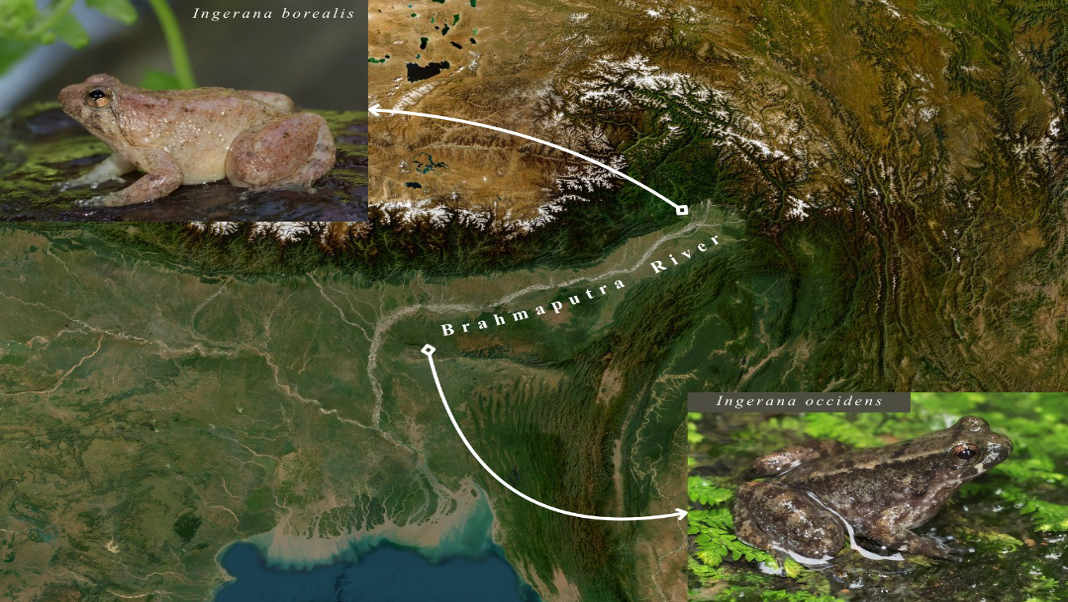

Research shows the Brahmaputra acted as a natural evolutionary barrier between Meghalaya and Arunachal frog populations.
ROOPAK GOSWAMI
Shillong, May 10: A quiet forest stream in Meghalaya has led to a significant scientific discovery, with researchers identifying a new species of frog from the Khasi and Garo Hills, according to a study published in the Journal of Natural History.
The finding not only adds a new species to science but also reshapes understanding of biodiversity in Northeast India.
The study shows that what was long considered a single species—Ingerana borealis—is actually two distinct species separated by the Brahmaputra River, a major biogeographic barrier.
Frogs found south of the river in Meghalaya differ significantly from those in Arunachal Pradesh. Based on detailed morphological and genetic analysis, the Meghalaya population has now been described as a new species, Ingerana occidens, by researcher R.S. Naveen from School of Environment and Science, Griffith University, Brisbane, Australia.
The naming of the two species reflects their geography. Ingerana borealis derives its name from the Latin word for “north”, referring to its distribution in regions north of the Brahmaputra.
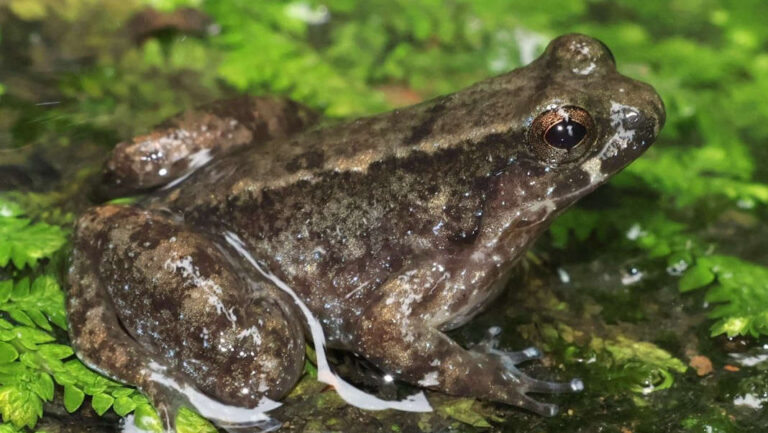
The newly described Meghalaya species, Ingerana occidens, comes from the Latin word for “west”, marking its range in the westernmost part of the genus’s distribution. Researchers have also suggested the common name “western trickle frog”, inspired by its streamside habitat.
The new species has been recorded across multiple locations in Meghalaya, including South Garo Hills and East Khasi Hills, where it inhabits canopy-covered forest streams.
Active mostly after dusk, the frogs are often seen on rocks and leaf litter along streams. The study notes that the species is locally abundant, despite having gone unnoticed in scientific records until now.
Measuring just 2–2.6 cm, the frog blends easily into its surroundings with brown to reddish tones. But its discovery carries larger implications.
The research highlights how the Brahmaputra River acts as a natural barrier, shaping species evolution in the region.
It also suggests that more species in the Northeast may still be misidentified or undiscovered, especially in biodiversity-rich landscapes like Meghalaya.
The study notes that earlier records grouped both frog populations under a single species. With the new classification, their actual distribution ranges are now more restricted, which could influence future conservation assessments.
For Meghalaya, the discovery reinforces its importance as a biodiversity hotspot—where even familiar species can still surprise science.