
By Dr. Bijoy A. Sangma
Asia Pacific is facing a difficult combination of conflict, displacement, natural disasters, economic insecurity and social disruption. Myanmar remains one of the region’s most serious humanitarian crises, while communities across South and Southeast Asia and the Pacific continue to face floods, cyclones, earthquakes and other disasters that destroy homes, interrupt livelihoods and place additional pressure on vulnerable families.
Behind these large problems are individual lives: a family that loses its home, a child whose education is interrupted, a small business that disappears overnight, a community forced to move, or a local leader struggling to respond with limited resources. Statistics help explain the scale of a crisis, but they rarely convey what it means for people to rebuild their lives after everything familiar has been disrupted.
The usual question in a crisis is what governments and international agencies can do. That question is necessary, but it is not sufficient. Civil society organisations, local institutions, community groups and faith communities also have a role, particularly when they already have trusted relationships and a sustained presence among the people affected.
This is the wider context in which Baptist churches across Asia and the Pacific will observe Asia Pacific Baptist Federation (APBF) Sunday on 16 August 2026. It also provides an opportunity to consider what a regional faith network can contribute to societies facing difficult circumstances.
How Regional Networks Matter
The Asia Pacific Baptist Federation or APBF is a regional organisation of the Baptist World Alliance. It connects Baptist conventions, associations and churches across Asia and the Pacific and works in areas including mission, leadership development, theological education, youth engagement, humanitarian response, community development and holistic transformation. APBF’s network spans approximately 26 countries, 73 conventions, 40,000 churches and around 7 million Baptist believers.
For more than three decades, I have been associated with APBF, serving in various capacities including Editor, Communications Director (Chair), APBAid, Congress Director and, eventually, Vice President. That long association has provided a first-hand view of how relationships across countries can develop into meaningful partnerships and, when properly organised, translate into practical action.
The numbers establish the scale of the network, but they do not by themselves establish its value. The more important question is what happens when relationships across countries become practical cooperation.
The challenges facing a Baptist church in Northeast India may differ from those facing a church in Indonesia, Nepal, Bangladesh, Myanmar, Taiwan, Malaysia, South Korea or the Pacific. Yet many confront familiar questions around leadership, youth migration, disaster preparedness, limited resources, education and changing communities.
One church may have experienced leaders but limited resources, while another has resources but needs local knowledge. One convention may have developed useful approaches to theological education, while another has experience in community-based disaster response. A regional network provides a way for such experience to be shared rather than developed separately in every place.
APBF puts this approach into practice through mission consultations, church mobilisation, leadership mentoring, vision visits and community transformation initiatives. Its work places emphasis on strengthening local leadership and enabling conventions and churches to build and sustain their own capacity rather than depend on outside intervention.
There is a wider development lesson here. Communities become stronger when they participate in shaping their own responses. Institutions become more sustainable when local leaders are equipped rather than bypassed. Partnerships become more useful when they transfer knowledge, build confidence and leave behind greater capacity.
The public responsibility of faith
Faith communities occupy a distinctive position in many Asian societies. They are often deeply rooted in local communities, with relationships, volunteers, leaders and institutions that remain present long after an individual project has ended.
That presence carries responsibility. When a cyclone destroys homes, the immediate needs include food, shelter and support for rebuilding livelihoods. When conflict displaces families, safety and dignity become urgent concerns. Young people facing uncertainty need education, mentoring and opportunities, while divided communities need patient efforts to rebuild trust.
For Christians, compassion, service, reconciliation, justice and human dignity are rooted in faith. In a plural society such as India, such commitments acquire public meaning when they are expressed with respect for the dignity, freedom and beliefs of every person.
Faith-based service should complement, rather than replace, government and professional humanitarian institutions. It should be offered with integrity, transparency and respect for voluntary participation. Its credibility should ultimately come from the quality of the service and the difference it makes in people’s lives.
Across the diverse societies of Asia Pacific, this responsibility is particularly important. Christian organisations can contribute constructively to public life when they respect people of every faith and none, comply with applicable laws and cooperate with other institutions wherever there is a shared commitment to human welfare.
From networks to action
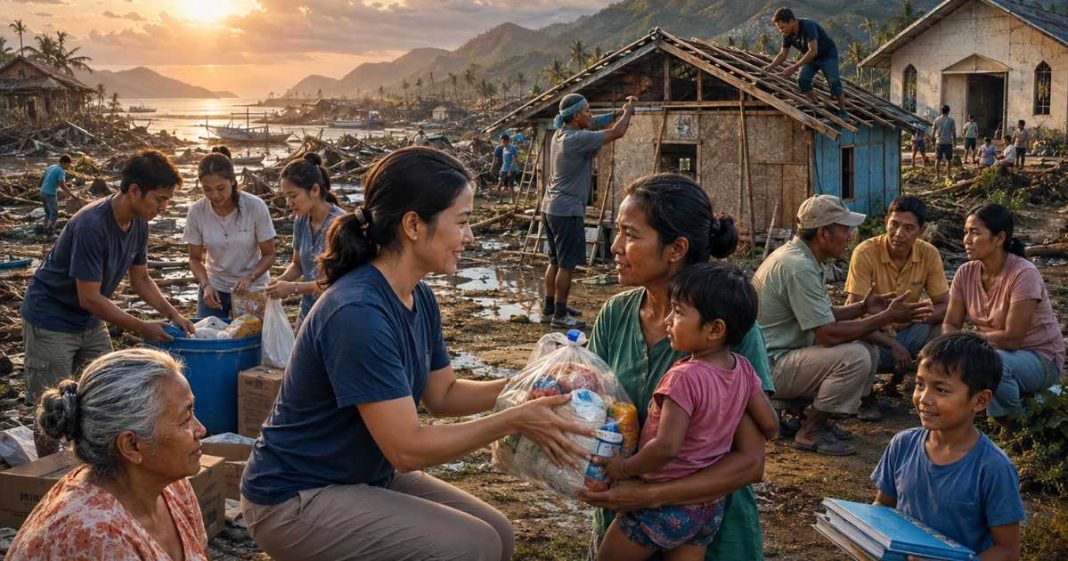
APBF’s humanitarian work offers a practical example. APBAid has worked in emergency response, recovery, development, capacity building and community resilience. Its work has included a response to communities affected by Cyclone Ditwah, where 90 families received assistance with food security, hygiene and essential household items through cooperation involving churches, local leaders and other partners.
The significance lies not only in the number of families assisted, but in the cooperation behind the response. A regional network, Baptist bodies, local churches, community leaders and ministry partners brought together different forms of knowledge and capacity.
APBF’s work in South Asia also includes Church and Community Process initiatives that seek to address practical community needs alongside spiritual development. Reports from these initiatives emphasise strong partnerships, local ownership and churches serving the communities.
The distinction matters. Doing something for a community is different from working with a community. The latter requires greater trust and local participation, but it can also leave behind stronger institutions and greater confidence within the community itself.
Knowing the limits
The crisis in Myanmar demonstrates why such partnerships must also be understood within their limits. Conflict, displacement, economic hardship and natural disasters have created needs that no church or faith-based organisation can address on its own.
Faith communities cannot resolve political conflicts, replace governments or substitute for professional humanitarian agencies. Problems of this scale require political decisions, humanitarian action, economic measures, international cooperation and local leadership.
Their contribution lies elsewhere. They can remain present in communities, listen to affected people, support vulnerable families and strengthen local leadership. Their networks can also help connect local initiatives with wider sources of knowledge, resources and experience. Where interests and responsibilities overlap, cooperation with governments, humanitarian agencies, civil society organisations and other faith communities can make that response more effective.
The measure of such work should be its contribution to people and communities, rather than the size or influence of the organisation involved.
What do institutions do with what they have?
The APBF experience raises a broader question of institutional responsibility. What do organisations do with the resources, relationships, knowledge and influence they possess? Do these assets remain within institutional boundaries, or are they used to strengthen the communities around them?
The question applies to churches, religious institutions, civil society organisations, professional networks and other institutions involved in public life. Training a young leader can strengthen a congregation. Professional expertise can help a community prepare for disaster. A congregation’s local relationships can support families during difficult times. A regional network can connect people who would otherwise never meet.
Such contributions may never become major news stories. Their effects can nevertheless extend well beyond the original intervention.
APBF’s vision speaks of renewed persons, healthy households, thriving churches and flourishing communities. The vision is rooted in its Christian understanding of mission, but it also raises a wider public question: whether people and communities are becoming stronger, healthier and better equipped.
That is a reasonable question for any institution.
Beyond APBF Sunday
APBF is one regional network within a much larger landscape of governments, civil society organisations, humanitarian agencies, local communities and faith traditions. It cannot do everything, and it does not need to. Its opportunity lies in connecting people, strengthening local capacity, supporting churches and leaders, mobilising resources, encouraging cooperation and contributing to community wellbeing.
The wider Christian community faces the same test. Its public credibility will depend less on the size of its institutions than on the quality of its presence and the value it brings to the communities in which it serves.
A family may recover more quickly because a local institution stood with it after a disaster. A community may become better prepared because knowledge and resources were shared. A young leader may gain the confidence and skills needed to serve others. Relationships between communities may become stronger when people choose cooperation over isolation.
These are modest outcomes compared with the scale of the region’s problems, but they are meaningful. Public life is shaped as much by such accumulated contributions as by large programmes and major institutions.
Perhaps that is the question worth carrying beyond APBF Sunday: not simply what institutions believe, but what those beliefs enable them to do for the people and communities around them.
In a region facing uncertainty and repeated crises, that is a responsibility worth taking seriously.
(The author is a former Vice President of APBF and currently serves as Global Chair of the Baptist World Alliance’s Commission on Human Rights, Peacebuilding and Reconciliation. The views expressed are his own.)