
1,077.1 mm of rain against average 2,695.3 mm during June-September
Shillong, Oct 2: Meghalaya recorded a 60% rainfall deficit during the 2026 southwest monsoon, receiving just 1,077.1 mm of rain against the seasonal normal of 2,695.3 mm, according to the India Meteorological Department (IMD).
The deficit was recorded during the June-September monsoon season, with the southwest monsoon advancing over Meghalaya on June 9.
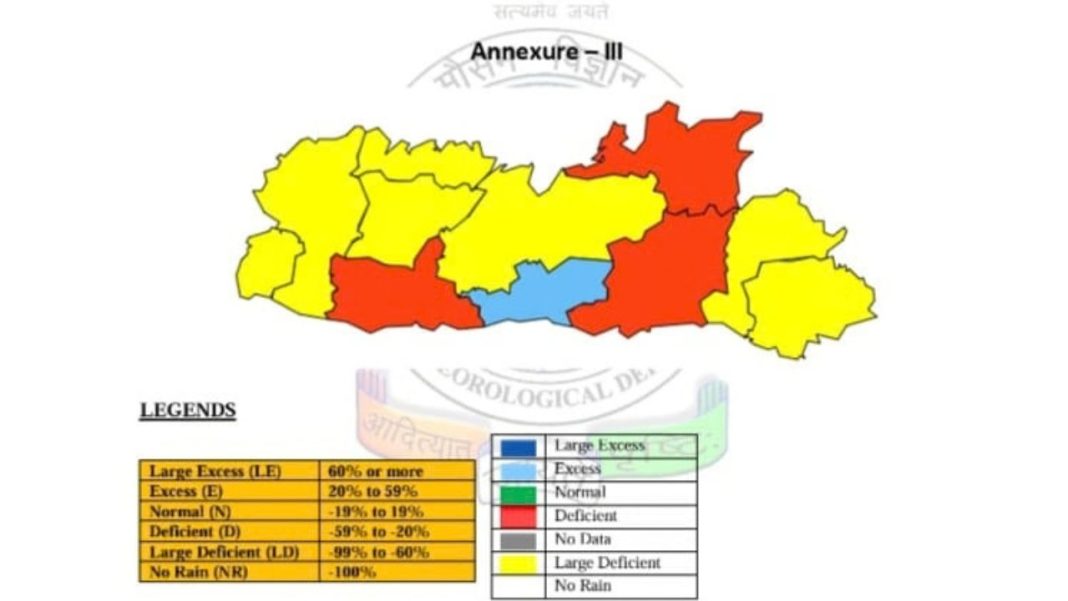
The rainfall shortage was widespread across the state. Of the 11 districts for which data were available, seven recorded large deficient rainfall, three recorded deficient rainfall and only South West Khasi Hills received excess rainfall.
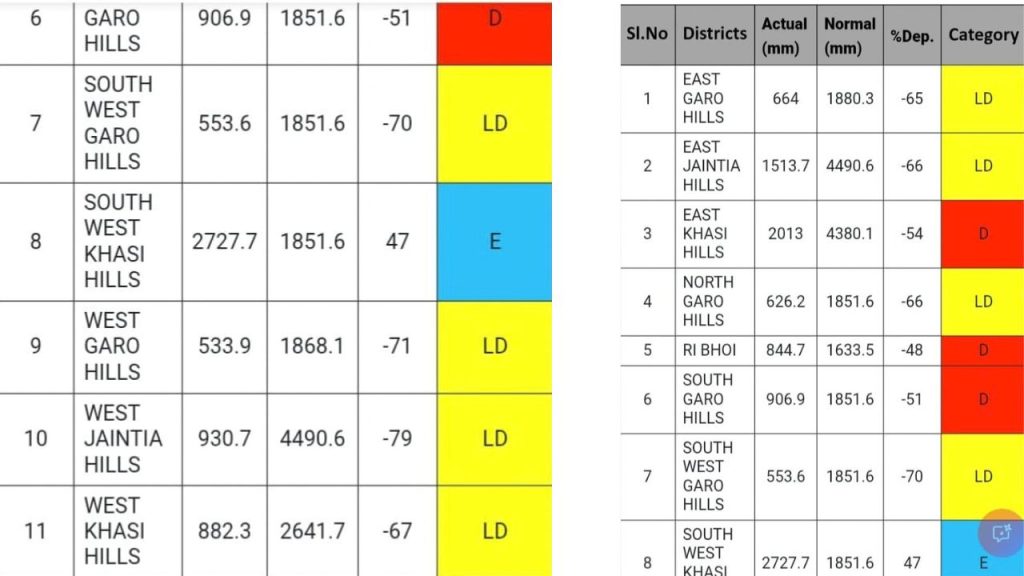
West Jaintia Hills recorded the highest deficit at 79%, followed by West Garo Hills at 71% and South West Garo Hills at 70%. East Jaintia Hills and North Garo Hills each recorded a 66% deficit, while West Khasi Hills recorded a 67% shortfall.
Among the districts, South West Khasi Hills was the only one to record excess rainfall, receiving 2,727.7 mm against a normal of 1,851.6 mm, a surplus of 47%.
East Khasi Hills, Ri Bhoi and South Garo Hills recorded deficient rainfall at 54%, 48% and 51% below normal, respectively.
The station-wise data show a similar pattern at several locations. Sohra received 5,277.2 mm, about 36% below its normal of 8,301.1 mm, while Mawsynram recorded 6,169.1 mm against a normal of 9,338.4 mm, a 34% deficit.
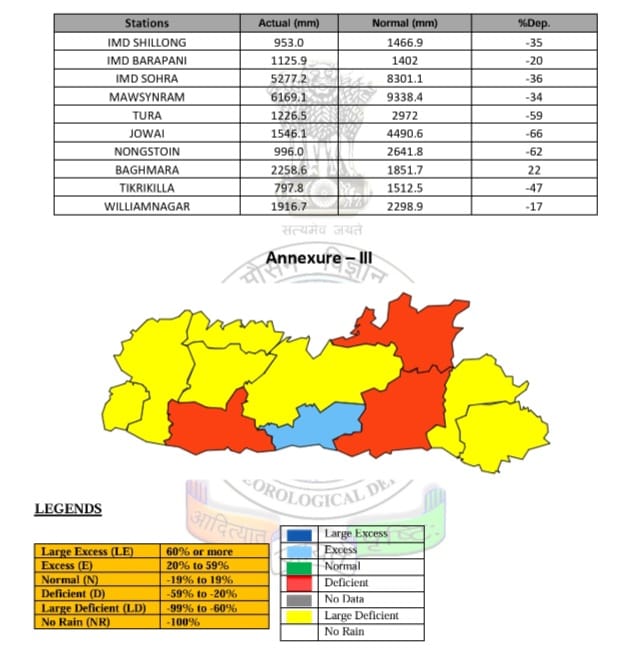
Nongstoin recorded a 62% rainfall deficit, receiving 996 mm against a normal of 2,641.8 mm. Jowai recorded a 66% deficit, while Tura was 59% below normal.
In contrast, Baghmara received 2,258.6 mm, 22% above its normal rainfall.
The IMD classifies rainfall deficits of 60% to 99% as “large deficient”, while a deficit of 20% to 59% is classified as “deficient”.
The figures underline the unusually uneven distribution of monsoon rainfall across Meghalaya this year, with several districts receiving substantially less rain than their seasonal norms.