
By Satyabrat Borah
The sun rises today on a world that feels a little smaller and a lot more connected as we stand on the precipice of a journey that has lived only in history books and fuzzy black and white film for over five decades. Tomorrow, April 1, 2026, the silence of the lunar distance will finally be broken by the voices of four explorers who carry the weight of our collective curiosity. This is the Artemis II mission, a bold step that transforms the moon from a distant light in the sky back into a destination for human footprints. It is a moment where the past and the future collide in a spectacular display of engineering and human spirit. We are not just sending a machine into the void. We are sending ourselves, represented by four individuals who embody the very best of what we can achieve when we decide to look upward and push against the boundaries of our own limitations.
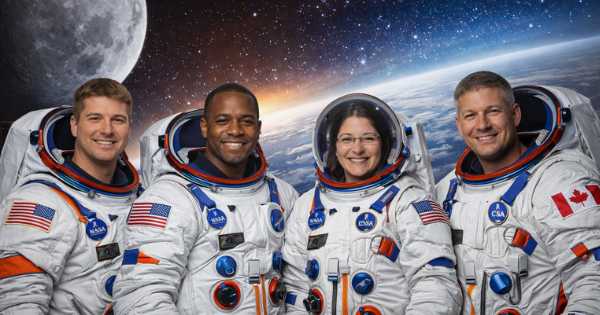
The crew of the Orion spacecraft brings together a wealth of experience that is as diverse as it is deep. Leading the way as Commander is Reid Wiseman, a man whose life has been defined by the cockpit and the stars. A Captain in the United States Navy, Wiseman has spent his career navigating the complexities of high stakes flight. His time on the International Space Station during Expedition 41 proved his ability to thrive in the harsh environment of space, where he spent 165 days living and working in a metal tube orbiting our planet. He was not just a passenger there. He was a scientist conducting hundreds of experiments that paved the way for the very mission he now leads. Having served as the Chief of the Astronaut Office, he understands the inner workings of NASA better than almost anyone, making him the ideal steady hand to guide this first crewed venture into the lunar neighborhood since the 1970s. His leadership is the foundation upon which the success of this mission rests, ensuring that every valve, every sensor, and every heartbeat on Orion is monitored with absolute precision.
Sitting beside him in the pilot’s seat is Victor Glover, another Navy Captain whose resume reads like a tribute to excellence. Glover is a pilot’s pilot, with thousands of hours in the air and the grit that comes from flying combat missions. He already etched his name into the records of history when he piloted the first operational commercial crew flight to the space station with SpaceX. During his half year in orbit, he stepped outside the station for four spacewalks, proving his physical and mental toughness in the vacuum of space. Now, he steps into a new role as the first person of color to leave the immediate vicinity of Earth. His task is critical. He will be the one at the controls during manual piloting trials, testing how Orion handles when a human touch is required in the deep cold of space. His technical skill is a vital safety net for the mission, providing the manual dexterity needed to ensure the spacecraft behaves exactly as it should when millions of miles from home.
Then we have Christina Koch, an electrical engineer who has already redefined what humans can endure in space. Koch holds the world record for the longest single spaceflight by a woman, a staggering 328 days. She was part of the first all-female spacewalks, showing the world that the frontier of space belongs to everyone. Her background is not just in the stars but in the most remote corners of our own planet, from the ice of Antarctica to the reaches of Greenland. This experience in isolated, high pressure environments makes her the perfect Mission Specialist to monitor the life support systems of Orion. As the first woman to travel toward the moon, she carries the dreams of every young girl who has ever looked at the night sky and wondered if she could go there too. Her job is to ensure the air the crew breathes and the water they drink remains stable throughout the ten day journey, a task that is the very definition of essential.
Joining this American trio is Jeremy Hansen, a Colonel in the Royal Canadian Air Force who represents the power of international friendship. While this is his first flight into space, he is far from a novice. He has been a leader within the astronaut corps for years, acting as a bridge between different space agencies and guiding new candidates through the rigors of training. His inclusion marks a massive milestone, as he becomes the first person from a nation other than the United States to journey into deep space. He represents the global reach of the Artemis program and the idea that the moon is a place for all of humanity. He will be focused on the scientific goals of the mission and the survival systems that will one day allow humans to stay on the lunar surface for long periods. His presence on the crew is a reminder that when we go to the moon this time, we go together.
Inside the Orion capsule, tucked away in the Official Flight Kit, are items that tell the story of where we have been and where we are going. These are not just trinkets. They are symbols of a continuity that spans generations. One of the most moving pieces is a small square of muslin fabric from the original Wright Flyer. It is a piece of the first airplane to ever take flight on Earth, a humble scrap of cloth that started the era of aviation. By carrying it to the moon, the crew connects the first wobbling flight at Kitty Hawk to the roaring engines of the SLS rocket. It is a reminder of how far we can go in just over a century of trying.
Alongside this piece of history is a legacy American flag that has seen more of the space age than most people. It flew on the very first shuttle mission and the very last one, and it was also there when private companies began taking humans to the station. Now, it heads toward the moon, a silent witness to the evolving nature of our journey into the stars. There is also a flag originally intended for Apollo 18, a mission that was cancelled decades ago. By bringing it now, the Artemis crew is finishing a story that was left incomplete, bridging the gap between the golden age of Apollo and this new era of sustainable exploration.
The kit also contains a photo negative from Ranger 7, which gave us our first close up look at the moon in 1964. Back then, the images were a revelation, a grainy look at a world we barely understood. Now, the crew will see that same surface with their own eyes in high definition. Finally, there is soil from the various NASA centers that are home to the Moon Trees. These trees grew from seeds that orbited the moon during the Apollo years, and they represent the living connection between our planet and the lunar surface. Bringing this soil back toward the moon is a poetic way of saying that we are bringing a piece of our home with us as we prepare to plant new roots on another world.
This mission is a test of everything we have built. It is a ten day loop that will take the crew around the far side of the moon, farther than any human has traveled in a lifetime. They will test the systems that keep them alive, the communication arrays that keep them connected to Earth, and the heat shield that will protect them when they come screaming back into our atmosphere at speeds that are hard to comprehend. It is a dangerous, beautiful, and necessary step. We are learning how to live in the deep ocean of space so that the next mission can actually touch the ground and stay there.
The Artemis II mission is the best example of what happens when we stop dreaming and start doing. It is a testament to the thousands of engineers, scientists, and dreamers who have worked in the shadows to make this launch possible. When the engines ignite tomorrow, they will carry more than just four brave souls. They will carry our history, our pride, and our hope for a future where the moon is no longer a distant mystery but a second home. We are going back to the lunar vicinity to prove that we haven’t lost our sense of wonder or our will to explore. As the world watches that rocket climb into the blue April sky, we will all be reminded that the stars are not as far away as they seem when we have the courage to reach for them. This is the start of a new chapter in the human story, and it is a story that belongs to every one of us.