
By Dipak Kurmi
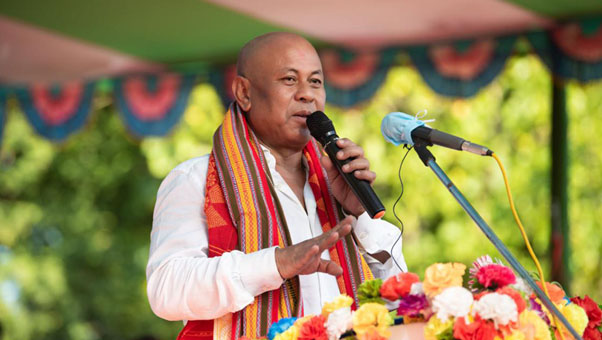
At a special programme held at the Srimanta Sankardev Kalakshetra, Assam witnessed yet another significant moment in its long pursuit of peace and stability. Financial assistance was ceremonially distributed to former BLT cadres residing outside the Bodoland Territorial Council region, marking a renewed commitment to rehabilitation and reintegration. The event, attended by BTC Chief Executive Member Hagrama Mohilary and Minister for Housing and Urban Affairs Jayanta Mallabaruah, symbolised the ongoing transformation of Assam—one shaped not by conflict, but by opportunity, collaboration, and hope. As part of the State Government’s broader efforts, these grants reaffirmed the belief that those who once walked the path of rebellion can now contribute meaningfully to collective progress.
In his address, Minister Jayanta Mallabaruah conveyed gratitude on behalf of Chief Minister Himanta Biswa Sarma, recognising the courage of former cadres who chose a constructive path over armed struggle. He expressed appreciation for their decision to embrace rehabilitation and development, reminding them that their return to civil society is not only welcomed but celebrated. The Minister emphasised that armed struggle, though born from years of neglect and lack of opportunity, could never fulfil their aspirations, whereas the present environment of peace and development offers a foundation on which to build a self-reliant future. His assurance that today marked their homecoming added emotional depth to the occasion, urging them to begin a dignified and peaceful life ahead.
The programme served as a reminder of the watershed changes since 2020, when the Government of Assam and the Government of India signed five historic Memorandum of Settlements—the NDFB Accord, Karbi Peace Accord, Adivasi Peace Accord, DNLA Agreement, and ULFA Peace Agreement. These landmark initiatives have brought 9,022 cadres of peace-signed groups back into the mainstream, in addition to over 2,000 members of smaller groups rehabilitated under State schemes. Such numbers reflect not just policy decisions, but lives reshaped and futures rewritten. In a State once shadowed by decades of militancy, these agreements mark the foundation of enduring peace.
Minister Baruah also reflected on the turbulent past that forced many young people to take up arms. He acknowledged the failure of previous governments to offer equitable development, compelling youth to believe that rebellion was their only road to dignity. Today, however, he noted a decisive turnaround, with development finally reaching communities in ways that earlier administrations failed to ensure. He reminded the audience of a time when Assam had to revolt to defend its natural resources, recalling protests forty years ago against crude oil being extracted from the State without benefiting local people. Today, pipelines are being built to bring oil into Assam to power its refineries, a shift he credited to the corrective vision of Prime Minister Narendra Modi.
The Minister underscored that armed revolution only prolonged insecurity, delaying growth and deterring investments for decades. Under the present leadership, Assam has seen industries arrive, peace prevail, and communities feel included in the wider developmental journey. He highlighted that investments which once seemed unimaginable are now becoming reality, noting that through Advantage Assam, the State is expected to receive investment worth five lakh crore rupees, with over one lakh crore already grounded. This progress illustrates the confidence investors now place in Assam—a confidence built on stability, governance reforms, improved infrastructure, and strengthened rule of law.
As part of the rehabilitation initiative, Minister Baruah informed that 442 former BLT cadres residing outside the BTC region were granted financial support of two lakh rupees each. This assistance, he said, was meant to help them begin a dignified new life driven by self-reliance. He encouraged the beneficiaries to pursue skill-development opportunities offered by the Government and praised CEM Hagrama Mohilary for leadership efforts that have bolstered peace in the region. The call to transition from being consumers to producers resonated strongly with the audience, aligning with the State Government’s vision of empowering individuals to participate actively in Assam’s economic transformation.
The Minister concluded with a forward-looking message, expressing confidence that under the leadership of Chief Minister Himanta Biswa Sarma, Assam is moving steadily towards becoming one of India’s top five performing States. He highlighted the Chief Minister’s decision to extend Scheduled Tribe status to six communities while safeguarding the rights of existing ST groups, calling it an example of balanced and progressive governance. This move, he noted, reflects a sensitivity to both aspirations and anxieties within various communities, strengthening the broader social fabric. His appeal to collectively build a peaceful, prosperous Assam echoed the dreams of earlier generations who long yearned for such a future.
The presence of key officials, including Director General of Police Harmeet Singh, Additional Chief Secretary Ajay Tewari and Special ADGP Hiren Chandra Nath, underscored the importance of the initiative. Their attendance also reflected the harmonious collaboration between administrative, police, and political leadership in driving peace-building efforts. As Assam continues its journey of recovery from decades of conflict, the unified presence of these senior leaders highlights a shared commitment to sustaining harmony and ensuring that rehabilitation becomes not an event, but an ongoing responsibility.
This programme was more than a distribution of financial assistance; it was a reaffirmation of the State’s belief that peace is built through inclusion, opportunity, and trust. It also reflects a remarkable shift in Assam’s socio-political landscape, where former combatants are not seen as adversaries, but as partners in development. With the State’s investment climate accelerating, infrastructure expanding, and socio-economic reforms deepening, Assam stands on the threshold of historic transformation. The rehabilitation of former cadres, supported by robust institutions and visionary leadership, serves as both a symbol and a catalyst of this new era.
Today’s Assam is an emerging story of reinvention—a State once defined by turbulence now charting a future rooted in stability and collective ambition. As former BLT cadres begin this new chapter, their journey mirrors that of the State itself: a journey from conflict to cooperation, from deprivation to development, and from fear to hope. The work ahead is ongoing, but the foundation has never been stronger.
(the writer can be reached at dipakkurmiglpltd@gmail.com)