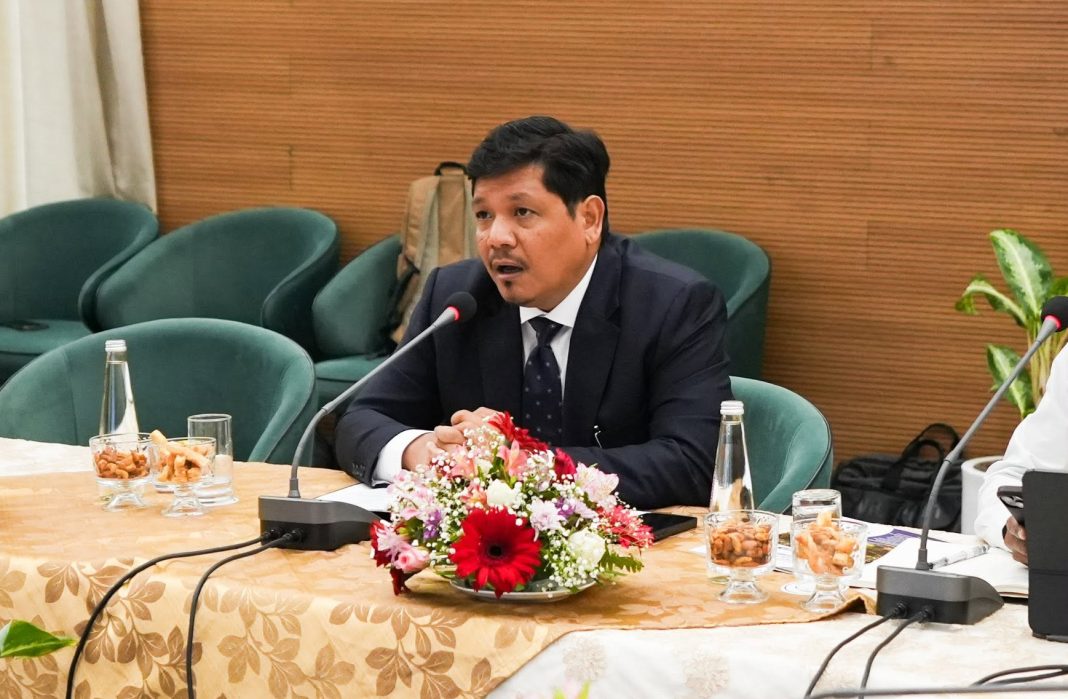

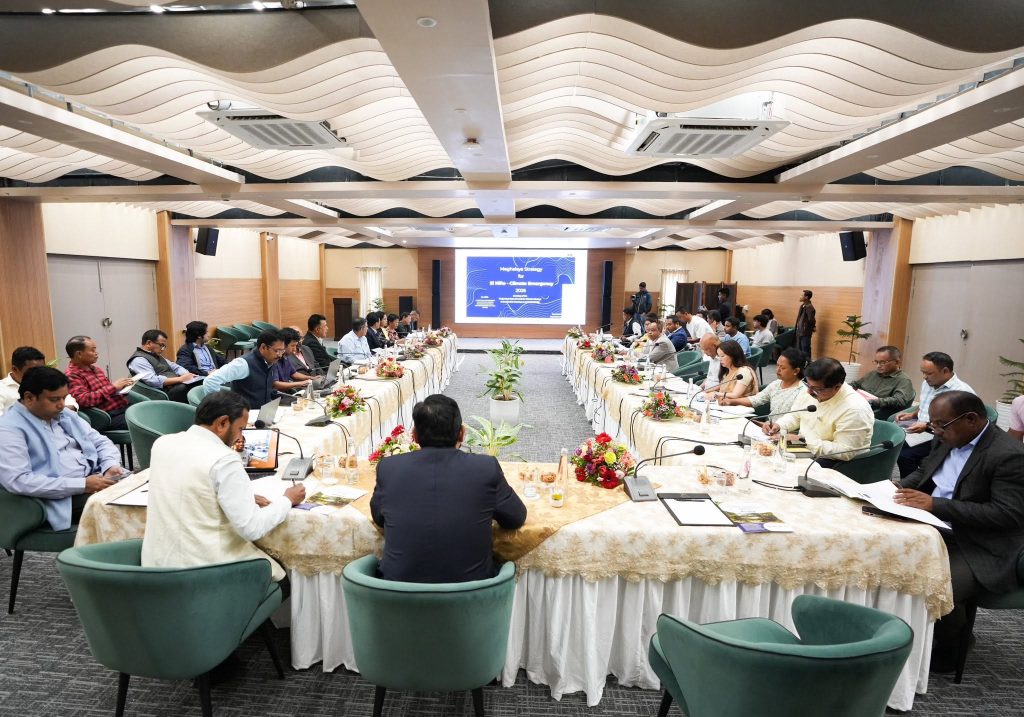
Shillong, June 23: With global weather patterns under the shadow of a looming El Niño event, Meghalaya moved swiftly on Tuesday to shore up its defences, as Chief Minister Conrad K. Sangma convened an emergency session of the Meghalaya Climate Council at the State Guest House, Taraghar, drawing together a high-level assemblage of government departments, scientific agencies and technical experts to chart a course of action before the threat turns crisis.
The meeting — attended by representatives from the India Meteorological Department (IMD), Meghalaya Basin Management Agency (MBMA), Public Health Engineering (PHE), the Agriculture and Farmers’ Welfare Department, the Food Civil Supplies and Consumer Affairs Department, and a host of allied agencies — was called in direct response to forecasts warning of the potential development of El Niño conditions that could significantly disrupt monsoon behaviour across the Indian subcontinent.
El Niño, the periodic warming of sea surface temperatures in the equatorial Pacific Ocean, has long been associated with erratic monsoon patterns in India — including reduced or delayed rainfall, extended dry spells, and extreme weather events with cascading consequences for agriculture, water availability and public health.
“Prepare, Don’t React”
Speaking at the helm of the council meeting, Chief Minister Sangma set the tone with a clear directive: anticipate, do not wait.
“We must prepare in advance rather than respond after adverse conditions emerge,” he stated, acknowledging that while Meghalaya’s precise exposure to El Niño effects remained uncertain, the State could not afford complacency. He called upon all departments to convert preparedness plans into concrete, time-bound actions with clearly defined responsibilities.
A technical presentation before the Council laid out the full spectrum of risk — from disruptions to rainfall and groundwater recharge to threats to soil moisture, crop cycles, livelihoods and public health infrastructure. Officials noted that extensive mapping and vulnerability assessments have already been completed to identify priority intervention zones, particularly with regard to water security.
Water: The Heart of the Crisis
Of all the sectors reviewed, water security emerged as the most urgent pressure point. The Council discussed a comprehensive slate of interventions — desiltation and restoration of existing ponds and reservoirs, construction of new water harvesting structures, creation of additional storage facilities, groundwater recharge initiatives, and intensive catchment area and watershed management.
The Chief Minister directed departments to fast-track ongoing soil and water conservation projects and identify measures executable within the next six to twelve months.
The Public Health Engineering Department informed the Council that critical water sources across the State are being monitored continuously. Emergency plans — including deployment of water tankers, rapid response protocols and water quality management measures — have been drawn up for deployment in the event of prolonged dry conditions. Emphasis was also placed on strengthening district-level coordination and ensuring the availability of water purification and treatment materials.
Fields at Risk: Farmers in the Frame
The Agriculture and Farmers’ Welfare Department reassured the Council that district-level contingency plans are in place and that sowing activities across the State are currently progressing normally. Adequate seeds and planting materials are being made available, while efforts are underway to promote short-duration crop varieties, efficient water management practices and expanded crop insurance coverage.
The Chief Minister, however, did not leave matters to assurance alone. He directed the department to strengthen farmer outreach, ensure timely supply of seeds and inputs, improve irrigation support and explore the wider adoption of solar-powered pumping systems to safeguard agriculture in vulnerable areas.
Food Stocks and Price Watch
On the food security front, the Food Civil Supplies and Consumer Affairs Department informed the Council that advance lifting and stocking of food grains and essential commodities are already underway to cushion any supply disruptions. Price monitoring mechanisms will be reinforced to track essential goods and prevent hoarding, shortages or abnormal price fluctuations that could disproportionately affect vulnerable populations.
IMD: No Guarantees, But Watch Closely
IMD officials who briefed the Council offered cautious counsel. While strong El Niño events have not invariably produced adverse outcomes for Meghalaya in the past, they underscored that preparedness and continuous monitoring remain non-negotiable. The Chief Minister responded by directing all concerned departments to intensify dissemination of weather advisories and early warning information through social media, local communication networks and community channels.
Forests as Shields
An important dimension of the discussion centred on the role of Meghalaya’s forests and sacred groves as natural climate buffers. Officials noted that healthy forest ecosystems help regulate water cycles and offer protection against both excessive rainfall and prolonged dry periods. The Council discussed expanding Payment for Ecosystem Services (PES) initiatives and developing broader models for catchment protection and conservation of natural resources. The Chief Minister called for sustained investment in forest conservation as an integral part of the State’s climate resilience strategy.
People’s Movement, Not Just Policy
Recognising that institutional action alone cannot deliver resilience, Chief Minister Sangma called for a ground-up mobilisation. He urged that district-level awareness programmes and consultations be held across the State, engaging village bodies, self-help groups, local institutions and community organisations. Water conservation and catchment protection, he stressed, must become a people’s movement — not merely a line in a government plan.
A State on Alert
Concluding the meeting, the Chief Minister reiterated that preparedness remained Meghalaya’s strongest defence against climate-related uncertainty. He called on all departments, institutions and communities to work in unison to protect water resources, agriculture, livelihoods and public welfare.
The Meghalaya Climate Council has been designated the State-level coordinating platform to monitor El Niño impacts across sectors and ensure implementation of the preparedness framework in the weeks and months ahead.
As El Niño watches intensify across South Asia, Meghalaya’s proactive mobilisation may offer a model for how sub-national governments can move decisively in the face of climate uncertainty — before the rains, or the absence of them, force their hand.