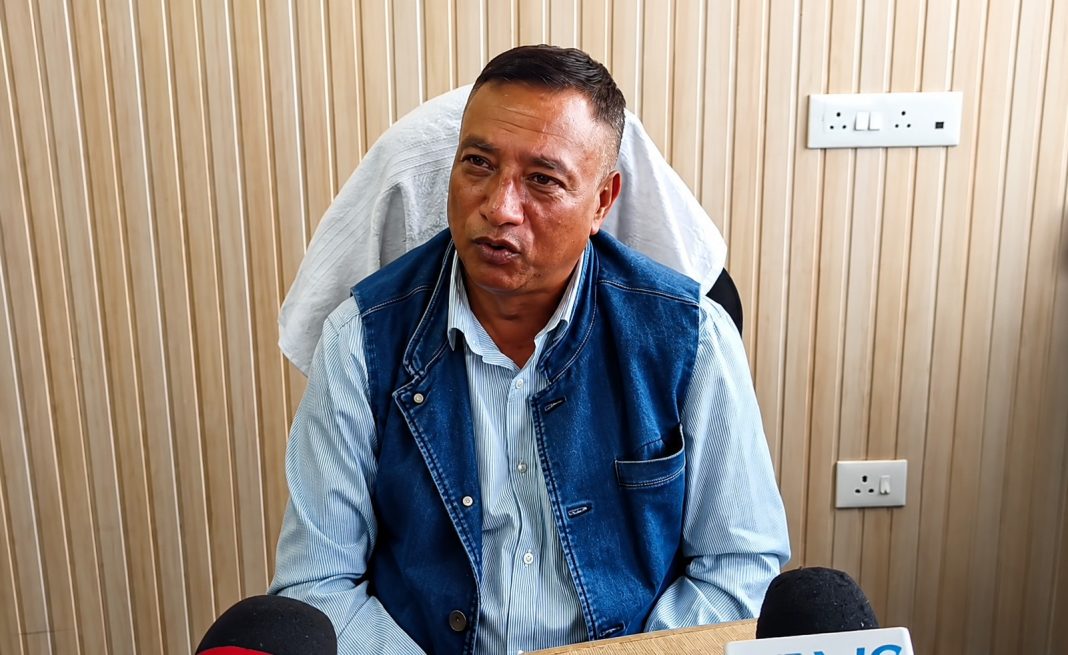

Shillong: While Bollywood actor John Abraham recently remarked that Meghalaya has the potential to produce many “Messis and Ronaldos,” senior Shillong footballer Jeremy Wallang believes the vision should extend beyond one state.
“If I could take the liberty of changing what John said a little, I would say that the entire Northeast has the potential to produce world-class players,” Jeremy Wallang told The Meghalayan Express in an exclusive interview.
According to the veteran footballer, football is deeply embedded in the culture of the Northeast, where children naturally gravitate towards the sport. He believes the region possesses the same hunger, determination and raw talent found among young footballers anywhere in Asia, Europe or the rest of the world.
“There shouldn’t be any reason why our boys and girls cannot reach the world-class level,” he said.
However, Wallang stressed that talent alone is not enough. He identified the lack of structured grassroots development, quality coaching, modern infrastructure and sustained financial support as the biggest hurdles preventing Meghalaya from consistently producing elite footballers.
“We have always had talented footballers in Meghalaya. Infrastructure, financial aid, proper youth coaches and coaching facilities play a huge role in developing children at a young age. This is where we are lacking, and we are still far behind international standards,” he observed.
Wallang believes football development must begin at the grassroots, with children introduced to professional coaching as early as five or six years of age. He also called for football associations to adopt a long-term vision, arguing that the future of the game cannot depend on short-term planning.
“The associations have an extremely important role in grooming our future players. Like the AIFF, they need a proper structure and a clear roadmap for football’s future,” he said.
He credited the transformation of football in Meghalaya to the rise of Shillong Lajong FC, describing the club’s qualification for the I-League as a watershed moment not only for the state but for the entire Northeast.
“In those days, Manipur was considered the powerhouse of Northeast football. Then Shillong Lajong qualified for the I-League, and suddenly everyone started believing that if Meghalaya could do it, so could they. It changed perceptions across the region,” Wallang recalled.
The club’s success, he said, forced administrators and clubs to rethink their approach. Stadiums improved, infrastructure became a priority and clubs increasingly focused on developing home-grown talent instead of relying heavily on players from outside the state.
Despite the progress, Wallang believes much remains to be done.
He urged the Meghalaya Government, the Meghalaya Football Association and football clubs to work together under a clearly defined long-term strategy focused on youth development.
“The clubs are the heart of football. Every stakeholder—the government, the association and the clubs—must know their roles and responsibilities. We need a roadmap that defines where Meghalaya football should be in the next 10 to 20 years,” he said.
Wallang also had a message for aspiring footballers. While encouraging youngsters to dream big, he emphasised the importance of education, discipline and continuous learning.
“A strong education is very important. Talent alone is not enough—you also need intelligence. Work hard every day, improve your weaknesses, never hesitate to ask your coaches for help and don’t play only for money. If you keep improving and enjoy the game, success will follow.”
Wallang’s remarks reinforce a growing belief that Meghalaya possesses immense footballing potential. But, as he points out, transforming that potential into world-class success will require more than passion. It will demand sustained investment, professional planning and a unified commitment from every stakeholder in the state’s football ecosystem.