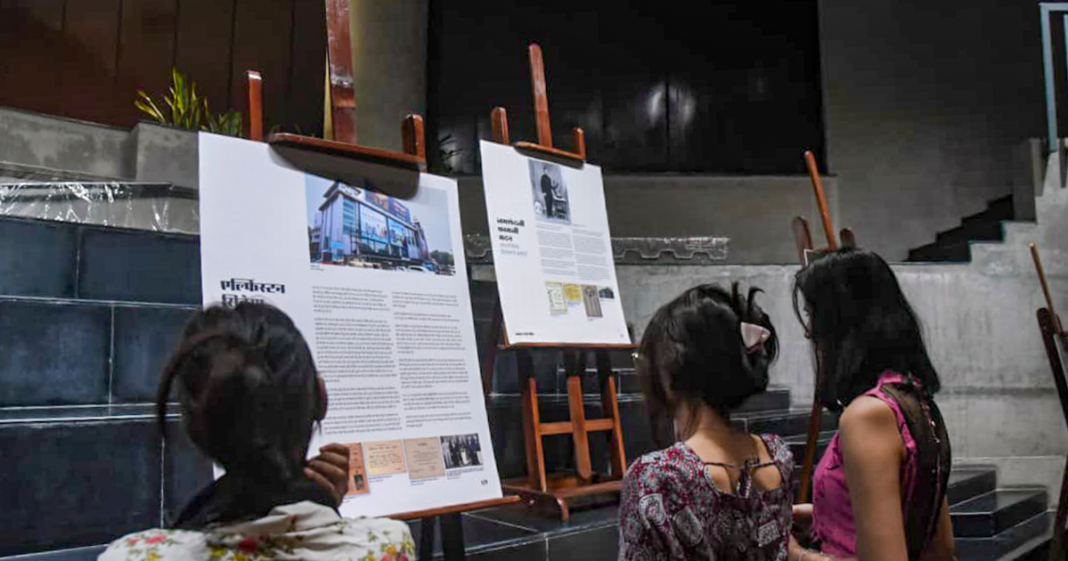

Patna, Jun 19: Rare old photographs of now-demolished historic cinema halls of Patna, and images of vintage tickets and other archival material associated with its long-gone single-screen theatres, many of which once also doubled up as performance venues, are on display here as part of an exhibition that attempts to connect the modern audience with a faded past.
Titled, ‘Dastan-e-Patna Talkies’, it also shines a spotlight on the city’s rich history as a hub of cinematic exhibition, its gradual loss due to changing times and the advent of digital technology and multiplexes.
The exhibits, presented through a set of panels mounted on easels, showcase the history of some of the most iconic and legendary cinema halls of Patna — ‘Elphinstone Picture Palace’ (Patna’s oldest theatre, which later became popularly known as just ‘Elphinstone’) and ‘Regent Cinema’ (said to have been founded originally as ‘Palace of Varieties’ in 1929), both near Gandhi Maidan; Pearl Cinema (the iconic single-screen theatre of the 1940s with an Art Deco design, demolished in 2012); Rupak Cinema (built in 1940s in Bakerganj area, demolished several years ago); and Ashok Cinema (on Patna-Gaya Road, dismantled many years ago to give way to a multiplex).
The old ‘Elphinstone’, which was a historic structure, and originally run by ‘Elphinstone Bioscope Company’ (or Madan Theatres, owned by Parsi cinema pioneer J F Madan, who in the early decades of the 20th century controlled over 100 theatres across the subcontinent), was razed over 10 years ago, and replaced by a new hall that bears the old name.
‘Elphinstone’ also had a provision for hosting theatrical and other cultural performances. Many cinema experts say it began as a theatre, and only later it was converted to be used as a cinema hall as well.
At this very theatre, Nobel Laureate Rabindranath Tagore had performed with his troupe, the dance-drama ‘Chitrangada’ during his visit to Patna in March 1936, according to archival records.
The exhibition features an image of a rare invitation card for a performance by celebrated Bharatnatyam exponent Rukmini Devi Arundale, at ‘Elphinstone’, opposite Lawn (old name of Gandhi Maidan), Patna on “12th November 1941”, and an image of a vintage poster of 1941 film ‘Major Barbara’ (based on an eponymous play by George Bernard Shaw), screened at ‘Regent Cinema’.
A print of an old photo of ‘Regent Cinema’ before it was remodelled with a modern architecture look is also on display.
Besides, an image of an invite sent by the management of the ‘Elphinstone Picture Palace (Patna)’ to Rai Bahadur Radha Krishna Jalan, a businessman and noted personality of his time, for a special show of the 1938 film ‘Baghban’, produced by General Films, on “23rd September 1938” has also been displayed, among other rare items.
Rajiv Soni, a Patna native based in Kolkata, and an avid photographer, now in his 70s, who curated the exhibition, told PTI that he “met with current family members of owners of some of these cinema halls, and procured details, and old photos and other archival documents for the exhibition”.
So, the 1938 invitation card sent by the management of ‘Elphinstone’ to Radha Krishna Jalan, is part of the collection of his great grandson, Aditya Jalan, in his late 40s, and resident of the legendary Quila House in Patna City.
Patna, which once boasted and took pride in its single-screen theatres, has silently given way to multiplexes over the past few decades.
Veena Cinema, near the Patna Junction railway station, built after independence, which once screened Hollywood films, and later had to run matinee shows of B-grade cinemas to stay afloat, and Diana Cinema in Danapur area near the military cantonment, and Krishna Talkies of Patna City (old Patna area) have barely survived. They have also been featured in the exhibition that began a few weeks ago at Arthshila Patna.
Soni, who has also authored a book on the heritage of Patna, lamented that historic cinema halls of Patna, which have also been public landmarks, could not survive the onslaught of modernity.
More than an archival presentation, the exhibition is an “attempt to preserve the fading memories associated with single-screen theatres and the culture surrounding them,” the organisers said.
The displayed memorabilia and visual material invite visitors to revisit an era when cinema halls were vibrant public spaces that brought communities together through shared cinematic experiences. (PTI)