
State ranked ‘Challenger’ as minerals and niche agri-products drive modest export performance
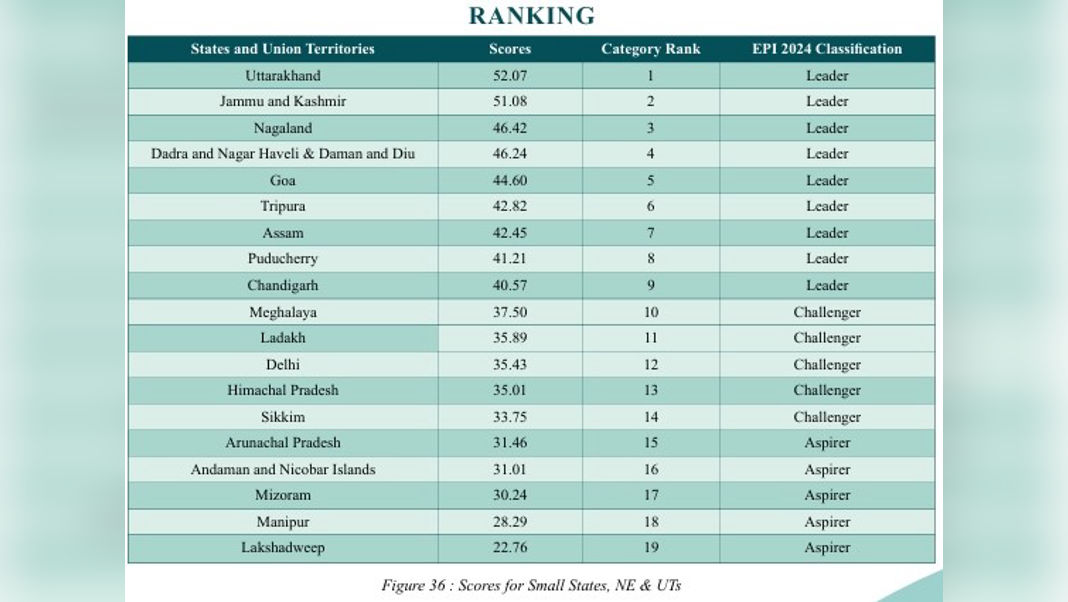
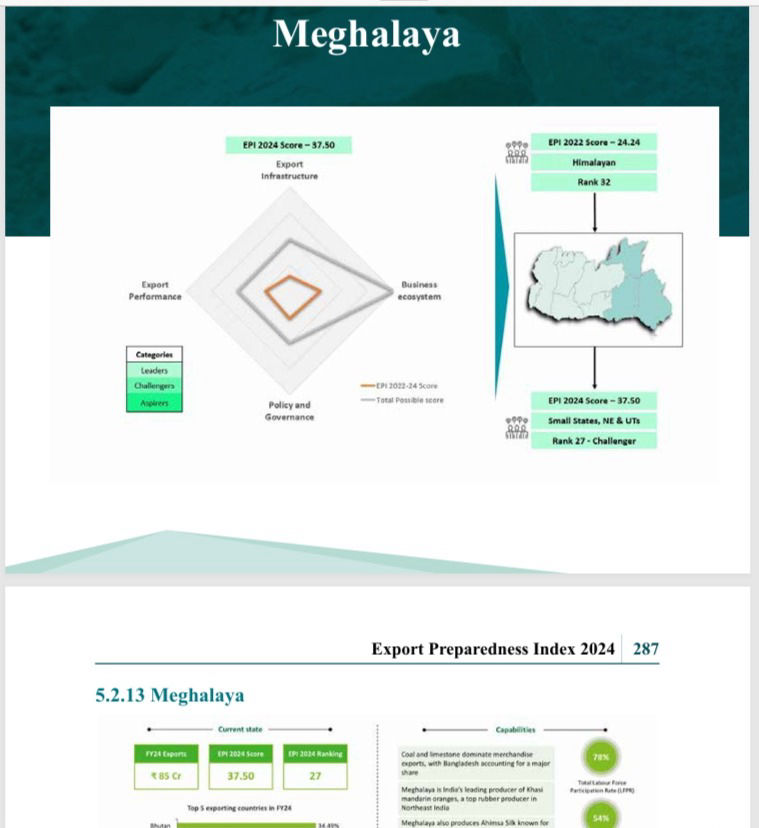
Shillong, Jan 14: Meghalaya has been ranked 10th among Small States, Northeast states and Union Territories in the Export Preparedness Index (EPI) 2024 released by NITI Aayog, and placed in the “Challenger” category, reflecting moderate export readiness with significant scope for improvement.
Overall, the state is placed 27th in the country. Meghalaya’s 10th rank in the Export Preparedness Index (EPI) 2024 places it mid-table among Northeast states, trailing Assam, Nagaland, and Tripura, but ahead of several others struggling with export readiness. While Assam, Nagaland and Tripura have emerged as regional leaders—benefiting from stronger policy frameworks, district-level export institutions, and better logistics—Meghalaya remains a “Challenger”, with exports largely driven by limestone, quartz, and niche agri-products. The report was released today.
According to the report, Meghalaya recorded exports worth around ₹83.7 crore in FY24, with its trade profile remaining largely resource-based and cross-border oriented. The index evaluates states on export infrastructure, business ecosystem, policy and governance, and export performance.
The EPI 2024 highlights limestone as Meghalaya’s largest export commodity, primarily routed through land customs stations to Bangladesh for industrial use, especially in cement manufacturing. Quartz, prized for its high-purity silica, is another major export supporting industrial and manufacturing applications.
Other notable exports include medicinal and aromatic plants, coke and semi-coke from coal processing, and ferro-silicon alloys, indicating limited but emerging activity in mineral beneficiation and metallurgical processing.
With more than 80 per cent of the population dependent on agriculture, Meghalaya’s export basket also includes high-value crops such as Lakadong turmeric, ginger, bay leaves, and areca nut. Lakadong turmeric, known for its exceptionally high curcumin content, has gained international recognition.
The report notes that GI-tagged products like Lakadong turmeric, Khasi mandarin, and Memong Narang enhance Meghalaya’s export branding by improving traceability, enabling premium pricing, and attracting health-conscious global markets.
Meghalaya’s 443-km international border with Bangladesh provides natural trade routes through land customs stations and border haats such as Dawki and Borsora, supporting cross-border trade in minerals and agricultural produce.
However, the EPI flags poor connectivity, difficult terrain, lack of cold-chain facilities, and absence of large-scale processing units as major constraints limiting export growth and value addition, particularly for perishable agri-horticultural products.
The index identifies natural health products, medicinal plants, bamboo and cane handicrafts, and value-added wood products as key sectors where Meghalaya can expand exports. Strengthening logistics, warehousing, cold-chain infrastructure, and access to export finance for MSMEs is seen as crucial for improving the state’s export competitiveness.
“Despite these constraints, Meghalaya’s strategic location, natural produce and cultural assets provide it with a unique export identity among India’s smaller states. Its trade flows may be
limited in volume, but they reflect the distinctiveness of its economy and the role of small-scale, community-led production in cross-border trade,” the report noted.