
By Dipak Kurmi
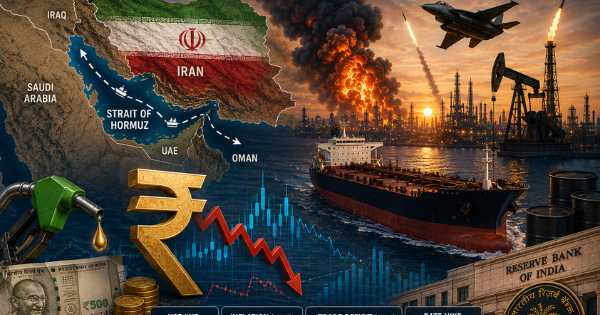
The modern globalized economy operates as a highly interconnected lattice, where a tremor in a critical geopolitical chokepoint can rapidly transform into domestic fiscal tremors thousands of miles away. Over a remarkably compressed timeline this July, a quartet of seemingly disparate macroeconomic indicators converged to sketch a vivid portrait of an economy absorbing an external shock it did not engineer. The Indian rupee plummeted past the psychological threshold of ninety-six against the United States dollar, while domestic retail inflation experienced a sudden ascension to 4.38 per cent in June. This inflationary spike effectively breached the Reserve Bank of India’s target midpoint of four per cent for the first time in seventeen months. Simultaneously, the merchandise trade deficit yawned open to a five-month high of 30.4 billion dollars, collectively triggering intensive market speculation regarding an imminent interest rate hike as early as August. Taken in isolation, each metric might invite a localized, benign explanation. When synthesized, however, they reveal a profound narrative of external vulnerability, demonstrating how an imported energy shock instantly cascades through trade balances, currency valuations, and domestic price stability.
To map the genesis of this synchronized economic pressure, one must look beyond domestic borders to the volatile waters of the Middle East, specifically the Strait of Hormuz. The resurgence of hostilities involving the United States-Israel coalition and Iran has resulted in periodic, highly disruptive closures of this maritime artery, a passage responsible for the transit of approximately one-fifth of global petroleum supplies. Prior to this flare-up, a fragile ceasefire had successfully anchored Brent crude prices near a manageable seventy dollars per barrel. However, a sequence of fresh military strikes and asymmetric tanker attacks shattered that equilibrium, forcefully propelling Brent crude back above the eighty-five-dollar mark. For the Indian subcontinent, which relies on the Persian Gulf region for roughly half of its total crude oil imports, this is far from an abstract exercise in geopolitical analysis. Instead, it constitutes a structural blow to the national balance of payments, immediately inflating the aggregate import bill, devaluing the sovereign currency, and embedding systemic cost pressures into every sector dependent on diesel-powered logistics.
The mechanism through which this energy shock distorts domestic stability is laid bare in the nation’s latest trade accounts. India’s merchandise imports experienced a staggering thirty-one per cent year-on-year surge in June, culminating in an absolute monthly expenditure of 70.8 billion dollars, driven primarily by petroleum outlays running far above historical averages. While the export sector demonstrated commendable resilience by expanding at a healthy clip of 15.5 per cent, it lacked the velocity required to offset the ballooning import bill, particularly as logistical frictions through the disrupted Strait of Hormuz capped shipping volumes. This expanding asymmetry has put the current account under measurable stress, prompting institutional economists to recalibrate their annual forecasts and pencil in a current account deficit approaching one per cent of the gross domestic product for the current fiscal year. The widening trade gap acts as a direct conduit for currency depreciation, as the heightened corporate demand for greenbacks to settle energy invoices naturally depresses the rupee’s external purchasing power.
Concurrently, the consumer price index bears the undeniable fingerprints of this imported supply disruption. The primary catalyst behind the June inflation print was the direct pass-through effect of May’s upward revisions to domestic petrol and diesel prices, which combined with a seasonal, climate-induced acceleration in vegetable costs to push aggregate food inflation to 5.32 per cent. Crucially, however, core inflation—which strips out volatile food and energy inputs—has remained remarkably well-behaved and tame. This divergence provides a vital silver lining for macroeconomic analysts, confirming that the current inflationary pulse is fundamentally driven by an imported cost shock rather than an overheated, demand-driven domestic market. The distinction between supply-side shocks and demand-pull inflation is of paramount importance because standard monetary tightening tools are notoriously blunt instruments when deployed against structural supply constraints; raising rates cannot open a blockaded maritime shipping route, nor can it lower the global price of a barrel of oil.
This fine economic distinction places the Reserve Bank of India in a deeply complex policy dilemma, forcing its Monetary Policy Committee to confront a far more adversarial matrix than the one they circumvented during their June pause. With the domestic growth trajectory remaining robust and projected at a steady 6.6 per cent, central bankers are intensely reluctant to choke off economic momentum by prematurely initiating a rate-hiking cycle designed to combat an external price surge that could theoretically dissolve if geopolitical tensions de-escalate. Yet, having actively missed its mandated four per cent inflation anchor, and with the financial community deeply fractured between forecasting an August pause and predicting a hawkish pivot, the central bank has virtually exhausted its room to project a relaxed stance. The rhetoric emanating from Mumbai must now balance the preservation of growth with a firm, credible commitment to price stability, ensuring that unanchored inflationary expectations do not become permanently embedded within the domestic corporate and consumer psyche.
Despite the confluence of these challenging indicators, the prevailing situation stops short of suggesting an imminent systemic crisis. The structural foundations of India’s external sector are vastly superior to those observed during previous historical currency shocks, notably the taper tantrum of two thousand thirteen. The nation possesses substantial foreign exchange reserves, which provide a potent war chest for the central bank to smoothing out excessive volatility. The monetary authority has been visibly active, intervening strategically across both spot and forward currency markets to defend the rupee from speculative depreciation and prevent disorderly adjustments. Furthermore, the domestic private sector has exhibited advanced financial maturity, with corporate hedging of foreign exchange exposures reaching record highs, thereby shielding balance sheets from the immediate sting of the dollar’s appreciation. These institutional cushions ensure that while the economy is undeniably under strain, it possesses the requisite liquidity and structural scaffolding to withstand prolonged external duress.
Ultimately, an objective synthesis of the data dictates a stance of heightened vigilance rather than overt panic. The four economic indicators under review—the breached inflation target, the weakened rupee, the expanded trade deficit, and the hawkish recalibration of monetary expectations—are fundamentally correlated manifestations of a singular, upstream geopolitical variable that remains entirely outside of domestic policy control. The true test of India’s near-term macroeconomic resilience will not be determined by the specific cadence of this month’s data releases, but rather by the duration of the maritime gridlock in the Middle East. If the Strait of Hormuz stabilizes and permits the free flow of energy traffic, these elevated numbers will likely prove to be a transitory blip on an otherwise stable developmental trajectory. Conversely, a protracted conflict will challenge the boundaries of current monetary buffers, forcing policy makers to make increasingly difficult trade-offs between defending the currency, anchoring domestic prices, and nurturing the country’s underlying economic growth.
(the writer can be reached at dipakkurmiglpltd@gmail.com)