
By Dipak Kurmi
Magh Bihu, a quintessential celebration in Assam, is not merely a festival; it is a grand homage to the bounty of nature, the harvest season, and the rich cultural tapestry of the Assamese people. This vibrant festival marks the culmination of the harvest cycle and brings together communities in a jubilant display of gratitude, feasting, and traditional rituals. While its roots lie deeply entwined with agrarian practices, Magh Bihu transcends its agricultural essence, evolving into an exuberant festival that celebrates not only the harvest but also the spirit of unity, gratitude, and regional identity.
One of the most captivating aspects of Magh Bihu is the intricate interplay of food, music, and dance, which gives the festival its distinct flavor. These elements come together to create an identity unique to Assam, blending traditional culinary delights with age-old customs. Food, in particular, takes center stage as families and communities prepare a plethora of delicacies using locally sourced ingredients such as rice, coconut, jaggery, sesame, and milk. These ingredients, abundant during this season, are transformed into an array of festive dishes that embody the culinary heritage of Assam.
The Culinary Kaleidoscope of Magh Bihu
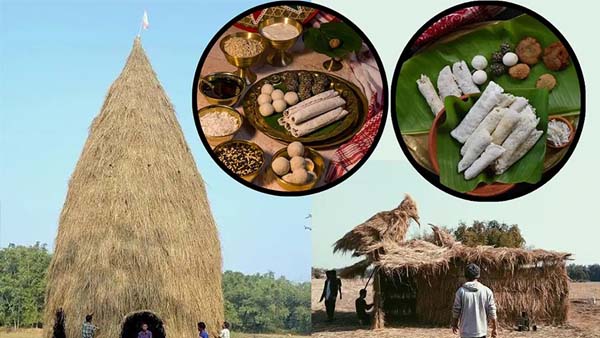
At the heart of Magh Bihu is the preparation of pithas, traditional Assamese sweetmeats that hold an irreplaceable position in the festival’s feast. These delicacies are crafted from rice flour and stuffed with indigenous fillings, showcasing the ingenuity and resourcefulness of Assamese cuisine. Til Pitha, a quintessential Bihu treat, is made by rolling rice flour into cylinders filled with a luscious mixture of sesame seeds and jaggery. Narikol Pitha follows a similar method, replacing sesame seeds with sweetened grated coconut, resulting in a symphony of textures and flavors.
Other variations include Tekali Pitha, a delectable creation where rice flour is combined with jaggery and coconut, wrapped in cloth, and steamed over boiling water. This method imparts a unique texture and taste, making it a cherished delight. Ghila Pitha, often likened to the Indian Malpua, is deep-fried rice flour that is soaked in sugar syrup to create a sweet, melt-in-your-mouth delicacy.
Adding to the variety is the celebrated Sunga Pitha, which is prepared inside hollow bamboo tubes over an open flame, a technique that infuses the dish with a smoky aroma. The Kholasapori Pitha, a minimalist version resembling a dosa, is fried with minimal oil and can be enjoyed as a savory or sweet dish, paired with jaggery or Aloo Bhaji.
The festival also features other unique preparations, such as Til Laru (sesame seed balls mixed with jaggery), Muri Laru (puffed rice balls bound with sticky jaggery), and Gura Laru (balls of rice flour and jaggery). Sandoh Guri, a breakfast staple, is prepared by grinding fried rice into flour and pairing it with milk, curd, or tea, sweetened with jaggery. This versatile dish reflects the ingenuity of Assamese cuisine in utilizing simple ingredients.
Community, Rituals, and the Spirit of Gratitude
While food forms the heart of Magh Bihu, the festival’s soul lies in its community-centric rituals and traditions. The celebrations begin with the construction of Meji and Bhelaghar, structures made from bamboo, wood, and thatch, which are later ceremonially burned. The act of offering the first harvest to the fire god symbolizes reverence for nature’s bounty and the continuity of life.
The night before the burning of the Meji is marked by a grand community feast, where families and neighbors gather to share a meal, strengthen bonds, and revel in the warmth of camaraderie. The traditional Assamese breakfast, or Jolpan, consisting of dishes like Komal Saul (soaked rice with curd or cream) and Doi-Chira-Gur (flattened rice with curd and jaggery), sets the tone for the festival’s feasting spirit.
As the day progresses, joyous dances and music add a rhythmic fervor to the celebrations. The festival becomes a melting pot of cultural expressions, with people embracing traditional attire, songs, and performances that highlight the vibrant Assamese heritage.
The Symbolism of Magh Bihu
Magh Bihu is more than a festival of food and fun; it is a profound expression of gratitude, a celebration of unity, and a reflection of Assamese identity. It embodies the harmonious relationship between humans and nature, acknowledging the cycles of life that sustain existence. The festival’s rituals, from the offerings to the fire god to the communal sharing of meals, echo the importance of gratitude and togetherness in the human experience.
As the flames of the Meji rise, lighting up the winter sky, they symbolize not only the warmth of community and culture but also the resilience and continuity of traditions that have withstood the test of time. Magh Bihu, with its rich tapestry of flavors, rituals, and celebrations, stands as a testament to the enduring spirit of Assam—a festival that bridges the past and present, celebrating the essence of life itself.
(the writer can be reached at dipakkurmiglpltd@gmail.com)