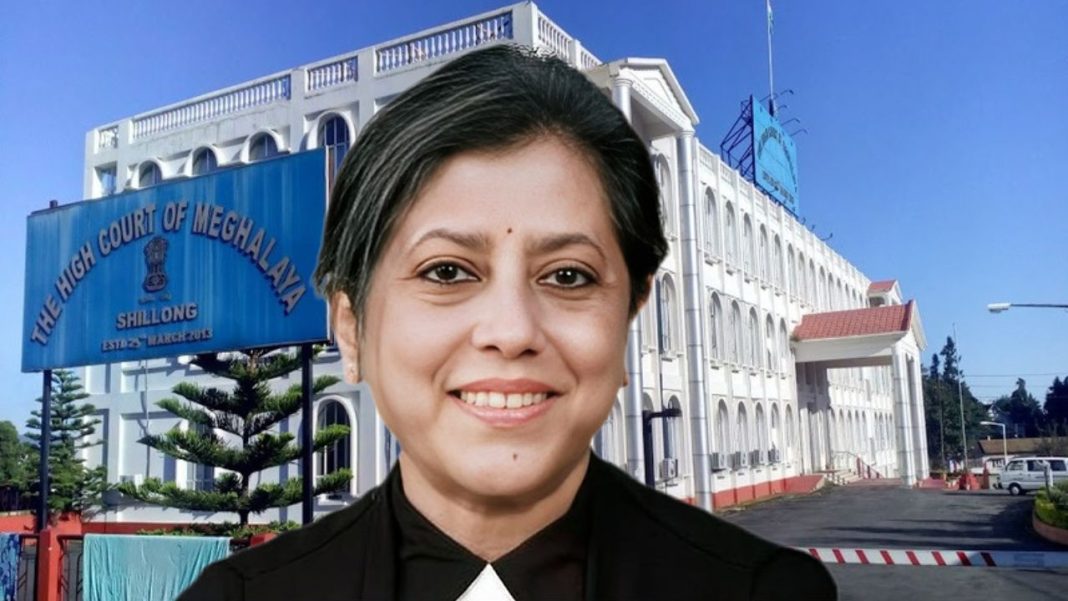

The objective of a mediator should always be to build bridges and not walls.
– Revati Mohite Dere, Chief Justice, Meghalaya High Court
Shillong, March 16: Meghalaya Chief Justice Revati Mohite Dere has advocated for taking the route of mediation while stakeholders, including courts and traditional dorbars, dealing with everyday conflicts.
In her address at a seminar on “Mediation: Concepts and Techniques”, Justice Dere underscored the importance of mediation as a constructive and effective means of resolving conflicts in today’s fast-paced world.
She observed that disputes commonly arise in workplaces, families, and communities, and mediation provides a platform that encourages dialogue, understanding, and empathy.
Justice Dere stated that mediation empowers disputing parties to develop mutually beneficial solutions rather than relying solely on the adversarial system of litigation.
She explained that mediation promotes constructive communication and helps restore relationships between parties. Compared with traditional litigation, mediation is faster, less confrontational, flexible, confidential, and cost-effective.
She also noted that court proceedings often involve high costs, prolonged delays, emotional strain and others.
The Chief Justice stressed that mediators must exercise patience, neutrality, and effective communication skills to facilitate consensus.
“The objective of a mediator should always be to build bridges and not walls,” she remarked at the seminar organized by the Meghalaya State Legal Services Authority, in collaboration with the Union Ministry of Law and Justice, the Meghalaya State Judicial Academy, and the High Court Mediation Committee, Meghalaya.
Highlighting Meghalaya’s social fabric, Justice Dere said traditional dispute resolution mechanisms already exist within communities such as the Khasi, Jaintia, and Garo, where family elders and respected clan members often intervene to settle disputes related to marriage, inheritance, and family responsibilities.
At the village level, institutions such as the Dorbar Shnong in the Khasi and Jaintia Hills frequently mediate minor civil disputes, including land boundary issues and neighbourhood conflicts, through dialogue and consensus.
In the Garo Hills, the village head known as the Nokma plays a key role in resolving disputes and safeguarding clan land and community interests.
She also referred to higher customary governance institutions such as the Dorbar Raid and Dorbar Hima, which function as forums for dispute resolution when issues cannot be settled at the village level, emphasising reconciliation and community harmony.
She added that the Meghalaya State Legal Services Authority is implementing the project “Increasing Access to Justice through Community Mediation,” funded by the Department of Justice, to enhance grassroots dispute resolution.
The initiative includes training and sensitisation programmes for headmen, Nokmas, and community leaders in mediation techniques, legal literacy, and customary laws.
Also addressing the gathering, Justice HS Thangkhiew, Chairman of the Meghalaya State Legal Services Authority, highlighted the growing importance of mediation as a vital component of the justice delivery system. He noted that mediation helps reduce the time and cost involved in resolving disputes while preserving relationships between the parties.
Justice Thangkhiew urged lawyers and other stakeholders to support mediation initiatives, stating that amicable settlement of disputes not only benefits society but also enhances the credibility of legal professionals and strengthens the justice system.
He also pointed out that Meghalaya has launched a community mediation pilot project supported by the Department of Justice, making it one of the first states in the country to implement such an initiative. The project involves research, surveys, and training programmes aimed at strengthening community-level mediation and reducing the burden of litigation in courts.
Among those present at the programme were judges of the Meghalaya High Court, including Justice Wanlura Diengdoh and Justice Biswadeep Bhattacharjee, along with Rangbah Shnongs, lawyers, government officials, and other stakeholders.
The programme also featured presentations by Dr Aman Hingorani, Senior Advocate at the Supreme Court of India and Senior Trainer with the Mediation and Conciliation Project Committee, and J. P. Singh, Senior Advocate at the Supreme Court of India.