
Shillong, Sept 5: In Shillong, a newborn who once might have been referred outside the state can now receive critical care at Ganesh Das Hospital. In Tura, a medical college is taking shape. In remote villages, digital libraries are bringing learning resources closer to children. At Mawkhanu in New Shillong, a massive football stadium is rising.
These are very different projects, but they have something in common: they are part of what Meghalaya is building with the money it has been spending on capital assets.
That brings the state’s much-discussed debt into a different perspective.
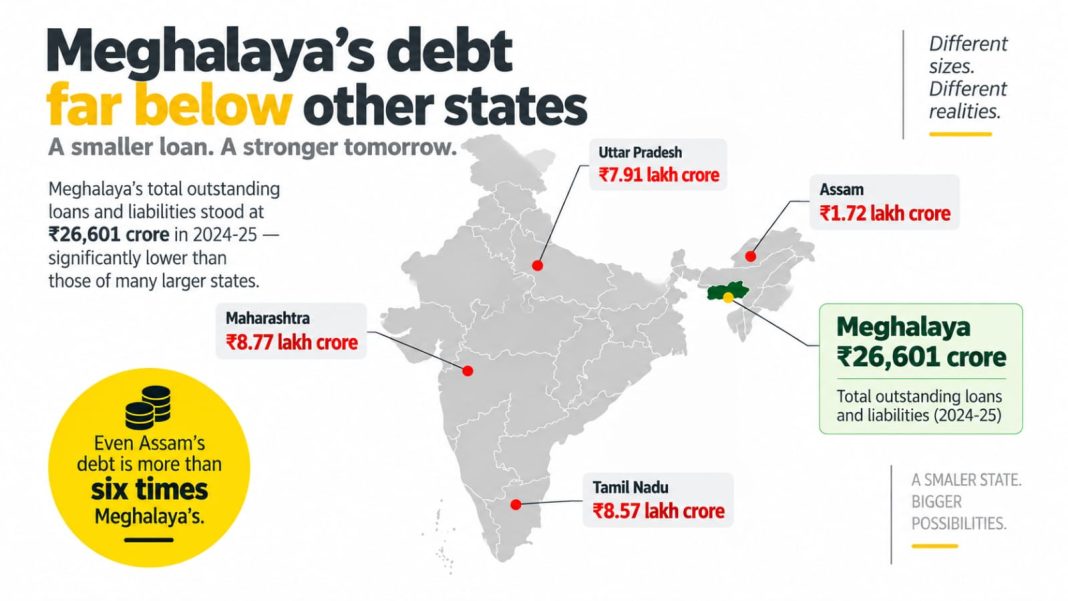
Meghalaya’s total outstanding loans and liabilities stood at ₹26,601 crore at the close of 2024-25. In absolute terms, that is considerably smaller than the debt carried by larger states. Assam, for instance, stood at ₹1.72 lakh crore.
The state has also seen a more measured increase in borrowing over the past nine years compared with Assam. While Assam’s debt increased 4.4 times during the period, Meghalaya’s rose 3.7 times.
But the more important part of the ₹26,601-crore figure lies within it.
Around ₹5,193 crore comes from Special Capital Assistance provided by the Centre at zero interest, with a repayment period of 50 years. The money is meant specifically for creating capital assets.
So while this assistance appears in the state’s overall liabilities, it does not carry the interest burden associated with a conventional loan.
With the special assistance included, Meghalaya’s debt works out to roughly 45 paise for every rupee it earns. Excluding the interest-free assistance, it falls to around 36 paise, a level that has remained broadly stable over the past four years.
At the same time, spending on creating assets has risen sharply.
Meghalaya’s economy grew by 12.03 per cent in 2024-25, ahead of India’s overall growth of 9.78 per cent. The state has also maintained an average annual growth of at least 10 per cent over the past three years.
Per capita income has nearly doubled, rising from ₹88,954 in 2018 to ₹1.57 lakh in 2024-25.
Government spending on capital asset creation has increased from ₹1,734 crore to ₹5,246 crore in five years. Put simply, about one in every five rupees of state spending in this category is now going towards creating assets.
And those investments are beginning to have physical form.
The medical college projects in Shillong and Tura are among them. So is the Babies’ Critical Care Unit at Ganesh Das Hospital in Shillong, which has added specialised newborn care within the state.
Around 750 digital libraries, estimated to cost ₹162 crore, are being developed to take learning resources to remote areas, with 75 already ready. A ₹732-crore football stadium is under construction at Mawkhanu in New Shillong.
Working women’s hostels are being developed in Shillong, Jowai and Byrnihat, alongside investments in roads, water supply and other public infrastructure.
None of this, however, means Meghalaya’s finances are without pressure.
The CAG has pointed to a sharp decline in Central grants, concerns over the growth of the state’s own revenue, limited returns from public sector undertakings and gaps in documentation and utilisation certificates.
The state paid ₹1,009 crore in interest on internal debt of around ₹16,282 crore during 2024-25. At the same time, its economy continued to grow at a strong pace.
There has also been a shift in the composition of government spending. The share of expenditure consumed by the day-to-day running of government has fallen from around 86 paise of every rupee five years ago to about 76 paise now, leaving more room for capital investment.
Government guarantees have also declined for four consecutive years, to ₹2,906 crore, with limits on government guarantees now in place.
So the question raised by the audited accounts is perhaps not simply how much Meghalaya owes.
It is what the state is building with that money, what the borrowing costs, and whether that pace of investment can be sustained.
The numbers do not erase the financial challenges. But they do add another dimension to the debt debate.
Because long after the loans are repaid, the question is what remains behind: a hospital, a school, a road, a water line, a library or a stadium.
That is ultimately what gives Meghalaya’s borrowing story its larger context.