
By Satyabrat Borah
The story of Pakistan’s nuclear program is one woven from ambition, desperation, espionage, and shadowy deals that spanned continents. It emerged not as a purely indigenous scientific triumph, as often portrayed within the country, but as something built on stolen secrets, clever deception, and a willingness to spread dangerous technology to others. At its heart stands Abdul Qadeer Khan, a metallurgist whose actions reshaped global nuclear dynamics in ways still felt today.
Pakistan’s pursuit of nuclear capability began in earnest after the traumatic events of 1971, when the country lost its eastern wing in a war with India, resulting in the creation of Bangladesh. The defeat left deep scars on national pride and security thinking. Then, on May 18, 1974, India conducted its first nuclear test, code-named Smiling Buddha, which it described as a peaceful explosion. For Pakistan’s leaders, this was an existential threat. Prime Minister Zulfikar Ali Bhutto famously declared that Pakistan would “eat grass” if necessary to develop its own bomb, ensuring it would never again face India from a position of weakness.
Bhutto had already initiated steps toward a weapons program earlier that year, convening scientists in Multan to discuss the path forward. The Pakistan Atomic Energy Commission, under Munir Ahmad Khan, focused initially on a plutonium route, drawing from existing reactor expertise. But the game changed dramatically with the arrival of Abdul Qadeer Khan.
Khan, born in Bhopal before Partition and raised in Pakistan, had studied metallurgy in Europe, earning degrees in Belgium and the Netherlands. In 1972, he joined as a subcontractor to URENCO, the British-Dutch-German uranium enrichment consortium. URENCO used advanced gas centrifuge technology to enrich uranium for civilian nuclear fuel, but the same process could produce highly enriched uranium suitable for bombs. Security at the facility was notoriously lax in those days, and Khan, a Pakistani patriot motivated by the 1971 war and India’s test, began systematically copying classified documents. He photographed blueprints for centrifuge designs, including models like CNOR, SNOR, G-2, and even aspects of the more advanced 4-M program then under development. He gathered supplier lists, operational manuals, and technical details that would shortcut years of research.
In late 1974 or early 1975, Khan wrote to Bhutto offering his services. Bhutto accepted enthusiastically. Khan stayed in the Netherlands a bit longer to collect more material before returning to Pakistan in December 1975, smuggling out the stolen designs. Dutch authorities later investigated, convicting him in absentia in 1983 to four years in prison for espionage, though the conviction was overturned on a technicality. Khan always denied the theft, claiming the designs were openly available or that he had merely used his expertise, but the evidence from multiple intelligence agencies points clearly to industrial espionage.
Back home, Khan was given extraordinary authority. Bhutto created Project-706, later evolving into the Khan Research Laboratories at Kahuta near Islamabad. Khan’s uranium enrichment path offered advantages over plutonium: it was easier to hide, required less fissile material for a bomb, and suited Pakistan’s limited infrastructure. He set about replicating the stolen centrifuges, starting with basic models and progressing to more sophisticated ones. To acquire the thousands of specialized parts,high-strength maraging steel rotors, carbon fiber composites, vacuum pumps, and precision bearings,Khan built an elaborate procurement network. He exploited export controls’ loopholes, using front companies, false end-user certificates, and intermediaries across Europe, the Middle East, and Asia.
This network, born from necessity to supply Kahuta, proved remarkably effective. By the early 1980s, Pakistan had produced small amounts of highly enriched uranium. Intelligence assessments suggest Pakistan had enough material for a device by around 1983 or 1984, though it conducted cold tests and refinements over the following years. China played a crucial supporting role, reportedly providing a tested bomb design (possibly tested on Pakistan’s behalf in 1990 at Lop Nur) and assisting with heavy water, reactors, and other technologies. In exchange, Pakistan shared centrifuge know-how with North Korea, part of a barter that included missile technology.
Yet the same procurement web that built Pakistan’s arsenal enabled something far more troubling: proliferation to other states. Khan and his associates began selling excess equipment, designs, and expertise. Starting in the late 1980s, Iran received centrifuge components and know-how, helping jump-start its enrichment program. Libya negotiated a comprehensive package in the 1990s and early 2000s, including thousands of centrifuge parts, uranium hexafluoride, and even a crude nuclear weapon design derived from Chinese origins. North Korea obtained centrifuge technology in return for Nodong missiles, which Pakistan adapted into the Ghauri series.
Khan’s operation functioned like a private nuclear supermarket. Front companies in Dubai, Malaysia, Turkey, South Africa, Switzerland, Germany, and elsewhere handled shipments. Associates like Buhary Syed Abu Tahir in Malaysia acted as key middlemen. Brochures advertised centrifuges and support services. Profits reportedly reached into the hundreds of millions, though Khan later claimed ideological motives to aid fellow Muslim nations rather than pure greed.
The network’s scale remained hidden for decades, partly because Western intelligence knew of Pakistan’s program but prioritized other concerns. During the Soviet invasion of Afghanistan in 1979, the United States funneled billions in aid through Pakistan, turning a blind eye to its nuclear activities under a waiver in certification laws. Presidents Carter and Reagan certified that aid was needed despite suspicions. Only in the early 1990s did sanctions bite briefly, but post-9/11 necessities revived close ties.
The unraveling came in late 2003. U.S. and British intelligence, tracking shipments, intercepted the German-flagged BBC China en route to Libya with thousands of centrifuge components. Libya’s leader Muammar Gaddafi, facing isolation, renounced his weapons programs and cooperated, naming Khan as the source. Iran had already admitted to IAEA inspectors that some centrifuges matched Pakistani designs. Confronted with overwhelming evidence, Pakistan’s government under Pervez Musharraf placed Khan under investigation.
On February 4, 2004, Khan appeared on national television in a carefully scripted confession. He admitted sharing technology with Iran, Libya, and North Korea, expressing “deepest regrets” and taking sole responsibility, absolving the government and military. Many observers viewed this as a scapegoating exercise to protect state institutions. Khan was placed under house arrest but never faced trial. He retracted parts of his confession later, alleging pressure, and lived freely until his death in 2021.
The episode exposed how a single individual’s actions, backed by state tolerance or complicity, could endanger global security. The network supplied turnkey capabilities, allowing recipient countries to bypass decades of development. While the Khan network was largely dismantled through international cooperation involving Malaysia, South Africa, Europe and others,its legacy persists. Iran advanced its program using early Pakistani technology. North Korea’s centrifuges likely trace back to those transfers. Questions linger about whether other clients existed or if remnants of the procurement web still operate.
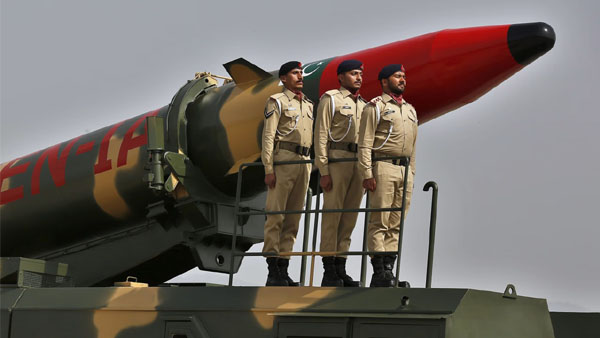
Pakistan’s program succeeded in its main goal: achieving strategic parity with India. The 1998 tests,Chagai-I on May 28 and Chagai-II on May 30,confirmed its status as a nuclear power, with an estimated arsenal now around 170 warheads. Yet the path involved theft from a peaceful multinational consortium, deception of export controls, and proliferation that multiplied risks worldwide.
Pakistan’s nuclear capability rests on a foundation of espionage that began in a quiet Dutch suburb and rippled outward, altering the balance of power in South Asia while reminding the world how fragile nonproliferation can be when ambition meets opportunity. The story underscores that nuclear weapons programs rarely emerge in isolation; they often rely on borrowed, stolen, or sold secrets, and once unleashed, those secrets prove hard to contain.