
By Dipak Kurmi
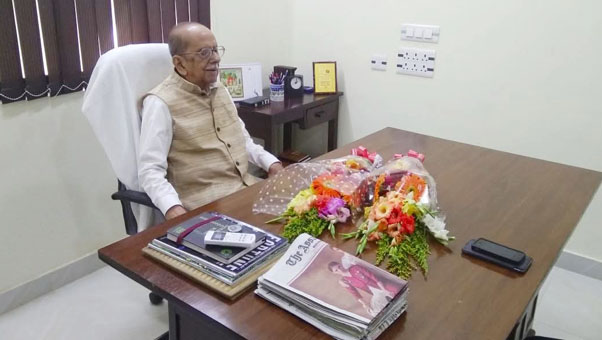
The passing of Padmashree Prafulla Govinda Baruah marks the close of a defining chapter in the intellectual, journalistic, and public life of Assam. He breathed his last at around 9.30 pm on Sunday at Apollo Hospital in Guwahati, following age-related ailments. He was 93. Widely known as P.G. Baruah, he was far more than the editor, owner, or managing director of The Assam Tribune Group. For decades, he stood as a moral compass for journalism in the Northeast, shaping not only newsrooms but also public opinion, civic consciousness, and professional ethics. His demise has cast a profound shadow over Assam’s media landscape, leaving behind a void that few believe can ever be filled. He is survived by his wife and two daughters, along with countless colleagues, readers, and well-wishers who regarded him as a mentor and guiding presence.
Born in Dibrugarh, Prafulla Govinda Baruah remained deeply rooted in Assam throughout his life, even as his outlook and influence reached far beyond regional boundaries. While some records mention his birth date as July 26, 1933, other authoritative sources cite July 26, 1932, a minor discrepancy that reflects the long span of a life lived through momentous historical change. His early schooling took place in Dibrugarh, after which he passed his matriculation examination from Gauhati University in 1949, securing First Division with letter marks in two subjects. He completed his Intermediate Science from Cotton College in 1951 and went on to graduate with Honours in Economics from Presidency College, Calcutta, in 1953. His academic journey continued with a Master’s degree in 1955, followed by an LL.B. degree from Calcutta University in 1957, where he earned a gold medal, underlining his exceptional intellectual discipline and scholarly depth.
Despite having the qualifications to pursue a successful career in law or academia, Baruah chose journalism, a profession he viewed as inseparable from public service. He entered the newspaper industry in 1962, a period when Indian journalism was navigating post-Independence challenges and redefining its role in a young democracy. In 1964, he received a prestigious scholarship to study journalism and printing technology at the Thomson Foundation in the United Kingdom. This exposure to international standards of journalism and publishing equipped him with technical knowledge and a broader perspective that would later shape the growth of The Assam Tribune Group. In 1966, he assumed charge as the Managing Director of the group, shouldering responsibility with quiet authority, discipline, and an unyielding commitment to ethical journalism.
The Assam Tribune, founded in 1939 by his father Radha Govinda Baruah, was already an established institution when Prafulla Govinda Baruah formally joined its leadership. Under his stewardship, however, it evolved into the most circulated English daily in Northeast India and a newspaper whose credibility became its defining strength. From 1997 until his death, he served as the Editor of The Assam Tribune, seamlessly blending managerial insight with editorial vision. His tenure as editor was marked by an uncompromising emphasis on factual accuracy, balance, and independence, values that became synonymous with the newspaper’s identity.
Under Baruah’s leadership, the newspapers of The Assam Tribune Group played a crucial role during some of the most turbulent periods faced by the Northeast. From the Chinese aggression of 1962 and the Indo-Pak war of 1971 to prolonged issues such as infiltration, identity concerns, and regional neglect, the group’s publications consistently articulated the anxieties, aspirations, and voices of the people. Baruah believed that journalism must stand with society in moments of crisis while also upholding the larger national interest. His editorial approach ensured that the Northeast was neither marginalised nor misrepresented in national discourse, and that its concerns reached policymakers in New Delhi with clarity and conviction.
Recognition for his lifelong contribution came from across diverse fields. In 2018, Prafulla Govinda Baruah was awarded the Padma Shri for his contribution to journalism, particularly for his work in the Northeast, a region often described as peripheral in mainstream narratives. Over the years, he received numerous honours and citations from academic, cultural, and social organisations. The Asam Sahitya Sabha felicitated him for his contribution to literature, art, and culture, while the late Kamala Saikia Trust honoured him for upholding the highest ideals of journalism, a tribute imbued with special significance in memory of a journalist who lost his life to violence. The Dr. B. Borooah Cancer Institute also presented him with an appreciation citation for his role in raising public awareness about cancer, reflecting his engagement with social causes beyond the newsroom.
Baruah’s contribution to literature and culture was both deep and sustained. Through his publishing house, Sahitya Prakash, he launched Goriyasi, a monthly literary magazine that emerged as an important platform for Assamese literature. Along with books published under the same banner, the magazine played a significant role in nurturing and promoting prominent literary voices in the state. His belief in education as a foundation for social progress found expression in his role in laying the foundation of RG Baruah College. He also established Jyotirupa, a socio-cultural organisation aimed at encouraging young talent. Through annual drama festivals, competitions, and live performances by renowned artistes from across the country, Jyotirupa enriched Assam’s cultural landscape and provided local audiences with rare opportunities to experience national-level artistic excellence.
Equally significant was Baruah’s engagement with issues of economic development and public policy. Along with a group of close associates, he organised a series of seminars under the banner of Assam Prakalpa, bringing together experts from economics and other disciplines to deliberate on pathways for Assam’s development. The recommendations that emerged from these deliberations were formally submitted to the government, reflecting his conviction that informed public discourse should guide policymaking. He also sponsored a major programme on Investment Opportunities in the Northeast, attended by eminent personalities including former Prime Minister Dr. Manmohan Singh, thereby helping position the region within a broader national economic framework.
Within The Assam Tribune Group, Prafulla Govinda Baruah was regarded not merely as an editor or administrator but as a paternal figure. Employees often spoke of his personal concern for their welfare and his readiness to stand by them in times of need. His leadership style combined firmness with empathy, authority with humility, and vision with accessibility. This human quality strengthened institutional loyalty and helped cultivate a professional culture rooted in trust, dignity, and mutual respect.
Prafulla Govinda Baruah’s life represented a rare synthesis of intellect, integrity, and institution-building. He belonged to a generation that viewed journalism not as a commercial enterprise but as a public trust, demanding courage, consistency, and compassion. As Assam and the Northeast navigate an era of rapid media transformation, his legacy remains a benchmark for editorial responsibility and public service. His passing is not merely the loss of an individual, but the closing of a luminous and enduring chapter in the history of Indian journalism.
(The author serves as a Sub Editor with Dainik Asam and may be contacted at dipakkurmiglpltd@gmail.com)