
By Satyabrat Borah
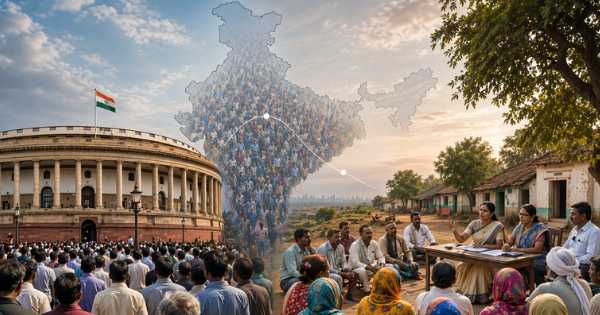
The conversation around India’s democratic future has become oddly fixated on a single, looming number: eight hundred and fifty. This is the figure often whispered or proposed as the new ceiling for the Lok Sabha, a jump from the current five hundred and forty three seats that has remained frozen since the early seventies. The logic driving this expansion feels intuitive at first glance because it relies on the simple math of fairness. If the population has grown and shifted unevenly across states, then the number of representatives must grow to match it.
We treat the ratio of citizens to legislators as the ultimate yardstick of a healthy democracy. But if we pause to look at the horizon of India’s demographic journey, we find that this push for a massive, permanent institutional expansion is hitting its stride just as our population growth is beginning to lose its breath. We are preparing to build a larger house for a family that is almost finished growing.
India is not on a path of infinite expansion.
Current projections suggest our population will reach its peak in the early twenty sixties, perhaps even sooner, before starting a long and steady decline. This means the demographic pressure used to justify an eighty percent increase in the size of the national legislature is a temporary phenomenon in the long life of a republic. If we lock ourselves into a much larger Parliament now based on the arithmetic of the present, we risk creating an unwieldy institutional structure that might be out of sync with the needs of a shrinking India fifty years from now.
The obsession with headcounts misses a deeper truth about what it actually means to be represented in the modern age.
The way we think about the service capacity of an elected official is often stuck in the era of the nineteen seventies. Back then, representation was tied strictly to physical presence and the limitations of a pre digital world. An MP in that decade dealt with a constituency where roads were poor, telephones were luxury items, and the primary way to hear a grievance was through a physical letter or a face to face meeting that required hours of travel. In that context, a smaller population per MP was essential for any semblance of responsiveness.
Today, the geography of power has been compressed by technology. While digital divides certainly exist, the average citizen’s ability to communicate with the state has been transformed by mobile phones and social messaging. A representative can now host a town hall via a screen or receive a thousand petitions in an afternoon without leaving their office. This does not replace the need for physical presence, but it fundamentally alters the calculation of how many people a single office can effectively serve.
Instead of asking how many more seats we can squeeze into a new chamber, we should be asking how we can make the existing tiers of our democracy work better.
India already possesses a vast and vibrant democratic architecture that is far closer to the people than the halls of New Delhi. There are over three million elected representatives at the local level, including over a million women who lead panchayats and urban bodies. These are the individuals who live in the same neighborhoods as their constituents and understand the daily struggles of water, sanitation, and local infrastructure. The real crisis of representation in India is not that we have too few members of Parliament, but that these three million local leaders often lack the financial power and legal authority to solve the problems they see every day.
When a citizen feels that their voice is not being heard, it is rarely because their MP represents two million people instead of one million. It is because the person they can actually reach, the local councillor or the panchayat head, is often powerless to help them because the authority stays concentrated at the top. Adding three hundred more MPs to the national stage might satisfy the demands of population arithmetic, but it does very little to improve the daily responsiveness of the state. It might actually do the opposite by further centralising political life around a massive national legislature while the local institutions that provide the most direct form of representation remain underfunded and overlooked.
The push for delimitation based on the two thousand eleven census or future projections is often framed as a technical necessity. We are told it is a matter of restoring the principle of one person, one vote. This is a valid concern, as the current disparity between states in the north and south creates a genuine tension in a federal system. But solving a federal imbalance through sheer numerical expansion is a blunt tool. It assumes that more voices in a single room lead to better outcomes, ignoring the fact that a legislature of nearly nine hundred people would likely become harder to manage, less deliberative, and more dominated by party leadership. Individual MPs would find it even more difficult to speak or influence policy in such a large crowd, potentially making them even less effective as representatives of their specific regions.
We have a choice to make about the kind of democracy we want to build for the next century. We can choose to follow the path of least resistance, which is to simply add more chairs to the table until the room is full. Or we can choose to strengthen the table itself. Strengthening the third tier of government,the panchayats and urban local bodies, would address the need for responsiveness and access far more effectively than a national expansion. If the goal of representation is to ensure that every citizen has a meaningful connection to the state, then empowering the millions of representatives who are already on the ground is the most logical solution. They are the ones who can offer the human touch that a distant national legislator, no matter how well meaning, cannot provide.
The demographic peak is coming into view, and with it, a chance to rethink our institutional priorities. We must move away from the idea that representation is a simple division problem where the answer is always to increase the divisor. True representation is about the quality of the interaction between the citizen and the representative, and that quality is determined by the capacity of our institutions to act. If we focus all our energy on the size of the Lok Sabha, we are treating the symptoms of a growing population while ignoring the health of our democratic system as a whole. A smaller, more effective national legislature complemented by a powerful and well funded local government system offers a much more resilient future for India. It respects the coming demographic changes while ensuring that the promise of democracy remains personal and accessible for everyone, regardless of the numbers on a census sheet.