
By Satyabrat Borah
The geopolitical chessboard of the Middle East has rarely witnessed a miscalculation as stark as the recent conflict initiated by Donald Trump and Benjamin Netanyahu against Iran. Launched with high-flying rhetoric and a laundry list of maximalist demands, the military campaign aimed at nothing less than engineered regime change in Tehran, the total dismantling of Iran’s ballistic missile and nuclear infrastructure, and the severing of its ties with regional non-state allies. In the heady opening days of the operation, the White House confidently dismissed any possibility of a negotiated settlement, famously demanding Iran’s unconditional surrender. This posture reflected a familiar historical hubris, the belief that overwhelming aerial bombardment and economic strangulation can bend a deeply nationalistic sovereign state to its knees.
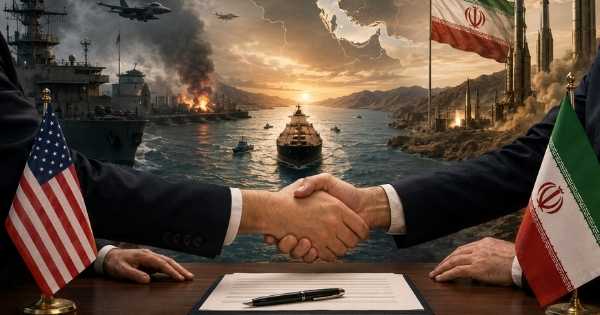
Instead of a swift capitulation, Washington ran into a geopolitical brick wall. Three months into a conflict that was supposed to showcase American dominance, the narrative has flipped entirely. The United States finds itself quietly negotiating a temporary ceasefire extension and the restoration of maritime traffic through the critical Strait of Hormuz, using Pakistan as a diplomatic go-between. The proposed memorandum of understanding, leaked extensively to American media, reveals a reality that would have been unthinkable to administration planners a few months ago. Under the terms of this draft, Iran will allow commercial shipping to return to pre-war levels, while the United States will systematically dismantle its naval blockade of Iranian ports and grant Tehran access to billions of dollars in frozen foreign reserves. The ceasefire is slated to extend across all active fronts, notably including Lebanon.
This dramatic shift from demanding total surrender to bartering for a maritime truce demonstrates that military force cannot easily extract political concessions from an adversary prepared to push back in kind.
The unraveling of the American military strategy can be traced to a fundamental misunderstanding of Iran’s asymmetric warfare capabilities. When the first bombs fell, the architects of the war expected Tehran to retreat into isolation or sue for peace under pressure. Iran chose to expand the theater of conflict both geographically and economically. By launching precise retaliatory strikes against American military facilities scattered across the Persian Gulf and asserting tight physical control over the Strait of Hormuz, Tehran effectively put a chokehold on global energy markets.
The immediate spike in oil prices and the skyrocketing costs of international shipping sent shockwaves through a fragile global economy, putting intense pressure on Washington from its own allies.
Realizing that air strikes were yielding diminishing returns and generating massive economic blowbacks, the administration attempted to pivot. A formal pause in major offensive operations was announced, followed by the implementation of a strict naval blockade designed to starve the Iranian economy into submission. This economic warfare met the exact same wall of resistance. Rather than returning to the negotiating table in a position of weakness, Tehran responded by freezing all backchannel communications and aggressively advancing its nuclear enrichment activities, pushing the nuclear file down its list of diplomatic priorities until Washington altered its behavior.
This hardline response effectively checked the American strategy. The fact that the United States is now actively working through Pakistani intermediaries to secure a memorandum of understanding indicates that Iran’s refusal to blink has forced a major recalculation in Washington. The administration’s focus has narrowed significantly. The sweeping demands regarding Iran’s domestic political structure, its regional alliance networks, and its conventional missile development have largely vanished from the current diplomatic discourse. The conversation has been reduced almost entirely to the nuclear issue, a pragmatic narrowing of scope that mirrors the exact path taken by the international community over a decade ago.
This brings a sense of historical irony to the current situation. The policy framework the administration is drifting toward is almost identical to the approach adopted by the Obama administration in 2013, which ultimately produced the Joint Comprehensive Plan of Action in 2015. That landmark international agreement successfully capped Iran’s nuclear ambitions in exchange for structured sanctions relief. It was a deal that was systematically dismantled by the subsequent administration in 2018 under the assumption that a campaign of maximum pressure could yield a much better bargain. After years of economic warfare and a disastrous three-month military campaign, the United States has arrived back at the exact same starting point, having spent immense blood, treasure, and international credibility only to find that the original diplomatic parameters were the only viable options available.
For any new diplomatic framework to succeed, the United States must confront a massive trust deficit that it created through its own past actions. Iran did not walk away from the original nuclear deal; it was complying fully with its obligations when Washington unilaterally withdrew and reimposed sweeping sanctions. Even after that breach of faith, Tehran showed a willingness to engage, participating in constructive dialogues in early 2025 and again in February 2026. This history means that Iranian negotiators are unlikely to accept vague promises of future sanctions relief in exchange for immediate, irreversible concessions. A sustainable agreement cannot be built on unilateral demands disguised as diplomacy. It requires a framework of verifiable, mutual compromises where both sides receive tangible benefits simultaneously.
The coming weeks will determine whether Washington has genuinely learned the lessons of this failed campaign or if it is merely looking for a temporary breathing room before renewing its aggressive posture. If the administration enters the upcoming direct negotiations with a sincere desire to establish a stable, balanced framework for nuclear non-proliferation, a durable settlement is entirely achievable. Iran has repeatedly demonstrated that it responds to respectful, peer-to-peer diplomacy that acknowledges its regional security concerns and economic rights. Such an outcome would stabilize global energy markets, reduce tensions across the Persian Gulf, and provide a rare off-ramp from a cycle of violence that has threatened to consume the entire region.
The alternative path carries catastrophic risks. If the administration intends to use these upcoming talks as a deceptive maneuver, attempting to achieve through diplomatic pressure the exact concessions it failed to secure through military force, the negotiations will inevitably collapse. A failure to build a genuine diplomatic bridge will send both nations back to the battlefield, but with much higher stakes. Iran will have every incentive to accelerate its nuclear capabilities as a final deterrent, while Washington will find itself facing a choice between a humiliating retreat or a massive, open-ended ground invasion to enforce its will.
Stepping into that trap would entangle the United States in another exhausting, multi-decade conflict in the Middle East. The lessons of recent history in Iraq and Afghanistan have demonstrated that entering a conflict with vague goals and an incomplete understanding of local realities leads to stagnation and strategic exhaustion. A war with Iran, a nation with a much larger population, more sophisticated defensive capabilities, and a deeply integrated network of regional allies, would dwarf those previous conflicts in scale and cost. It would drain American resources, alienate critical international partners, and permanently destabilize the global economy. The current pause in hostilities offers a brief window to choose a different future, a chance to replace the hollow promises of military adventurism with the hard, necessary work of realistic diplomacy.