
By Dipak Kurmi
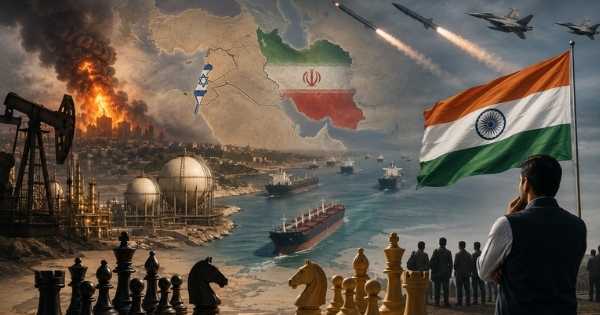
The contemporary geopolitical landscape of West Asia has shattered the comfortable illusion that India can treat the region as a distant crisis zone manageable through cautious rhetoric and calibrated ambiguity. The eruption of the full-scale military conflict involving Iran, Israel, and the United States has abruptly transformed regional instability into an immediate, structural, and deeply localized challenge for New Delhi. This high-intensity warfare directly threatens India’s core national interests, disrupting critical energy security parameters, jeopardizing vital maritime access, severing established trade routes, and placing the lives of nearly ten million Indian expatriates across the Gulf in severe jeopardy. Faced with this volatile reality, India no longer possesses the luxury of passive observation; the choice before New Delhi is starkly binary, requiring either a swift, strategic adaptation to the changing architecture of regional power or a continuous, exhausting cycle of reaction to geopolitical shocks that should have been long anticipated.
For several decades, India’s foreign policy playbook in West Asia relied on a familiar, highly predictable formula of comprehensive multi-alignment, a mechanism designed to engage everyone, offend no one, and allow the region’s geopolitical storms to pass safely around the subcontinent. This non-aligned, risk-averse posture was highly effective when the regional order remained volatile but relatively containable, allowing steady bilateral relationships to grow in parallel with competing actors. However, this traditional formula has lost its strategic utility under the pressure of current events, which have exposed a profoundly more hazardous landscape defined by weakened state structures, assertive external actors, asymmetric military technologies, and a regional architecture moving far beyond its historical assumptions. The traditional Look West and Link West frameworks, which were conceptualized for an era of predictable diplomacy and uninterrupted commercial expansion, are facing an unprecedented stress test, proving that the period when India could cultivate ties without making sharp strategic choices has definitively concluded.
The unfolding conflict has delivered a definitive critique of imported geopolitical strategies, proving conclusively that the doctrine of maximum pressure did not yield maximum results for its architects. The long-held assumption by external powers that systemic coercion, regime-change logic, and shock-and-aw tactics could force a deeply embedded regional power like Iran into total political and economic submission has entirely collapsed. Instead of forcing compliance, these coercive policies have catalyzed deeper regional fragmentation, accelerated the weaponization of critical chokepoints, and rendered the entire West Asian landscape profoundly less predictable. India must derive a hard, realistic lesson from this systemic failure, recognizing that foreign strategic theories do not guarantee regional stability and that strategic wishful thinking cannot serve as a substitute for an active, deterrent national policy.
The collapse of the old regional equilibrium directly impacts the fundamental pillars of the domestic Indian economy, where energy corridors, shipping lanes, and maritime trade routes are exposed to immediate interdiction whenever West Asia convulses. This vulnerability is underscored by the reality that India imports close to eighty-eight percent of its crude oil and over sixty percent of its liquefied petroleum gas, with an overwhelming ninety percent of these crucial gas imports historically transiting through the vulnerable Strait of Hormuz. When the closure of this vital chokepoint disrupted global energy markets, it initiated immediate economic repercussions within India, sending crude prices surging toward one hundred twelve dollars per barrel and triggering domestic shortages that directly impacted retail inflation and expanded the national fiscal deficit via an increased fertilizer subsidy burden. Furthermore, the conflict directly threatens the safety and economic contributions of the ten-million-strong Indian diaspora in the Gulf, whose forty billion dollars in annual remittances form a vital pillar of India’s macroeconomic stability, transforming their protection from a humanitarian concern into a core national security priority.
In this significantly more multipolar, heavily militarized, and volatile environment, a rising global power cannot continue utilizing a lower-intensity foreign policy vocabulary while operating in a higher-intensity strategic theater. While maintaining a balance of relationships remains a useful diplomatic asset, allowing balancing to degenerate into strategic drift represents a dangerous vulnerability that invites external manipulation. India must continue its engagement with all primary regional actors, yet it must simultaneously learn to speak and act with absolute clarity whenever its fundamental national and economic interests are directly threatened. A state with global ambitions cannot remain a neutral, passive spectator while competing actors actively reshape the regional security architecture, meaning that New Delhi must comprehensively synthesize its diplomatic overtures, maritime defense capabilities, and long-term energy resilience strategies.
This necessary evolution requires an immediate, substantial investment in maritime planning and deterrence, particularly as the West Asian conflict serves as a live laboratory for revolutionary asymmetric tactics, grey-zone warfare, and advanced drone and missile technologies that are actively redefining maritime risks across the wider Indian Ocean Region. India’s free access to international waters can no longer be treated as a detached, abstract legal principle; it is a vital, practical requirement that demands the active deployment of naval assets to protect domestic shipping and secure trade corridors. The limits of peacetime planning have been sharply exposed by the disruption of ambitious connectivity initiatives like the India-Middle East-Europe Economic Corridor, which was overtaken by events and now requires a thorough, wartime structural redesign to account for the reality that maritime chokepoints are increasingly treated as primary strategic targets. Similarly, long-term strategic projects like Iran’s Chabahar Port, once envisioned as India’s premier gateway to Central Asia bypassing Pakistan, face structural paralysis under the weight of expired sanctions waivers and escalating kinetic conflict, forcing New Delhi into tactical adjustments to preserve its geopolitical investments.
Navigating this fractured landscape also demands a highly realistic, unsentimental assessment of external global actors, particularly regarding the quiet, calculated role played by Beijing. China has been far from a passive observer in this crisis, utilizing its background economic and diplomatic support for Iran to anchor its own influence while quietly reaping the strategic benefits that regional instability inflicts upon its democratic competitors. While India must avoid overstating every single Chinese diplomatic maneuver as an existential confrontation, New Delhi must clearly comprehend Beijing’s actions as part of a broader, structural contest for long-term strategic and economic hegemony across the West Asian landmass. Conversely, Pakistan’s historical role as a regional facilitator should not be allowed to distort India’s broader strategic vision, because its relevance matters far less than whether regional diplomacy ultimately produces a sustainable peace that lowers the threat of escalation along India’s maritime approaches.
Crucially, an effective Indian foreign policy must refuse to reduce the structural complexities of West Asia to simplistic, sectarian shorthand. The narrative of an immutable Shia-Sunni divide, frequently overplayed by external commentators, fundamentally misreads the primary drivers of regional instability, which are rooted in a intense competition for geopolitical leadership, institutional legitimacy, and strategic influence. India’s regional calculations will achieve much greater resilience if they are built upon these cold, realistic power dynamics rather than on superficial labels that obscure the true motivations of regional states. There are clear indications that New Delhi has already recognized this imperative, embarking on a subtle, calculated recalibration demonstrated by prime ministerial visits to Israel and the United Arab Emirates, alongside frequent crisis-driven high-level deployments of the National Security Adviser and External Affairs Minister to Riyadh, Abu Dhabi, and Doha.
These proactive diplomatic movements have been accompanied by a concerted effort to restore India’s regional strategic credibility, notably through its explicit support at the BRICS foreign ministers’ meeting for a negotiated two-state solution to the Palestinian issue that explicitly references East Jerusalem. This balanced, principled stance illustrates that India is actively working to regain its footing after a period of regional volatility left its diplomatic posture appearing less settled than required for a major power. However, these welcome adjustments must not conclude with mere diplomatic symbolism or short-term insulation, because temporary shielding from energy price hikes is fundamentally different from executing a durable, long-term national strategy. New Delhi must formalize a comprehensive framework that integrates robust crisis response mechanisms, enhanced maritime protection, accelerated energy diversification, and continuous regional engagement, actively planning for structural instability rather than operating under the flawed assumption that regional crises will remain perpetually manageable. Ultimately, West Asia has become a decisive test of whether India possesses the national will to act as a truly consequential, forward-leaning power or if it will remain a merely cautious, reactive actor. Because the region directly intersects with India’s domestic economy, its citizens, its maritime supply lines, and its global standing, West Asia must be treated as central to New Delhi’s strategic horizon. In the modern geopolitical arena, hesitation is also a choice, but for a rising India, it is rapidly becoming an unsustainably costly one.
(the writer can be reached at dipakkurmiglpltd@gmail.com)