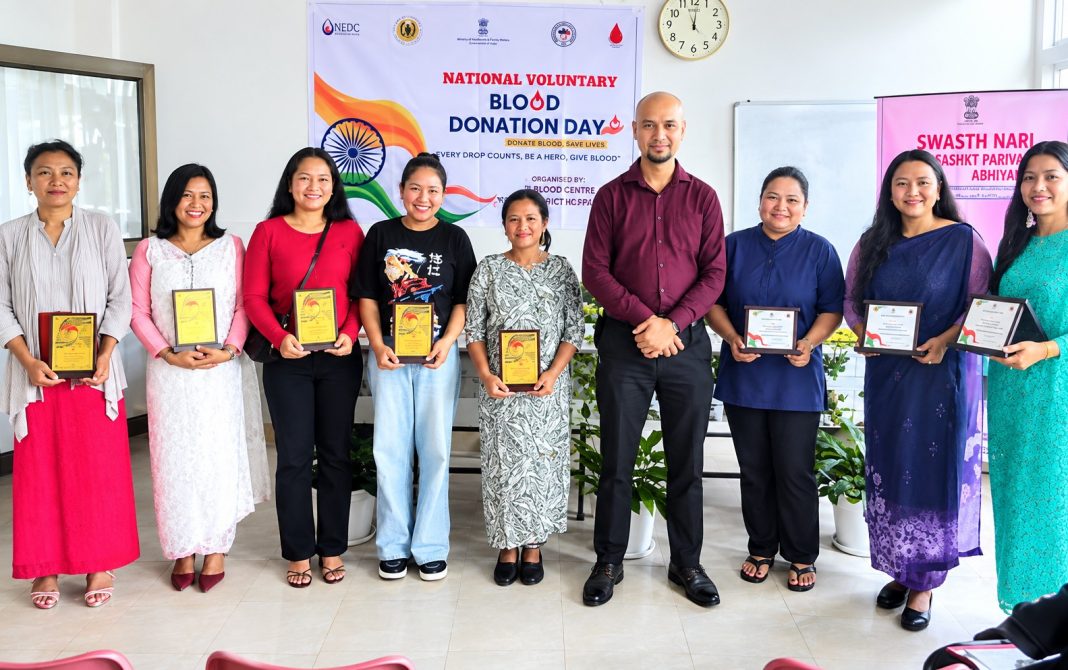

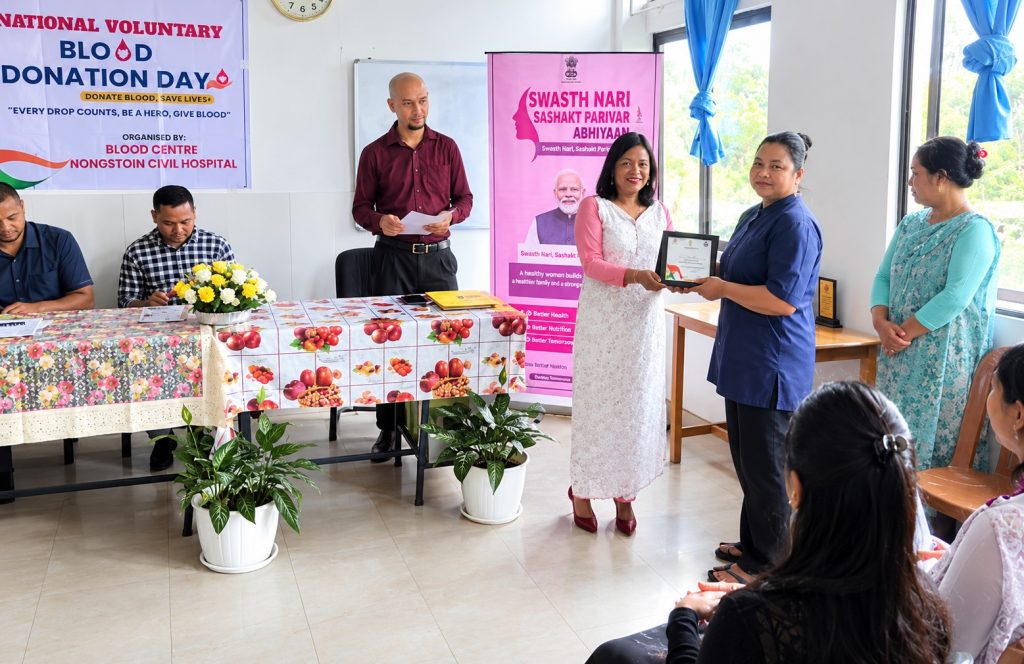
Although 93.6% of its voluntary donors are male, 15 female donors were felicitated on National Voluntary Blood Donation Day.
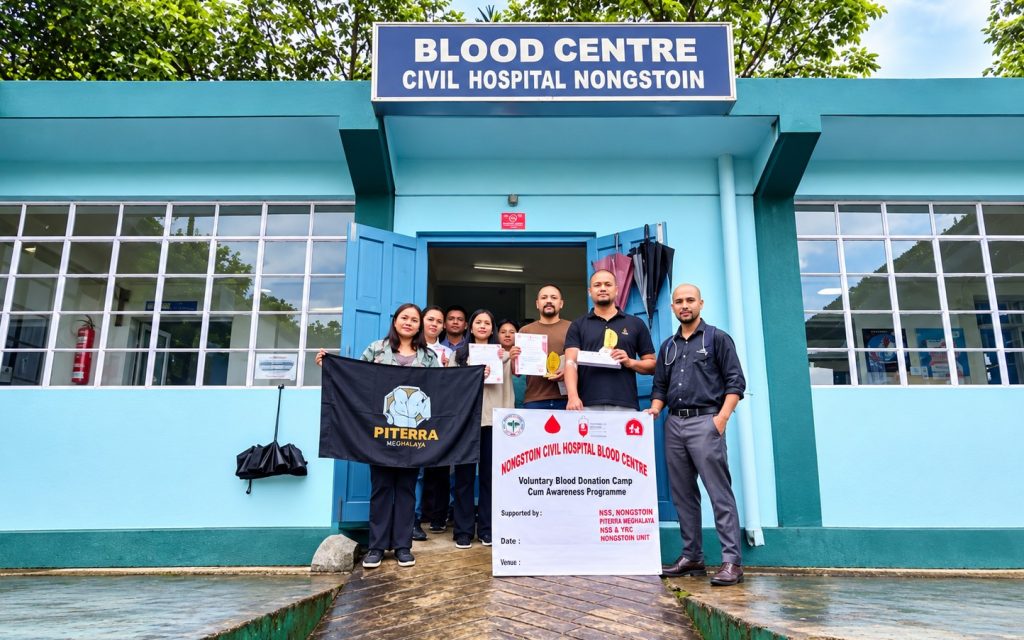
Shillong, Sept 13: It took the blood collection centre at Nongstoin Civil Hospital almost a year to get its first donor. Four years later, the centre has an altogether different story to tell.
Initially, there was fear, hesitation and concern among some community members that donated blood could be misused.
The first units of blood were donated at the centre by two local pastors on September 6, 2022, almost a year after it received the license.
However, there has been encouraging response from donors as six community organisations alternatively conduct voluntary blood donation camps at the centre.
Groups with interested donors have also started approaching the centre for blood donation.
The journey has been documented in a new implementation learning note by the State Health Systems Resource Centre (SHSRC), Meghalaya, which examines how the centre built relationships with communities and gradually increased voluntary blood donation.
The centre’s performance has also received national recognition.
In June 2026, it received an Outstanding Performance in Blood Transfusion Services trophy from the Blood Transfusion Services Division of the Directorate General of Health Services, Ministry of Health and Family Welfare, along with a Certificate of Appreciation from the National Blood Transfusion Council.
From reluctant donors to community mobilisation
Dr Eric Hilton Wanniang, Specialist/In-Charge of the blood centre, started by leading from the front.
He has donated blood more than 20 times, while most eligible staff at the centre donate regularly.
The idea was to show potential donors that blood donation was safe and that health workers themselves were willing to participate.
“We have walked the talk, and that’s how people have been convinced,” Dr Eric said.
He also took the message beyond the hospital.
In the early stages, Dr Eric visited community organisations for awareness sessions, including football and motorsports associations in Riangdo.
He adjusted his schedule to suit the organisations, sometimes attending programmes in the evenings and at night.
“Everyone was very reluctant, and whenever they called us for a program, I had to go and make myself available even at night. That’s how we initially started,” he said.
The repeated engagement eventually helped create a network of organisations capable of mobilising their own members.
The six organisations now choose dates and locations that suit them, mobilise donors and inform the centre. The centre provides technical support and conducts awareness sessions where required.
The relationship has also changed when blood stocks are low.
“Whenever we tell them there’s less blood in the centre… they come forward and tell us, ‘We have so many donors, will you come and conduct a blood donation camp here?’” Dr Eric said.
‘Inform first and then ask’
The centre has also tried to make people see blood as a community resource rather than something owned by the hospital.
Dr Eric describes the centre as a custodian of donated blood.
“The blood in the blood centre belongs to the public,” he said, adding that maintaining adequate stocks is a shared responsibility.
Church leaders, pastors, voluntary organisations and student groups have played an important role in spreading awareness. Students, mainly through the NSS unit of Nongstoin College, account for around 10% of voluntary donors.
The centre has also tried to increase the visibility of women donors.
Although 93.6% of its voluntary donors are male, 15 female donors were felicitated on National Voluntary Blood Donation Day, with the recognition later shared through community WhatsApp statuses.
For people who are afraid of needles or blood, Dr Eric takes a more personal approach.
The learning note recounts the case of a man who accompanied friends to a donation camp intending only to watch. After Dr Eric explained the natural life cycle of red blood cells and addressed his concerns, he decided to donate and later became a regular donor.
The centre’s approach is simple: “inform first and then ask.”
Donors also receive a Voluntary Blood Donation Card, valid for six months, which allows them to claim blood for a first-degree relative from any blood centre in Meghalaya without arranging a replacement donor.
Certificates and a small token gift are also provided.
Building a donor culture takes time
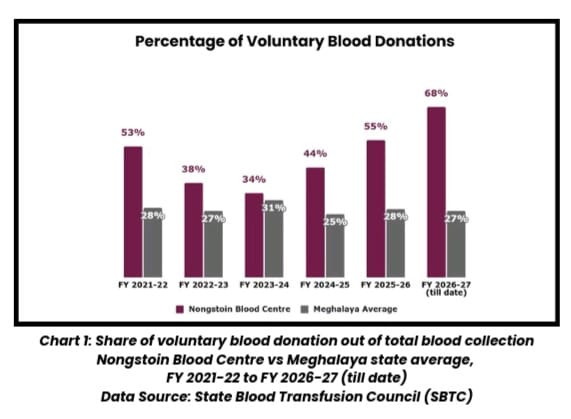
Data from the State Blood Transfusion Council cited in the learning note shows that Nongstoin’s share of voluntary blood donations remained above the Meghalaya state average in every year covered, from FY 2021-22 to FY 2026-27 till date.
The progress has come despite operational constraints, including limited manpower, no dedicated vehicle for donation camps, equipment gaps, power-backup challenges and the absence of a Blood Component Separation Unit. Dr Eric is also the centre’s sole Medical Officer.
For Dr Eric, the change could not have happened overnight.
“Convincing community members will take time. We have to sow the seeds, but for it to take root, it will take time,” he said.