
By Satyabrat Borah
The sun over India has been unforgiving lately, and if you happen to spend even a few minutes outside during the peak summer months, you feel it instantly. It is not just the usual sticky, heavy heat that we have grown up with. It feels different now, sharper and far more aggressive. When a place like Sri Ganganagar in Rajasthan hits forty-eight degrees Celsius, it stops being just a weather update on our phones. It becomes a survival challenge. We often look at the sky and blame the delayed monsoon or talk about global warming as this distant, abstract thing happening somewhere high up in the atmosphere. But if we take a closer look at our surroundings, we notice that the real enemy is much closer to home. It is right under our feet, in the walls around us, and in the choices we make every single day while building our lives and our cities.
We have trapped ourselves in a cage of our own making, and we can call this condition a concrete fever. For decades, our response to development has been to pour cement over everything that breathes. We cut down trees that stood for generations, we pave over ponds, and we replace patches of grass with smooth, black asphalt that absorbs heat like a giant sponge. When the sun beats down on these hard surfaces all day long, they do not just reflect the light, they store the heat deep inside their bellies. Then, long after the sun goes down, when the earth is supposed to cool down and breathe, these concrete structures start releasing that trapped heat back into the air. This is why our nights in the city do not bring the relief they used to. This is why a city can feel ten degrees hotter than a village just a short drive away. We have built giant heat magnets and now we are wondering why we are burning.
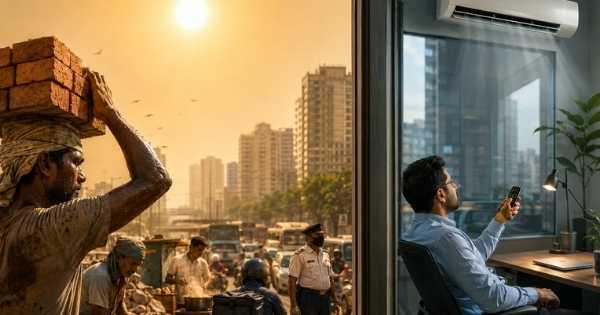
The way we live and work in these environments shows a deep divide in our society. If you are fortunate enough to work in an office with glass windows and a steady power supply, your immediate reaction to this oppressive heat is simple. You reach for the remote and turn down the temperature on the air conditioner. It feels like a triumph of human intelligence over nature. You create a tiny, perfect bubble of winter inside your room while the world outside is melting. This feels like the perfect technological fix, a quick and easy solution that money can buy. But this comfort is an illusion built on a terrible mathematical trade.
An air conditioner does not actually destroy heat, because physics does not work that way. It simply takes the heat from inside your room and pumps it outside. It uses an immense amount of electricity to do this, which usually comes from burning coal, adding more gases to the atmosphere. Then it blows hot, dry air directly into the faces of the people standing on the street. For every wealthy person sitting in a cool room, there are dozens of people outside who are paying the price. The thousands of cooling units hanging from the sides of our apartment buildings and offices are acting like tiny flamethrowers, making the shared air of the city warmer for everyone else. The machine you bought to save yourself is actively making the world outside worse for your neighbors.
The people who bear the brunt of this choices are the ones who keep our society running but have the least power to change it. Think of the construction workers carrying bricks on their heads under a midday sun, the street vendors standing next to boiling pots of oil on the asphalt, the delivery riders rushing through traffic on hot metal bikes, and the traffic police officers breathing in hot exhaust fumes. They do not have the luxury of an indoor job. They cannot simply choose to stay inside when the weather report issues a warning. For them, the heat is not an inconvenience, it is a physical assault.
When the humidity rises, as it has done drastically in places like Delhi over the last decade, the human body loses its ability to cool itself down through sweat. The air becomes so heavy with moisture that our natural defense mechanism stops working. Working in that kind of weather is a gamble with life. We have laws on paper that say employers must stop outdoor work when the temperature crosses a dangerous threshold. These rules are meant to protect human physiology from snapping under the strain. In reality, these laws are ignored because deadlines must be met, profits must be made, and the lives of informal workers are often treated as expendable.
We need to start having an honest, unglamorous conversation about how we design our habitats. We cannot rely on individual gadgets to save us from a collective disaster. We need to look at our building codes and rewrite them for a world that has already changed. We need to mandate that our structures use reflective materials. It sounds simple, but painting roofs white or using specialized tiles that bounce sunlight back into space can drop indoor temperatures significantly. If a building does not absorb the heat in the first place, it does not need a massive air conditioner to cool it down later. This is the kind of slow, deliberate work that does not make for exciting headlines, but it changes the baseline of how a city experiences a summer.
Alongside reflective surfaces, we need to bring back the green cover we so carelessly destroyed. Trees are not just decorations to make a colony look pretty. They are active infrastructure. A mature tree acts like a natural cooling tower, throwing shade on the ground so the asphalt does not bake, and releasing moisture into the air through its leaves. When you walk under a canopy of trees on a hot day, you feel an instant drop in temperature that no artificial fan can replicate. We need to make sure that our urban planning laws require a certain percentage of every neighborhood to be left wild and green. We need to stop seeing patches of earth as wasted real estate waiting to be covered in tiles.
This requires a shift in how we spend our public money. We have budgets for roads, flyovers, metro lines, and airports. We do not have a dedicated national conversation about a budget for heat management. We treat heatwaves like a temporary bad mood of nature that we just have to endure until the clouds arrive. We need to start treating extreme heat as a public health emergency and a structural disaster, much like a flood or an earthquake. This means investing in public cooling shelters, ensuring water stations are available every few hundred meters, and restructuring our working hours so that no one is forced to risk their life under a burning sky.
The path ahead is politically difficult because it requires us to slow down and think about the collective good. It requires us to tell developers that they cannot build glass boxes that act like greenhouses in a tropical country. It requires us to enforce labor laws and penalize those who put workers in harm’s way. It requires us to look at our lifestyle choices and realize that our personal comfort cannot come at the expense of the person standing on the pavement. The concrete fever is a warning sign from our environment that our current way of building and living is hitting a wall. We can either listen to this warning and change our design, or we can keep turning up the air conditioning until the system collapses underneath us.